
Priya Jaiswal stands at the forefront of international trade analysis, bringing a wealth of experience from the intersecting worlds of global banking and the automotive sector. As a recognized authority in market portfolio management, she has spent years deciphering the complex fiscal policies and shifting consumer behaviors that define modern commerce. Her insights are particularly sought after now, as the global market grapples with a massive realignment of manufacturing power and trade protectionism. In this discussion, we delve into the staggering 70% growth in Chinese automotive exports, the strategic maneuvers behind the new European Union import quotas, and the fiscal realities of a production gap that sees Chinese electric vehicles manufactured for thousands less than their Western counterparts. We also explore the geopolitical friction points that are forcing a transition from centralized manufacturing to a localized, globalized production model.
The following conversation examines the rapid pivot of manufacturers toward overseas markets to compensate for a nearly 30% drop in domestic sales. It explores the financial mechanics of the $11,000 cost advantage held by Chinese firms and the strategic implications of the European Union’s 350,000-unit cap on hybrid imports. Furthermore, the discussion touches upon the expansion of production facilities into regions like Latin America and Southeast Asia as a primary defense against rising tariffs and the ongoing exclusion of these vehicles from the United States market.
How are manufacturers recalibrating their business models as they witness a significant contraction in home-grown demand alongside an unprecedented surge in global shipments?
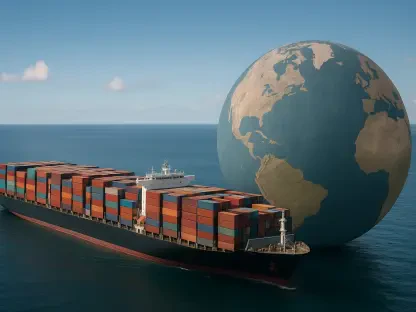
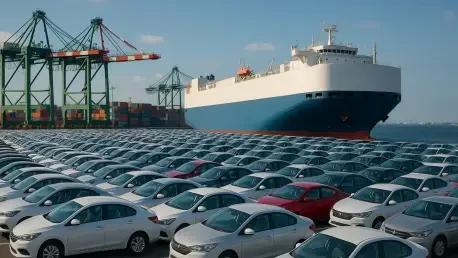
The shift we are seeing is essentially a survival reflex triggered by a 27% year-on-year drop in domestic sales this September, leaving over 1.6 million units looking for a home. To stabilize their balance sheets, Chinese automakers have aggressively pivoted toward the global stage, resulting in a massive 64% surge in passenger car exports just last month. By exporting over 7.1 million vehicles in the first nine months of 2026, these companies are effectively turning the world into their primary showroom to offset the cooling consumer confidence and the scaling back of government subsidies at home. This isn’t just about selling off excess inventory; it’s a calculated, high-stakes move to capture market share in regions where the demand for plug-in hybrids and pure electric vehicles is still accelerating. You can feel the urgency in the industry as they chase profit growth in overseas markets, treating international expansion not as a luxury, but as the only viable path to sustain their massive production scales.
What are the broader implications of the European Union’s decision to limit hybrid imports to a specific annual threshold, and how does this change the competitive landscape for Chinese brands?
The European Union’s move to cap hybrid imports at 350,000 units annually is a definitive strike aimed at rebalancing a trade relationship that many feel has become dangerously lopsided. When you consider that Chinese brands captured 12% of the total European new-car market in August and were responsible for one out of every four hybrid sales, the sheer scale of their penetration becomes clear. This quota, which includes plug-in hybrids and will be strictly monitored by customs authorities across 27 nations starting this December, forces Chinese manufacturers to compete for a limited number of “slots.” It effectively ends the era of unfettered volume growth and forces these companies to prioritize higher-margin models or accelerate their plans for European-based assembly. For the European consumer, this could mean a temporary stabilization of prices, but for the manufacturers, it’s a signal that the “easy” phase of export-led growth has hit a significant regulatory wall.
The production cost disparity between Chinese and European electric vehicles is staggering; how is this financial advantage reshaping trade relations and forcing the hand of Western regulators?
The financial reality is that it costs a Chinese-branded firm approximately $20,000 to produce an electric vehicle, whereas a European equivalent requires an investment of about $31,000. That $11,000 gap represents a massive competitive moat that allows Chinese firms to absorb tariffs and still offer prices that undercut local incumbents. Western regulators see this not just as efficiency, but as an existential threat to their domestic industrial bases, which explains the aggressive shift toward protectionist measures and quotas. We are seeing a “tug-of-war” where the sensory appeal of affordable, high-tech EVs for the average driver clashes with the cold, hard numbers of trade deficits that politicians are desperate to correct. This cost advantage is the primary engine behind the 70% growth in exports we’ve seen so far in 2026, and it remains the biggest source of friction in every trade negotiation from Brussels to Washington.
As trade barriers heighten, we are seeing a shift toward localized manufacturing in regions like Southeast Asia and South America. What does this transition tell us about the long-term survival strategy of these automotive giants?
The move to set up factories in Thailand, Indonesia, Brazil, and Hungary is a clear acknowledgment that the “made in China” export model is no longer sufficient to bypass global trade barriers. By moving production closer to the end consumer, companies like BYD are essentially neutralizing the threat of tariffs while also tapping into local labor markets and regional supply chains. This “localization” strategy is about building a physical footprint that is immune to the whims of customs officials; once a car is built in Hungary, for instance, it is no longer subject to the same hybrid quotas that apply to direct imports. It’s a sophisticated evolution of the industry that transforms these companies from national champions into true multinational conglomerates. This shift requires immense capital investment, but it is the only way to protect the momentum they’ve gained and ensure that their global footprint remains permanent regardless of geopolitical volatility.
With the United States market remaining largely inaccessible following recent high-level diplomatic stagnation, what is your forecast for the global distribution of Chinese vehicles through the end of this year?
Given that the meeting between President Trump and leader Xi Jinping failed to yield any breakthroughs for EV access, the U.S. will remain a locked door for the foreseeable future, making other regions even more critical. Despite these headwinds, my forecast is that Chinese automakers will hit or even exceed the 10 million vehicle export mark by the conclusion of 2026. We are seeing a relentless push into Latin America and Africa, and with Canada recently easing its stance through a tariff cut deal, the volume will simply flow toward the path of least resistance. While the EU’s 350,000-unit cap on hybrids will certainly sting, the momentum in pure electric vehicles and the expansion of overseas assembly lines will likely compensate for those losses. The year will end with China firmly entrenched as the world’s leading vehicle exporter, though the composition of those exports will look increasingly diverse as manufacturers adapt to a world defined by quotas and localized production.