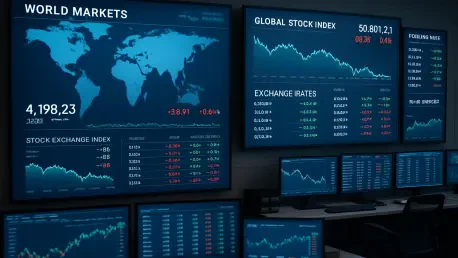

In trading rooms from New York to Tokyo, a profound and unusual stillness has taken hold as the global financial system collectively pauses for a single announcement destined to shape the economic landscape. Investors across all major asset classes have adopted a rare “wait-and-see” posture, their actions betraying a deep-seated uncertainty ahead of a pivotal monetary policy decision from the U.S. Federal Reserve. While Wall Street appears tranquil on the surface, this quiet tension masks a maelstrom of global crosscurrents, from diverging central bank policies to simmering geopolitical conflicts. The central question resonating through the markets is not just whether the Fed will adjust interest rates, but whether it is about to signal a new economic era or unleash a major liquidity surprise that could redefine market dynamics for months to come.
An Eerie Calm Before the Federal Storm
The state of global finance ahead of the Federal Reserve’s announcement is one of suspended animation. From the bourses of Europe to the trading floors of Asia, market participants have largely held their positions steady, creating a period of subdued activity that belies the high stakes of the impending decision. This collective pause reflects a broad consensus that any significant portfolio adjustment would be premature until the world’s most influential central bank reveals its hand. The quiet in U.S. markets, where major indices have been trading in a tight range, stands in stark contrast to the volatility seen elsewhere.
This placid American facade was shattered by tremors from overseas, most notably in Australia, where markets were jolted by unexpectedly hawkish commentary from the governor of its central bank. The sharp reaction Down Under served as a potent reminder of how sensitive the global system has become to the pronouncements of policymakers. It highlighted the nervous energy simmering just beneath the surface, with investors acutely aware that a single phrase or data point from the Fed could trigger a rapid and significant repricing of assets worldwide.
Ultimately, the market’s vigil boils down to a fundamental uncertainty about the path forward. Is the Federal Reserve preparing to formally declare the end of an era of aggressive tightening and pivot toward a more accommodative stance? Or is there a less-telegraphed maneuver lurking in the details of its statement, particularly concerning its massive balance sheet? This ambiguity has left investors poised on a knife’s edge, bracing for a decision that could either validate the recent calm or unleash a wave of volatility across stocks, bonds, and currencies.
A World of Conflicting Signals and Rising Tensions
The Federal Reserve does not operate in a vacuum, and its upcoming decision is set against a complex and often contradictory international backdrop. Central banks across the globe are pursuing markedly divergent monetary paths, creating a challenging environment for investors to navigate. The Reserve Bank of Australia recently sent a hawkish jolt through the markets with its stern rhetoric on inflation, while the Bank of Japan continues to send persistently dovish signals, maintaining its ultra-loose policy. Meanwhile, European central bankers have offered a mixed and uncertain outlook, adding another layer of complexity to the global puzzle.
Compounding these monetary policy divergences are persistent geopolitical frictions that threaten to spill over into the economic sphere. Tensions between the United States and China, particularly over the trade of advanced technology, remain a significant source of risk. The recent political backlash against a decision to allow U.S. firms to sell advanced AI chips to Beijing underscores how national security concerns are increasingly intertwined with corporate performance and market sentiment, creating headwinds for key sectors of the economy.
In this fragmented global landscape, the Federal Reserve’s announcement has taken on outsized importance. As the steward of the world’s primary reserve currency, the Fed’s policy decisions have a cascading effect on the global financial system. A hawkish surprise could strengthen the dollar and tighten financial conditions worldwide, while a more dovish tone could provide a tailwind for risk assets. Consequently, this single announcement from Washington holds the key to the near-term direction for nearly every major asset class, making it the focal point for investors everywhere.
A Microscopic View of Market Jitters
A closer look at U.S. equity markets reveals a picture of division beneath the overall stagnation. While Wall Street’s major indices traded mostly flat, sector-specific performance told a different story. Industrials and healthcare stocks felt the most pressure, registering as the day’s most significant decliners. In a curious twist, the energy sector emerged as the biggest climber, rallying despite a concurrent fall in crude oil prices, suggesting investors were betting on longer-term fundamentals. This divergence was also evident at the individual stock level, with financial heavyweight JPMorgan falling 4.7% and tech giant Nvidia seeing a 0.3% drop, while mining firm Newmont Corporation surged 5.7% and Warner Bros. bucked the trend with a 3.8% gain.
The global currency and bond markets provided a much more dynamic theater of action, driven largely by the rhetoric of central bankers. In the G10 foreign exchange arena, the Australian dollar soared to become the day’s top performer following the hawkish commentary from its central bank governor. In contrast, the Japanese yen faltered, weakened by dovish remarks from its own monetary authority. This divergence was mirrored in sovereign debt markets, where Australian 10-year government bond yields surged to a two-year high of 4.77% and long-dated German bond yields climbed to a 14-year peak. U.S. Treasuries, however, found favor, outperforming their global peers as some investors sought relative safety ahead of the Fed’s decision.
The commodities space was not immune to the pre-decision jitters, witnessing both a historic milestone and a puzzling retreat. Precious metals captured headlines as silver prices broke through the $60 barrier for the first time, a landmark achievement reflecting a mix of industrial demand and safe-haven buying. Conversely, oil prices retreated by approximately 1%, creating a disconnect with the rallying energy stocks and adding another layer of complexity for investors trying to position themselves for the economic environment to come.
Deciphering the Consensus from Expert Chatter
Across trading desks and strategy sessions, a powerful consensus has formed around the idea that the era of globally synchronized easy money is definitively over. Analysts point to a chorus of “global rate hawks” whose recent commentary signals a major policy pivot. Statements from policymakers like RBA Governor Michele Bullock and ECB Board Member Isabel Schnabel have reinforced the view that central banks are shifting their focus squarely toward taming inflation, even at the risk of slower growth. This has led to the widespread expectation of a “hawkish cut” from the Federal Reserve—a scenario where it delivers a widely anticipated interest rate reduction but accompanies it with firm language suggesting that future easing is far from guaranteed.
The intersection of geopolitics and technology was vividly illustrated by the recent trajectory of Nvidia’s stock, which became a case study in market sensitivity to political risk. The company’s shares reversed a strong pre-market gain to close lower after the Trump administration’s decision to permit the sale of advanced AI chips to China was met with fierce bipartisan opposition. Critics, including both China hardliners and prominent Democrats, argued forcefully that providing Beijing with such powerful technology poses a long-term threat to U.S. economic and national security by enabling military advancements and potentially allowing China to strategically supplant American tech leadership.
Despite the broader uncertainty, demand for U.S. sovereign debt has remained remarkably robust, a phenomenon some analysts have dubbed “duration elation.” Evidence of this came from the Treasury’s recent auction of $39 billion in 10-year bonds, which saw exceptionally strong demand. According to analysis from Exante Data, key metrics for the auction were significantly above average, indicating a broad base of buyers. This suggests that the recent spike in Treasury yields is being viewed by many investors not as a warning sign, but as a prime opportunity to lock in attractive returns on one of the world’s safest assets.
The Balance Sheet Wild Card That Could Change Everything
While a quarter-point interest rate cut is almost fully priced into the market, the real potential for a surprise lies not in the rate itself but in the Federal Reserve’s strategy for its balance sheet. An out-of-consensus forecast from Bank of America strategists has captured Wall Street’s attention, suggesting the Fed may announce a large-scale Treasury bill purchasing program of roughly $45 billion per month, potentially starting as soon as January. Such a move, while technical in nature, would have significant implications for market liquidity and sentiment.
It is critical to distinguish this potential maneuver, known as Reserve Management Purchases (RMP), from the more familiar policy of Quantitative Easing (QE). Whereas QE is designed to stimulate the economy by lowering long-term interest rates, RMP is a technical operation aimed at ensuring the plumbing of the financial system functions smoothly. The primary goal would be to keep reserves in the banking system “ample” to prevent a repeat of the September 2019 repo market crisis, when a shortage of liquidity caused a dramatic and destabilizing spike in short-term borrowing rates.
The Fed has both the capacity and a clear motivation for such an action. Its balance sheet has shrunk considerably from its peak, providing ample room for new purchases, particularly of short-term T-bills. Analysts like Mark Cabana of BofA and Padhraic Garvey of ING argue that such a program is necessary to maintain financial stability amid high levels of government debt issuance. While a program of this scale would inevitably face criticism as a form of “money-printing,” it would likely be welcomed by both financial markets and the White House as a measure to ensure the smooth functioning of the critical U.S. Treasury market.
The hours leading up to the Federal Reserve’s announcement were defined by this unique combination of surface-level tranquility and deep underlying tension. The financial world found itself at a crossroads, shaped by the conflicting policies of global central banks, the persistent shadow of geopolitical risk, and the internal market divisions between winning and losing sectors. It was a moment where expert consensus pointed toward a carefully managed policy shift, yet the potential for a surprise announcement regarding the Fed’s balance sheet loomed large as a true game-changer. Ultimately, the market understood that the path forward would be dictated not just by the headline rate decision, but by the subtle and technical details that would reveal the central bank’s true intentions for the economic road ahead.