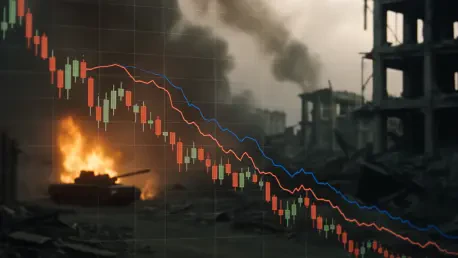

The sudden eruption of a localized military standoff can instantly paralyze global supply chains and send shockwaves through the most sophisticated trading algorithms on Wall Street. When the 2026 Iranian crisis began to dominate international headlines, the immediate reaction from the financial world was not one of measured calculation but of rapid, defensive recalibration. Geopolitical instability serves as a unique catalyst because it introduces variables that traditional economic models struggle to quantify, such as the potential closure of maritime chokepoints or the sudden implementation of sweeping trade sanctions. As news of the escalating tension spread, the divergence between asset classes became stark, with energy commodities skyrocketing while equity futures plummeted in a synchronized display of risk aversion. This initial period of intense fluctuation often masks the underlying resilience of global finance, yet it highlights how sensitive the modern, interconnected economy remains to the threat of physical conflict. Investors must navigate a landscape where a single diplomatic failure can erase billions in market capitalization within minutes, forcing a pivot toward assets that traditionally provide a buffer against the unpredictability of international relations.
Market Volatility and the Energy Dilemma
The most immediate and visceral consequence of geopolitical friction in oil-producing regions is the instantaneous surge in energy prices that ripples through every level of the global economy. During the recent escalations, benchmark crudes like West Texas Intermediate and Brent saw substantial daily gains as traders scrambled to price in the looming risk of a blockade in the Strait of Hormuz. This maritime corridor is essential for the movement of a significant portion of the world’s petroleum, and even the suggestion of its closure is enough to trigger a massive influx of speculative capital into oil futures. For the average consumer, these abstract market movements manifest as tangible pain at the gas pump and rapidly increasing monthly utility bills. This surge in energy costs functions as an informal tax on both citizens and corporations, siphoning away capital that would otherwise be used for investment or discretionary spending. Consequently, the inflationary pressure created by such spikes becomes a formidable obstacle for economic planners who are already struggling to maintain a delicate balance between growth and price stability.
Beyond the immediate impact on fuel prices, the broader industrial complex faces a steep rise in operational overhead that can stifle manufacturing and logistics for months. Companies that rely heavily on transportation, such as international shipping firms and heavy manufacturers, find their profit margins squeezed as the cost of moving goods rises in tandem with crude prices. This situation creates a challenging environment for the U.S. economy, where consumer spending remains the primary engine of domestic growth. When households are forced to allocate a larger portion of their income to heating their homes or commuting to work, they naturally pull back on retail purchases and services. This contraction in demand can lead to a slowdown in the broader economy, potentially tipping fragile markets into a recessionary period if the conflict remains unresolved for an extended duration. The interconnectedness of modern supply chains means that an energy shock in one part of the world is no longer a localized event but a global systemic risk that demands a coordinated response from both the public and private sectors.
Resilience in the Face of Systemic Shocks
Despite the initial wave of panic that typically accompanies the news of military escalation, equity markets often demonstrate a remarkable and surprising degree of long-term resilience. While indices like the S&P 500 might suffer a sharp decline at the opening bell, history shows that these downturns are frequently short-lived as institutional investors look toward long-term data rather than short-term headlines. Analysis of past conflicts, ranging from the Korean War to more recent regional skirmishes, suggests that markets tend to find an equilibrium once the initial shock is absorbed and the scope of the conflict is understood. Many professional traders now view these moments of geopolitical tension as opportunities to acquire high-quality stocks at a discount, operating under the assumption that the fundamental strengths of the global economy will eventually outweigh the temporary disruption. Unless oil prices breach the critical psychological threshold of $100 per barrel, many analysts believe that the structural integrity of the bull market can withstand the pressure of regional instability, leading to a “V-shaped” recovery.
This ability to bounce back is driven by a sophisticated understanding of historical precedents where the market has expanded by an average of 8% in the year following a geopolitical crisis. This trend encourages a “buy the dip” mentality among both retail and institutional participants, who recognize that while the political landscape is volatile, corporate earnings and technological innovation often continue unabated. However, this resilience is not a guarantee of safety, as it depends heavily on the conflict remaining contained within a specific geographic area. If a regional standoff evolves into a broader international confrontation, the historical models may no longer apply, and the market could enter a period of sustained contraction. The current environment in 2026 shows that while investors are more accustomed to dealing with uncertainty, they remain hyper-focused on the actions of central banks and the potential for a shift in monetary policy. The interplay between geopolitical risk and investor psychology creates a complex feedback loop where the market’s recovery is as much about confidence in the future as it is about the reality of the present.
Divergent Impacts Across Specific Sectors
The negative effects of geopolitical conflict are rarely distributed evenly across the financial landscape, with certain sectors bearing a disproportionate share of the burden. The travel and leisure industries are notoriously vulnerable during these periods, as airlines and cruise lines face a “triple threat” of escalating fuel expenses, potential airspace closures, and a sharp decline in consumer confidence. For instance, major carriers often see their stock prices tumble by 3% to 5% within hours of a conflict’s outbreak, reflecting the market’s concern over immediate logistical hurdles and the prospect of grounded fleets. Similarly, the housing sector often experiences a cooling effect as the conflict influences the bond market and drives up mortgage rates. Homebuilders like D.R. Horton and companies specializing in construction materials frequently see their valuations drop as potential buyers retreat from the market in the face of increased borrowing costs. These industries are the canaries in the coal mine, signaling a broader retreat from luxury and long-term financial commitments as uncertainty takes hold of the public consciousness.
While consumer-facing industries struggle, the defense and intelligence sectors often experience a significant influx of capital as governments prioritize national security and military readiness. Defense contractors and specialized software firms, such as Palantir and Lockheed Martin, typically see their share prices rally in anticipation of increased government spending on advanced weaponry and analytics. This shift represents a migration of capital away from cyclical, consumer-sensitive stocks toward “defensive” assets that are perceived as essential during times of war. Furthermore, energy giants like Exxon Mobil often see their profit margins expand alongside the rising price of crude, making them attractive targets for investors looking to hedge against inflation. This bifurcation within the market creates a stark divide between winners and losers, forcing portfolio managers to engage in aggressive sector rotation to protect their returns. The ability to identify which industries will buckle under pressure and which will thrive in a high-tension environment is a critical skill for anyone navigating the complexities of the 2026 global market.
Global Bond Markets and Central Bank Policy
Geopolitical conflicts significantly complicate the traditional “flight-to-safety” behavior that typically defines the bond market during periods of high international tension. Historically, investors have flocked to U.S. Treasury bonds as a secure haven, a move that usually drives prices up and yields down; however, the threat of energy-driven inflation can flip this dynamic entirely. If the market anticipates that rising oil prices will lead to a sustained increase in the cost of living, bond yields may actually rise as investors demand higher returns to compensate for the eroding value of their capital. This creates an incredibly difficult dilemma for the Federal Reserve, which must decide whether to lower interest rates to stimulate a flagging economy or keep them high to combat the inflationary pressures caused by the conflict. If the Fed chooses to cut rates, they risk letting inflation spiral out of control, but if they remain hawkish, they could accidentally trigger a deep recession by stifling the job market and slowing down business investment.
This localized economic tension is mirrored in international markets, where European and Asian indices often show significantly less resilience than their American counterparts. Countries that are heavily dependent on imported energy or are geographically closer to the conflict zone face a more acute risk of supply chain disruptions and sudden industrial slowdowns. In Germany and France, for example, a spike in natural gas prices can lead to immediate production cuts in the chemical and automotive sectors, causing domestic stock markets to drop by 2% or more in a single session. Meanwhile, safe-haven assets like gold continue to attract interest as a tangible store of value when fiat currencies and paper assets seem increasingly volatile. The interconnected nature of the global financial system means that no market is truly isolated from the effects of a regional war, and the ripple effects can be felt from the bond trading desks in London to the electronics factories in Shenzhen. Navigating these anomalies requires a nuanced understanding of how global liquidity flows are redirected in response to the ever-shifting winds of international diplomacy.
Navigating Future Financial Instability
The market events observed throughout the current period indicate that the relationship between geopolitics and finance has entered a more sophisticated and reactive phase. Investors are no longer merely reacting to headlines; they are increasingly relying on real-time data and historical modeling to predict the duration and depth of market corrections. To navigate this environment effectively, it is essential to maintain a diversified portfolio that includes exposure to energy and defense as a natural hedge against regional instability. Furthermore, keeping a close eye on the $100-per-barrel oil mark will remain the most reliable indicator of whether a localized conflict is evolving into a systemic economic crisis. Strategic capital allocation must focus on industries that demonstrate structural resilience, such as cybersecurity and automated logistics, which remain vital regardless of the geopolitical climate.
Looking ahead, the primary focus for market participants should be the agility of central bank responses and the potential for a shift in global trade alliances. As the world moves toward a more fragmented economic landscape, the traditional safe-haven status of certain assets may be challenged by new digital alternatives or emerging regional currencies. Decision-makers should prioritize liquidity and maintain a “wait-and-see” approach during the first forty-eight hours of any major geopolitical event to avoid the pitfalls of emotional trading. By understanding the historical patterns of “V-shaped” recoveries and the specific sectoral winners in times of crisis, one can transform a period of high volatility into a strategic opportunity for long-term growth. Ultimately, the ability to separate temporary political noise from fundamental economic shifts will be the defining factor in successfully managing global market risks throughout the remainder of the decade.