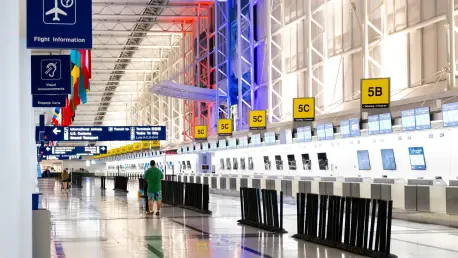

With a storied career analyzing market dynamics, Priya Jaiswal has a unique lens on the high-stakes rivalries that define global industries. Her expertise in business and finance provides a crucial perspective on the unfolding corporate battle at Chicago O’Hare, where two of America’s aviation giants, United and American Airlines, are locked in a fierce competition. This intense standoff is not merely about market share; it’s a strategic chess match involving gate control, flight schedules, and the pursuit of lucrative business travelers. We explore the financial risks of an aggressive expansion strategy, the unique economic landscape of O’Hare that sustains such competition, and how this corporate conflict ultimately shapes the travel experience for millions of passengers.
United’s CEO has pledged to add “as many flights as are required” to defend its gate count at O’Hare in 2026. Can you detail the operational and financial challenges of executing such a strategy, and what risks it poses for the airline’s profitability?
That “line in the sand” comment is a declaration of a war of attrition. Operationally, it’s a massive undertaking. Adding flights on this scale isn’t just about having planes; it’s about sourcing crews, managing maintenance schedules, and stretching ground operations to their limits, all of which creates immense strain. Financially, it’s a high-stakes gamble. The strategy implies a willingness to fly planes at lower-than-ideal capacity simply to occupy a gate and block a competitor. This can crush profit margins, as costs for fuel, labor, and landing fees remain fixed while revenue per flight drops. The CEO claims United earned about $500 million in Chicago last year; a strategy like this puts that profitability directly at risk, betting that they can absorb the losses longer than their rival can.
While most major U.S. hubs are dominated by a single airline, Chicago O’Hare remains a battleground. What makes this airport uniquely able to sustain two large competing hubs, and why are gates and peak-time slots so critical for winning over high-value corporate travelers there?
Chicago’s resilience as a two-hub airport comes down to its massive, diverse local economy and its geographic position as a natural crossroads for the entire country. Unlike some hubs that are primarily for connecting traffic, O’Hare serves a huge base of “origin and destination” travelers, particularly from the business sector. For these high-value corporate clients, time is the most valuable commodity. They aren’t just buying a seat; they’re buying a schedule. Having access to a gate during the 7-9 AM morning rush or the 4-6 PM evening departure window is everything. It allows an airline to offer the frequent, conveniently timed flights that a business traveler demands, which is why United’s claimed 38 percentage-point lead among this demographic is such a powerful metric in this fight.
American Airlines is expanding its O’Hare schedule to over 500 daily departures and is buying gates from another carrier. Beyond simply adding flights, what specific steps must American take to effectively challenge United’s claimed 38 percentage-point lead among Chicago’s business travelers?
Simply adding flights is just the first step; it’s about the quality and strategic timing of those flights. To truly challenge United, American needs to build a schedule that offers a compelling alternative for the business traveler. This means using their newly acquired gates to create a dense network of departures during peak business hours to key corporate destinations. They need to demonstrate operational reliability—that their flights leave on time, every time. Beyond the schedule, they must aggressively pursue corporate accounts, offering better loyalty perks and travel management solutions. It’s a comprehensive battle for convenience and reliability, not just a race to the highest flight count.
One executive has asserted that his airline is earning hundreds of millions in Chicago while its competitor is losing a similar amount. Without validating those specific figures, could you explain the key factors that might lead to such a dramatic profitability difference between two carriers operating major hubs at the same airport?
A profitability gap of that magnitude, if accurate, would likely stem from a few key areas. First is the mix of passengers. The dominant carrier, in this case United with its claimed 38-point lead, captures a larger share of last-minute, high-fare business travelers, which dramatically improves the revenue per flight. Second is network efficiency. The airline with more flights and better gate access—United currently operates about half of all scheduled flights at the airport—can create more efficient connections and optimize aircraft usage, which lowers their cost per passenger. Finally, there’s the power of scale. A larger operation can negotiate better terms with airport vendors, ground handling services, and corporate clients, creating a virtuous cycle of lower costs and higher revenue that can indeed lead to one airline being highly profitable while its rival struggles.
This corporate rivalry focuses heavily on gate access and flight schedules. How does this high-stakes competition between United and American ultimately impact the average leisure passenger in terms of fares, route options, and the potential for increased airport congestion at O’Hare?
For the leisure passenger, this rivalry is a double-edged sword. On one hand, intense competition typically leads to more choices and can put downward pressure on fares, especially on overlapping routes. With United planning nearly 650 daily departures and American pushing past 500, travelers will see an abundance of options. However, the downside is significant. The carriers’ focus is on winning the premium business traveler, not necessarily on serving every small or mid-sized leisure market. Furthermore, packing so many additional flights into an already congested airport without proportional infrastructure growth can lead to more delays, longer taxi times, and a generally more stressful travel experience for everyone on the ground.
What is your forecast for the competitive landscape at Chicago O’Hare over the next five years?
I foresee the next five years at O’Hare being defined by a period of intense, perhaps even irrational, competition. United has publicly committed to a strategy of growth at any cost to defend its position, while American is investing heavily, including paying $30 million for just two gates, to claw back market share. This will likely lead to an over-saturation of flights on key routes and sustained pressure on profitability for both carriers. I expect the fight for gate access to become even more critical as airport infrastructure projects progress. While this battle might offer short-term benefits for consumers in terms of choice, the long-term stability of having two robust, profitable hubs is not guaranteed. One of these carriers will likely have to scale back its ambitions eventually, but not before a very costly and turbulent period for the industry.