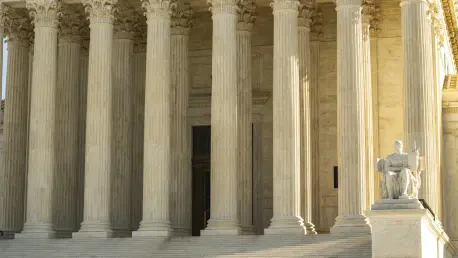

What happens when the highest court in the land holds the key to transforming the very structure of American governance? In a moment that could redefine presidential authority, the U.S. Supreme Court is on the brink of a decision that might hand Donald Trump sweeping control over federal agencies during his second term. This isn’t just a legal skirmish—it’s a battle over the heart of democracy’s checks and balances, one that could ripple through every corner of society, from consumer protections to economic stability. The stakes couldn’t be higher, and the nation watches as the justices deliberate a shift that might echo for generations.
Why This Power Shift Matters Now
The timing of this judicial crossroads is no accident. With Trump back in the Oval Office, the alignment of a conservative Supreme Court majority and an administration eager to centralize authority creates a perfect storm for reevaluating executive power. A pivotal case before the justices challenges nearly a century of precedent, threatening to dismantle the independence of federal agencies that have long operated outside direct presidential control. This isn’t merely about legal theory; it’s about who ultimately steers the ship of government in a deeply divided nation.
Beyond the courtroom, the urgency of this moment ties into broader political currents. The push for expanded executive power mirrors a growing frustration among some factions with bureaucratic resistance to presidential agendas. As public trust in institutions wavers, a ruling favoring Trump could either be seen as a necessary correction or a dangerous overreach, depending on where one stands. The outcome promises to shape not just this administration, but the very framework of governance for years to come.
The Core Issue: Presidential Control on Trial
At the center of this storm lies a fundamental question: should the president have unchecked authority to remove heads of independent agencies? For decades, agencies like the Federal Trade Commission (FTC) and the National Labor Relations Board (NLRB) have functioned with a degree of autonomy, insulated by legal protections established in the 1935 case, Humphrey’s Executor v. United States. That ruling declared that presidents could not fire agency leaders without cause, preserving a balance against executive overreach.
Now, a case involving Rebecca Slaughter, an FTC official dismissed by Trump, puts this precedent directly in the crosshairs. If the Court sides with the administration, the ripple effects could be profound, stripping away safeguards that have defined the administrative state. It’s a legal battle that transcends one individual, touching on the very nature of how power is distributed in government.
The Legal Backbone: Unitary Executive Theory
Driving this push for change is a doctrine known as the unitary executive theory, a conservative legal principle asserting that the president must wield total control over the executive branch. This idea, championed by figures like the late Justice Antonin Scalia, has gained traction in recent years, bolstered by rulings such as the 2020 decision on the Consumer Financial Protection Bureau (CFPB). In that case, Chief Justice John Roberts underscored that presidential removal power should be the norm, not the exception.
Proponents argue this framework ensures accountability, aligning all executive actions under a singular, elected leader. Critics, however, see it as a dangerous concentration of authority, potentially undermining the impartiality of agencies tasked with protecting public interests. The debate isn’t just academic—it’s a lens through which to view the future of American regulation and oversight.
Broader Impacts: A New Administrative Landscape
Should the Supreme Court rule in favor of expanded removal powers, the independence of numerous federal bodies could vanish overnight. Entities like the Consumer Product Safety Commission (CPSC) and even the Federal Reserve might find themselves under direct presidential influence, altering how they address everything from product recalls to monetary policy. A separate case involving Federal Reserve Governor Lisa Cook, set for argument this year, further complicates the picture, as justices grapple with the economic fallout of such a shift.
The potential for disruption is staggering. Imagine consumer safety standards swayed by political whims, or labor protections reshaped to fit an administration’s immediate goals. These agencies, often seen as technocratic buffers against partisan meddling, could become extensions of the White House, fundamentally changing how government interacts with everyday life.
Expert Voices Weighing In
The gravity of this moment is not lost on legal scholars and justices alike. Chief Justice Roberts has repeatedly signaled a preference for presidential authority, as evidenced in his prior rulings, while Scalia’s 1988 dissent—stating the president must hold “all of the executive power”—remains a touchstone for conservatives. On the other side, Justice Elena Kagan has voiced concern, noting the conservative majority seems eager to upend long-standing precedents like Humphrey’s Executor.
Legal historians such as Caleb Nelson and Jane Manners challenge the constitutional basis of the unitary executive theory, arguing that Article II offers no clear mandate for unrestricted removal power. Meanwhile, the Justice Department, represented by Solicitor General D. John Sauer, has staunchly defended Trump’s position, calling the 1935 ruling “egregiously wrong.” These clashing perspectives highlight a deep divide, one that the Court’s decision will inevitably address, if not fully resolve.
Looking Ahead: Navigating Uncharted Territory
As the justices deliberate, the nation braces for a ruling that could redefine governance. For agency leaders and policymakers, preparing for a world where presidential directives override independent mandates means rethinking operational strategies—potentially prioritizing alignment over autonomy. Citizens, too, must stay vigilant, as shifts in agency oversight could directly impact workplace rights or market regulations; tracking updates on cases like Slaughter’s and Cook’s through trusted sources offers a way to stay informed.
For the administration, a favorable outcome might streamline federal operations under a unified vision, yet it must tread carefully to avoid destabilizing critical institutions like the Federal Reserve. Reflecting on past debates, it was clear that balancing power demanded thoughtful compromise, a lesson that lingered in the air after each judicial session. Moving forward, stakeholders across the spectrum had to consider how to adapt to a landscape where executive reach might know fewer bounds, ensuring that democracy’s guardrails held firm against the winds of change.