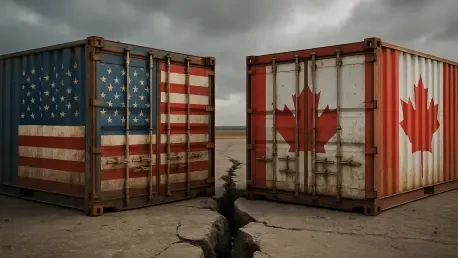

A carefully calibrated trade adjustment between Canada and China has ignited a firestorm of diplomatic tension with the United States, threatening to unravel the economic stability of North America and placing the long-standing alliance between the two neighbors on precarious ground. The core of the conflict centers on a targeted agreement concerning electric vehicles and agricultural products, a move that U.S. President Donald Trump has decried as a betrayal, met with a threat of crippling 100% tariffs on all Canadian goods. This escalating dispute pushes beyond mere economic policy, morphing into a clash of national sovereignty, geopolitical posturing, and the very definition of loyalty within the continent’s most critical trade partnership. The situation forces a stark question: can this alliance withstand the pressure of global economic realignment, or is this the first shot in a devastating trade war?
The Heart of the Dispute
A Targeted Trade Rectification
Canadian Prime Minister Mark Carney has firmly rejected the characterization of the recent agreement with Beijing as a comprehensive free trade deal, instead framing it as a necessary measure to “rectify” a punitive tariff situation. The deal specifically addresses China’s retaliatory tariffs on key Canadian exports such as canola oil, pork, and seafood. In a reciprocal move, Canada agreed to lower its own 100% tariff on Chinese-made electric vehicles (EVs). However, this reduction is not an open invitation; the agreement establishes a strict annual cap of 49,000 Chinese EVs that can be imported at a reduced 6.1% tariff. This figure, as Carney’s government has pointed out, represents a modest 3% of Canada’s total vehicle market, a detail intended to assuage fears of a market flood. Furthermore, the Prime Minister has suggested that this limited arrangement is also a strategic precursor to attracting future Chinese investment directly into Canada’s domestic auto manufacturing sector, positioning the deal as a pragmatic economic adjustment rather than a wholesale pivot away from its traditional partners.
USMCA and the Nonmarket Economy Clause
Central to Canada’s defense is its adherence to the United States–Mexico–Canada Agreement (USMCA). Prime Minister Carney has been unequivocal in stating that his country has no intentions of pursuing a free trade agreement with China, a move that would directly challenge the terms of the USMCA. He highlighted a specific provision within the trade pact that obligates member nations to provide notification before entering into free trade negotiations with any “nonmarket economy,” a designation that includes China. Carney has publicly reaffirmed his commitment to this clause, positioning his government’s actions as fully compliant with its North American treaty obligations. This legalistic and transparent approach is designed to counter the narrative of subterfuge, arguing that the targeted tariff adjustment with China falls well outside the scope of a full-fledged free trade agreement that would trigger the USMCA’s notification requirement. By emphasizing procedural correctness, Canada aims to isolate this specific deal from broader accusations of disloyalty and treaty violation, asserting its right to manage bilateral trade disputes independently while respecting the foundational rules of its continental partnership.
Escalating Rhetoric and Broader Implications
Trump’s Vehement Opposition
The nuanced Canadian position has been met with a wave of severe condemnation from Washington. President Donald Trump has utilized social media to launch a blistering attack, declaring the EV deal a catastrophic error that will devastate Canada’s economy. In his characteristically direct style, Trump asserted that China is “completely taking over” its northern neighbor and that the agreement will transform Canada into a “Drop Off Port” for Chinese products, enabling them to flood the American market unchecked. This aggressive stance was amplified by U.S. Treasury Secretary Scott Bessent, who warned that the United States would not permit Canada to become a backdoor for cheap Chinese goods. Bessent further personalized the attack, accusing Prime Minister Carney of engaging in performative diplomacy, or “virtue-signaling to his globalist friends at Davos,” thereby framing the Canadian action not as a sovereign economic decision but as a betrayal of North American economic solidarity driven by personal ambition. This unified and hostile response signals that the U.S. administration views the matter not as a minor trade adjustment but as a direct challenge to its “America First” economic doctrine.
A Diplomatic Deep Freeze
The trade disagreement is symptomatic of a much deeper and more widespread deterioration in U.S.-Canada relations. Prime Minister Carney has recently adopted a more assertive international posture, positioning himself as a champion for “middle powers” and calling for them to form a united front against economic and political coercion from larger nations. This stance is widely interpreted as a direct rebuke of President Trump’s transactional and often confrontational foreign policy approach. The diplomatic rift has been further widened by actions from the White House that seem to question Canadian sovereignty itself. President Trump has shared altered maps on social media platforms that provocatively depict Canada as a territory of the United States, a move that, while dismissed by some as political theater, has been received in Ottawa as a profound and inflammatory insult. This combination of targeted economic threats and symbolic aggressions has pushed the relationship to a breaking point, transforming a specific trade issue into a fundamental clash over national respect and the future of the North American alliance.
The Redefined Alliance
The standoff over the China deal ultimately marked a significant turning point in the U.S.-Canada relationship. The intense rhetoric and tariff threats from the White House, met by Canada’s firm defense of its sovereign economic decisions, revealed deep fractures in what was once considered an unshakeable alliance. While a full-scale trade war was narrowly averted through backchannel negotiations, the conflict left a lasting scar. The episode established a new precedent where bilateral actions by one partner were viewed through a lens of suspicion and potential continental betrayal by the other. It forced both nations to re-evaluate the terms of their economic codependence, prompting a more cautious and transactional approach to future dealings. The dispute underscored the growing influence of global geopolitical rivalries on regional partnerships, demonstrating that even the most deeply integrated economies were not immune to the pressures of a multipolar world. The trust that had long underpinned North American trade was eroded, replaced by a more guarded and strategic posture that reshaped continental diplomacy for years to come.