
The delicate balance of global financial markets was starkly illustrated as a series of unexpected remarks from the U.S. President sent shockwaves from Wall Street across the Pacific, leaving Asian bourses to navigate a complex and contradictory landscape of investor sentiment. This recent episode underscores the profound influence that political rhetoric can wield over market stability, demonstrating how swiftly confidence can be eroded and asset values reshuffled based on pronouncements far removed from traditional economic indicators. The subsequent trading session in Asia became a case study in regional divergence, as some markets succumbed to the negative momentum while others found pockets of resilience, highlighting the nuanced interplay between global pressures and local economic fundamentals. This environment of uncertainty, sparked by statements targeting key U.S. industries, ultimately broke a multi-day winning streak for major American indices and set a cautious tone for international investors grappling with the implications for global trade and corporate policy.
A Ripple Effect Across Asian Bourses
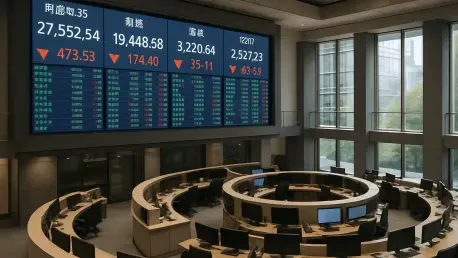
The cautionary sentiment emanating from the United States rippled through Asian trading desks, though the impact was far from uniform, creating a mosaic of gains and losses across the continent’s major exchanges. In Japan, the Nikkei 225 experienced a notable decline of 0.69%, with heavyweight technology stocks bearing the brunt of the sell-off. Prominent names such as SoftBank and Tokyo Electron saw their values retreat as investors grew wary of sectors sensitive to global economic shifts. Similarly, Hong Kong’s Hang Seng Index registered a significant loss, falling 0.97% as concerns over the tech industry’s outlook also weighed on market leaders like Lenovo and Baidu. In stark contrast to these downturns, some regional markets managed to buck the trend. South Korea’s Kospi emerged as a strong performer, climbing 1.27% in a display of investor confidence. Australia’s S&P/ASX 200 also eked out a gain, finishing the day 0.29% higher, although this positive headline figure masked underlying corporate drama, such as the 1.57% drop in BlueScope Steel shares after the company rejected a takeover bid. Meanwhile, mainland China’s markets remained largely flat, showcasing a degree of insulation from the immediate geopolitical tremors.
Geopolitical Factors and Commodity Shocks
The primary catalysts for the market volatility were two distinct statements from the U.S. administration that rattled specific sectors and commodity markets. The first shock came when the President declared an intent to prevent defense companies from issuing dividends or engaging in stock buybacks until unspecified complaints were resolved. This directly targeted the financial strategies of major U.S. defense contractors, causing their stocks to tumble and triggering a broader risk-off sentiment that terminated a three-day rally for both the S&P 500 and the Dow Jones Industrial Average. The second major development impacted the energy sector, as an announcement was made that the United States would receive up to 50 million barrels of crude oil from Venezuela’s interim authorities. This news immediately raised concerns about an increase in global oil supply, sending prices downward. Brent crude, the international benchmark, fell to $60.39 a barrel in response. This combination of industry-specific pressure and a sudden shift in commodity supply dynamics created a complex headwind that Asian markets struggled to interpret, ultimately leading to the fragmented performance seen across the region’s financial centers.