
A market tremor that vaporized over a trillion dollars in tech valuations has now given way to a precarious calm, forcing investors to question whether unprecedented AI spending is a catastrophic cash burn or the cost of future dominance. This recent volatility highlights a fundamental tension in the technology sector as it navigates the transition into an era defined by artificial intelligence. The rebound in stock prices suggests a market grappling with a new financial reality, where astronomical investment is becoming a prerequisite for survival and leadership.
The Market’s Tug of War Over AI Capital Expenditure
The central theme roiling the technology sector is the profound conflict between investor anxiety over massive AI spending and the strategic necessity of these investments for long-term growth. On one hand, the sheer scale of the announced capital expenditures has triggered concerns about profitability and financial discipline. On the other, industry leaders argue that failing to invest aggressively would be a fatal error, ceding the most significant technological shift in a generation to competitors.
This dynamic has left market participants weighing two starkly different futures. One view holds that the colossal capital expenditure, or capex, is a sign of a speculative bubble, where trillions are being committed with no clear path to commensurate returns. The alternative perspective, which is steadily gaining ground, frames this spending as a foundational investment for the next era of technology, akin to the build-out of the internet itself, where the initial costs are immense but the eventual rewards are transformative.
Contextualizing the Jitters a Trillion Dollar Reaction
The market’s recent anxiety was not unfounded, culminating in a severe sell-off that erased over $1 trillion from Big Tech’s collective market capitalization. This downturn included the worst week in months for the “Magnificent 7” stocks, a group of technology titans whose performance often dictates broader market sentiment. The reaction was swift and brutal, reflecting a deep-seated fear that the industry was entering a period of unsustainable spending.
This widespread concern was a direct response to the staggering investment figures revealed by the industry’s leaders. Combined, Amazon, Alphabet, Microsoft, and Meta announced capital expenditures that put them on a trajectory to spend approximately $700 billion annually. This enormous outlay initially overshadowed otherwise strong quarterly earnings and impressive cloud growth, leading investors to question whether the costs of the AI arms race were beginning to outweigh the benefits.
Analysis of the Market Shift Data Rationale and Consequences
Methodology
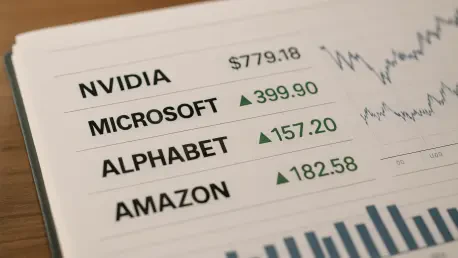
This analysis is founded upon a comprehensive review of daily stock market performance data for key technology companies, including Oracle, Microsoft, Nvidia, Meta, Alphabet, and Amazon. The quantitative assessment was designed to track the initial sell-off and the subsequent, uneven recovery across the sector, identifying which companies led the rebound and which continued to lag.
To provide qualitative depth, this market data was synthesized with information from quarterly earnings reports, which offered precise details on capital expenditures and management outlooks. This was further enriched by commentary from financial analyst reports issued by prominent firms such as D.A. Davidson, Deutsche Bank, Bank of America, and Morgan Stanley, as well as public statements from influential industry leaders like Nvidia’s CEO.
Findings
The data clearly indicates that the initial sell-off was a direct, reactive event tied to the scale of announced AI infrastructure spending by Amazon, Alphabet, Microsoft, and Meta. However, the subsequent rebound, while mixed, was led by companies that either directly benefit from the AI build-out or successfully justified the strategic necessity of their investments. For instance, Oracle surged following an upgrade, while chipmaker Nvidia saw gains on the basis of sustained demand.
A new consensus is now forming that the massive capex is a necessary, long-term strategic imperative. This view is supported by industry leaders, who point to “sky-high” demand for computing power as justification for the spending. Analysts concur, with firms like Bank of America noting that tech executives are highly confident in their demand forecasts, expecting the new capacity to be fully utilized and eventually drive significant returns.
Implications
The findings strongly imply that short-term stock volatility will likely persist as the market continues to digest the unprecedented scale of AI investment. For investors, this signals a potential shift in valuation metrics, where aggressive capex, once viewed with skepticism, may increasingly be seen as a positive indicator of a company’s commitment to future market leadership and its ability to build a competitive moat.
This trend also solidifies the dominant position of key infrastructure providers, particularly in the semiconductor and cloud-computing spaces, as they are the primary beneficiaries of this spending cycle. Moreover, the confident outlook from corporate leaders and the persistent demand for AI services suggest that spending estimates will face continued upward pressure, reinforcing the capex-heavy environment as the new normal for the tech industry.
Evaluating the AI Investment Strategy and Its Future
Reflection
The market’s rapid pivot from panic to cautious acceptance serves as a critical learning moment for investors unaccustomed to the financial demands of a full-scale technological transition. The initial, severe overreaction can be interpreted as a reflexive response to figures that defy historical precedent. Investors initially framed the spending as a “cash burn,” a term that implies waste and inefficiency.
However, the narrative has swiftly changed. The same expenditures are now increasingly described as a “strategic investment,” a reframing that highlights the market’s remarkable ability to adapt to new paradigms. This shift underscores a growing understanding that participation in the AI arms race requires a level of capital commitment that redefines traditional financial models and corporate strategy.
Future Directions
Looking ahead, market analysis and investor scrutiny will need to evolve, focusing intently on the return on investment (ROI) generated by this monumental capex. The primary questions are no longer about the necessity of the spending but about its efficacy. The market will demand answers on how quickly companies can monetize these massive infrastructure outlays through new products, services, and efficiency gains.
Future earnings reports will become critical battlegrounds where companies must demonstrate tangible progress. Key metrics will include the growth of AI-driven revenue streams and the utilization rates of newly built data centers. Ultimately, the durability of the current market rebound will depend on whether the projected demand for AI capacity continues to meet, or ideally exceed, the historic build-out currently underway.
Conclusion Embracing Capex as the New Competitive Moat
The recent turbulence in technology stocks and the subsequent recovery indicated that the market has begun a significant recalibration of its perspective on Big Tech spending. What was initially perceived as reckless expenditure has been reframed as an essential investment in future dominance. The market’s adjustment to this new paradigm, though volatile, pointed toward a growing consensus.
This episode revealed that massive, sustained investment in AI infrastructure is no longer just an option but the primary competitive battleground for the technology sector’s next chapter. The jitters and the rebound that followed represented the market’s difficult but necessary process of accepting that today’s unprecedented capital expenditure is the foundational cost of building tomorrow’s uncontested market leadership.