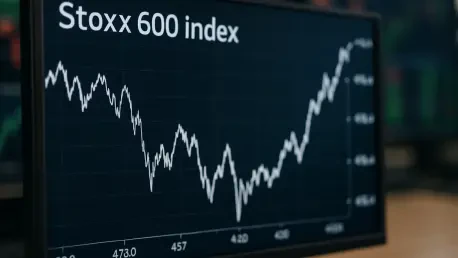

A powerful wave of optimism, originating from a blockbuster earnings report in Asia, swept across European markets, lifting the pan-European Stoxx 600 index to a notable 0.6% gain and underscoring the profound interconnectedness of the global technology supply chain. The day’s trading was overwhelmingly dictated by the semiconductor industry, where record-breaking results from a single Taiwanese chipmaking giant acted as a high-tide mark, raising all adjacent boats in the European tech sector. This surge was not merely a speculative reaction but a fundamental response to tangible proof of sustained, voracious demand for the advanced chips that power the artificial intelligence revolution. The impressive performance served as a powerful testament to the AI boom’s durability, sending a clear signal to investors that the companies providing the essential tools and equipment for this technological shift are poised for significant growth, thereby overshadowing more mixed corporate news and simmering geopolitical tensions that competed for market attention.
The Semiconductor Rally
TSMC’s AI-Fueled Triumph
The primary catalyst for the market’s ebullience was the fourth-quarter financial disclosure from Taiwan Semiconductor Manufacturing Company (TSMC), the world’s largest contract chipmaker and a critical bellwether for the entire technology industry. The company reported a staggering 35% increase in profit, a figure that comfortably surpassed consensus analyst estimates and immediately assuaged any lingering fears of a slowdown in the high-end computing market. Executives attributed this remarkable performance directly to the relentless and accelerating demand for sophisticated chips designed for artificial intelligence applications. This news validated the prevailing market narrative that AI is not a fleeting trend but a foundational technological shift driving substantial capital investment. The strength of these results indicates that major technology firms are continuing to pour resources into developing and deploying AI infrastructure, a process that begins with the highly complex silicon manufactured in TSMC’s foundries, ensuring a robust pipeline of demand for the foreseeable future and justifying investor confidence in the sector’s long-term trajectory.
The significance of TSMC’s announcement extended far beyond its own bottom line, providing a crucial forward-looking barometer for the health of the entire global electronics ecosystem. When a company of TSMC’s scale signals such strong demand and projects a positive outlook, it provides invaluable clarity for a complex network of suppliers, partners, and even competitors. This guidance is meticulously analyzed by market watchers because it directly informs the capital expenditure plans of the industry. A bullish forecast from TSMC implies that it will continue to invest heavily in expanding its manufacturing capacity and upgrading its facilities with the latest-generation equipment. This creates a predictable and lucrative stream of orders for the specialized companies that design and build these intricate machines. Consequently, the chipmaker’s confidence translates into tangible business for its suppliers, creating a domino effect of positive sentiment and revised earnings expectations that rippled from Taipei to trading floors across Europe, turning a single company’s success into a sector-wide rally that demonstrated the deep symbiosis within the semiconductor world.
European Chip-Makers Catch the Wave
The positive shockwave from TSMC’s earnings was felt most acutely among Europe’s leading semiconductor equipment manufacturers, whose fortunes are inextricably linked to the capital spending cycles of major chip foundries. Dutch firm ASML, a lynchpin in the industry, saw its shares surge by 6% to close at a new all-time high, a direct reflection of its critical role in the production of advanced semiconductors. Investors recognized that TSMC’s success in meeting AI-driven demand is built upon the unique capabilities of ASML’s lithography systems. Similarly, other key players in the European supply chain experienced spectacular gains. ASM International, another Dutch equipment supplier, skyrocketed by 11.2%, while BE Semiconductor saw its stock climb an impressive 7.3%. This synchronized upward movement was not coincidental; it was a clear market endorsement of the reality that for chipmakers to thrive, their European equipment partners must thrive first, providing the essential, technologically sophisticated machinery required to etch the increasingly complex circuits that define modern computing power.
The rally in these European stocks underscores the highly concentrated and specialized nature of the semiconductor supply chain. ASML, for instance, holds a functional monopoly on the extreme ultraviolet (EUV) lithography machines necessary to produce the most advanced chips at scales of 7 nanometers and below, which are the workhorses of the AI industry. Without these multi-million-dollar machines, foundries like TSMC simply cannot manufacture the processors that power the latest data centers and smart devices. This makes ASML’s financial performance a direct derivative of the expansion plans of its largest customers. The surge in its stock, along with that of its peers, was therefore a logical pricing-in of expected future orders. Investors were not just reacting to past performance but were actively forecasting a period of sustained investment and growth, driven by the clear evidence that the AI revolution requires a massive build-out of manufacturing capacity, a build-out that relies almost exclusively on the technological prowess of a handful of European companies.
Broader Market and Geopolitical Currents
Corporate Maneuvers Beyond Tech
While the technology sector basked in the glow of TSMC’s success, corporate news from other industries presented a more varied and complex picture for investors. In the financial sector, Italian lender UniCredit’s shares rose a modest 1.4% after the bank moved quickly to dismiss media reports suggesting it was exploring an acquisition of a stake in its rival, Banca Monte dei Paschi di Siena. The bank’s firm denial, which labeled the claims as “pure invention,” helped quell market uncertainty, though the episode occurred against a backdrop of persistent analyst expectations for a wave of mergers and acquisitions to consolidate Italy’s banking landscape. In a different corner of the market, the luxury goods sector offered a cautionary tale. Swiss conglomerate Richemont announced a respectable 4% increase in its third-quarter sales, yet its shares paradoxically fell by nearly 2.1%. This negative reaction suggested that investors were either disappointed by the growth rate, concerned about future profitability, or had already priced in higher expectations, highlighting a market sentiment far more cautious than that seen in the tech world.
The divergent investor reactions to the news from UniCredit and Richemont reveal the nuanced, sector-specific dynamics at play beyond the overarching tech rally. For UniCredit, the primary goal was to manage market perception and prevent speculative trading from destabilizing its stock, a task it accomplished with its decisive public statement. The underlying M&A chatter, however, continues to signal that investors see potential value in consolidation, a long-term theme for the European banking industry. In the case of Richemont, the share price decline despite rising sales points to deeper investor concerns. This could reflect worries about contracting profit margins in the face of inflation, a potential slowdown in key consumer markets like China, or a belief that the luxury sector’s post-pandemic boom is beginning to moderate. Unlike the clear-cut, forward-looking optimism driving semiconductor stocks, these instances showed a market grappling with more ambiguous signals, where positive operational results did not automatically translate into investor confidence and where corporate strategy was being scrutinized with a much more critical eye.
Navigating a Market of Contrasting Signals
The day’s trading ultimately concluded as a story of sector divergence, where the powerful, forward-looking narrative of the AI-driven semiconductor boom decisively overshadowed a more muddled collection of geopolitical and macroeconomic data points. The remarkable performance of TSMC provided a clear and compelling investment thesis that rippled through the global supply chain, directly lifting European equipment makers to new heights. This focused rally stood in stark contrast to the ambiguous signals emanating from other corners of the market, such as the mixed results in the luxury goods sector and the speculative M&A currents in Italian banking. The market’s enthusiastic response to the chip sector’s strength, even while processing unresolved geopolitical discussions and cautious economic forecasts, demonstrated investors’ strong appetite for clear growth stories. It confirmed that in the current climate, tangible evidence of participation in the artificial intelligence revolution remained one of the most potent catalysts for driving shareholder value, capable of setting the dominant tone for a trading session.