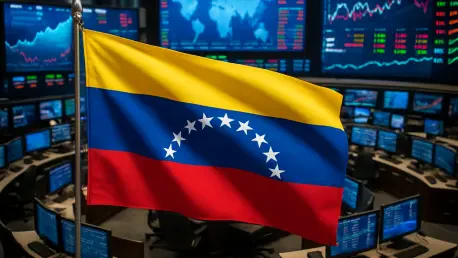

The sudden apprehension of Venezuelan President Nicolas Maduro by U.S. military forces in early January sent a jolt through the international community, but the reaction across global financial markets was far from uniform, painting a complex picture of investor sentiment. As Maduro and his wife were transported to New York to face grave charges of narco-terrorism, traders and analysts scrambled to decipher the implications of a geopolitical event that simultaneously sparked a risk-on rally in certain equity sectors while triggering a classic flight to safety in others. This divergence created a fascinating paradox: while the capture of a leader from an OPEC founding nation, home to the world’s largest proven crude reserves, would typically ignite fears of supply disruption, the initial market movements told a story of nuanced calculation rather than widespread panic. The event served as a real-time stress test, revealing a market that has become increasingly adept at distinguishing between immediate chaos and long-term strategic shifts, with Asian bourses and commodity desks offering starkly different interpretations of what the future might hold.
A Sector-Specific Surge in Asian Equities
In the immediate aftermath of the news, Asian stock markets opened the week with a powerful surge, but the gains were conspicuously concentrated in specific industries, indicating a tactical response rather than a broad-based wave of optimism. Japan’s Nikkei 225 index leaped an impressive 2.82%, while South Korea’s Kospi climbed 2.41% to notch a new record high, driven by a speculative frenzy in the defense sector. Investors swiftly piled into companies like Mitsubishi Heavy Industries, which saw its stock jump 6.4%, and South Korea’s Hanwha Aerospace, which gained 4%, on the anticipation that heightened geopolitical instability would translate into increased military activity and defense contracts. However, this bullish sentiment was not universal across the region. Hong Kong’s Hang Seng index remained conspicuously flat, suggesting that the rally was less about confidence in the global economy and more of a targeted bet on conflict. The muted performance in Hong Kong, coupled with the steady stance of U.S. equity futures, underscored the perception that the event’s fallout would be contained, reshaping security dynamics rather than global economic fundamentals.
The Curious Case of Commodities and Safe Havens
The reaction in commodity markets presented the most striking contradiction, defying long-standing patterns of geopolitical risk. In a move that surprised many observers, global oil prices fell despite the turmoil in Venezuela. Both Brent and West Texas Intermediate crude benchmarks dipped, as traders appeared to price in a more stable, long-term future for Venezuelan oil production over the risk of immediate supply disruptions. The market’s calculus suggested that the removal of the Maduro regime could ultimately pave the way for a revitalization of the nation’s dilapidated oil infrastructure, potentially increasing global supply down the line. In stark contrast to this forward-looking optimism in the energy sector, the precious metals market reflected deep-seated investor anxiety. Spot gold prices advanced more than 1%, climbing to $4,383.99 per ounce as capital flowed into traditional safe-haven assets. This dual movement—falling oil prices and rising gold prices—perfectly encapsulated the market’s split personality, where a strategic, long-term bet on political change in Venezuela coexisted with an immediate, tactical hedge against the inherent uncertainty of the situation.
A New Geopolitical Playbook for Investors
The capture of Nicolas Maduro ultimately served as a defining moment that revealed a significant evolution in how global markets process geopolitical shocks. The event established that investors were capable of looking past immediate headlines to assess deeper, long-term implications, particularly within the energy sector. Instead of a reflexive spike in oil prices, the market demonstrated a sophisticated understanding of how a regime change could eventually stabilize and increase supply, a calculation that overrode short-term disruption fears. It also highlighted the bifurcation of risk appetite, where a flight to the safety of gold occurred simultaneously with a targeted, risk-on rally in Asian defense stocks. This divergence underscored a fragmented sentiment, where strategic optimism and tactical caution managed to coexist. The relative calm in U.S. futures further reinforced the view that the incident was perceived as a contained, regional political event rather than a trigger for systemic global instability, providing a new playbook for navigating an increasingly complex world.