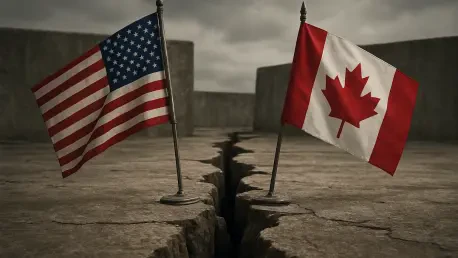

In a world of shifting alliances and high-stakes trade negotiations, the relationship between the United States and Canada has entered a period of unprecedented volatility. To help us decipher the recent diplomatic and economic tremors shaking North America, we’re joined by Priya Jaiswal, a leading authority on international finance and geopolitical strategy. Today, we’ll explore the strategic thinking behind sudden tariff threats, the potential for “middle powers” to assert their influence, and how personal political feuds are reshaping the future of a trade partnership that sees nearly $3.6 billion worth of goods and services cross the border each day.
A 100% tariff has been threatened over Canada’s new trade deal with China, a deal that was initially praised. What do you believe is the political calculus behind this sudden reversal, and how can Canadian officials effectively navigate such unpredictable policy shifts from a major ally?
The whiplash from praise to a 100% tariff threat is a classic negotiation tactic designed to create instability and keep allies off-balance. Initially, praising the deal made Canada feel secure, but the reversal serves as a stark reminder of who holds the power in the relationship, especially after Prime Minister Carney’s celebrated speech in Davos seemed to upstage President Trump. The calculus here is less about the specifics of the China deal and more about reasserting dominance. For Canadian officials, navigation requires a two-pronged approach. Publicly, they must remain firm and principled, as Minister LeBlanc is doing. Privately, they must engage in relentless back-channel diplomacy, not just with the White House, but with governors, members of Congress, and industry leaders in the 36 U.S. states for whom Canada is the top export destination, reminding them of the very real economic pain such a tariff would inflict on their own constituents.
In Davos, Prime Minister Carney called for “middle powers” to unite against coercion, a statement that received widespread attention. What practical, concrete steps could a coalition of such nations take to create a meaningful economic and diplomatic counterweight to pressure from larger powers? Please detail a possible first move.
This is a critical moment for middle powers, and Carney’s call to action was more than just rhetoric; it’s a strategic necessity. To move beyond speeches, a coalition needs to build tangible, interlocking economic structures. A powerful first step would be to create a multilateral “Supply Chain Security Pact” focused on critical minerals and technology. Instead of each nation scrambling for resources, they could pool investment, coordinate production, and establish shared, resilient supply lines for things like semiconductors, EV batteries, and pharmaceuticals. This creates an economic bloc that isn’t just a market but a vital production partner. It transforms their collective status from “on the menu,” as Carney put it, to being an indispensable part of the global economic table that larger powers can’t afford to ignore or bully.
The use of the nickname “Governor Carney” and social media posts showing Canada as a U.S. territory mark an escalation in personal rhetoric. How do these targeted provocations impact the day-to-day diplomatic work between the two countries, and what are the risks of this personal feud?
These personal provocations are incredibly corrosive. They move the conflict from the realm of policy disagreement, which is manageable, to one of personal insult and disrespect for national sovereignty. For the diplomats and trade officials working on the ground, this creates a toxic and unpredictable environment. It’s hard to build the trust needed for complex negotiations when your counterpart’s leader is publicly mocking your own. The primary risk is that this personal feud hijacks the entire bilateral relationship. Critical files, from border security to managing the 85% of U.S. electricity imports that come from Canada, can get derailed. Decisions become driven by ego and political point-scoring rather than by the mutual interests of hundreds of millions of people, which is a truly dangerous path to go down.
Given that the Canada-U.S.-Mexico trade agreement is up for review this year, how does this new tariff threat complicate negotiations? Considering Canada’s role as a top supplier of oil, steel, and critical minerals, what specific leverage does it hold in these high-stakes discussions?
This threat complicates the review immensely by creating an atmosphere of coercion rather than good-faith negotiation. It’s like trying to discuss the terms of a lease while the landlord is threatening to burn the building down. However, Canada is not without significant leverage, and it’s leverage that’s hardwired into the U.S. economy and its national security apparatus. Canada supplies 60% of U.S. crude oil imports and is the largest foreign supplier of steel and aluminum. Even more critically, it possesses 34 of the critical minerals and metals the Pentagon has identified as vital. This isn’t just about commerce; it’s about the foundational inputs for American defense and high-tech industries. Canada’s leverage lies in making it clear that a stable, predictable partnership is essential for America’s own strategic objectives and that weaponizing trade is a threat to that stability.
What is your forecast for the future of the U.S.-Canada trade relationship if these tensions continue to escalate?
If these tensions persist, my forecast is a fundamental and perhaps permanent re-engineering of the North American economic relationship. We will see a shift from deep integration to a more cautious, managed, and defensive partnership. Canadian businesses and government will be forced to aggressively diversify their trade relationships, treating the U.S. market as just one of several strategic options, rather than the default. This won’t be a sudden rupture but a slow, painful decoupling in key sectors as Canada builds out alternative supply chains and markets to insulate itself from this volatility. The seamless, almost invisible border that facilitates $3.6 billion in daily trade will become harder and more fraught with political risk, ultimately eroding the very efficiency and prosperity that has defined this relationship for generations. It would be a strategic and economic loss for both nations, driven entirely by a breakdown in political trust.