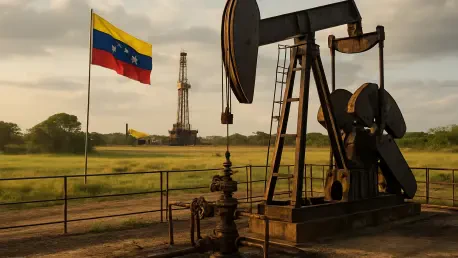

The Contrarian Bet: Why Burry is Going Long on a Broken Oil State
Michael Burry, the investor immortalized for his prescient bet against the U.S. housing market in “The Big Short,” is known for seeing value where others see ruin. While his fame was built on forecasting collapse, his latest high-conviction play is the mirror opposite: a calculated, long-term wager on the revival of Venezuela’s shattered oil industry. This article deconstructs Burry’s strategic investment, which began taking shape in 2020, revealing a sophisticated two-pronged approach targeting the U.S. companies best positioned to profit from the return of Venezuelan crude. It’s not a “big short” on failure but a “big long” on a complex and politically fraught recovery.
From Oil Giant to Pariah: The Collapse of Venezuela’s Black Gold
To understand Burry’s thesis, one must first grasp the seismic shift in the global energy landscape caused by Venezuela’s downfall. Home to the world’s largest proven oil reserves, Venezuela was once a dominant force, particularly for the U.S. Gulf Coast. Its crude is predominantly heavy and high in sulfur—a specific grade that many complex American refineries were purpose-built to process. However, decades of political mismanagement, chronic underinvestment, and crippling U.S. sanctions decimated the state-owned oil company, PDVSA. Production plummeted, infrastructure crumbled, and a vital source of specialized crude for the U.S. market vanished, forcing refiners to find less-than-ideal alternatives. This historical dependency and subsequent supply shock are the foundational pillars upon which Burry’s entire investment strategy is built.
Deconstructing Burry’s Two-Pronged Venezuelan Play
The Refining Windfall: A Perfect Match for Gulf Coast Processors
The primary thesis of Burry’s play centers on U.S. refiners, with Valero Energy as his prime target. The logic is rooted in industrial chemistry and economics. Complex Gulf Coast refineries are engineered to thrive on heavy, sour crude, which they can process into high-value products like diesel, jet fuel, and asphalt at a greater profit margin than lighter, sweeter crudes. For years, these facilities have operated at suboptimal efficiency using mismatched feedstock. Burry anticipates that the restoration of Venezuelan oil exports would be a game-changer, allowing these refineries to finally run on the exact crude they were designed for. This would unlock significant efficiency gains and fatten profit margins, a view widely shared by Wall Street analysts who also identify Valero, along with smaller peers like PBF Energy and HF Sinclair, as the principal beneficiaries of any meaningful restart.
Rebuilding the Ruins: The Multi-Billion Dollar Infrastructure Opportunity
The second, equally critical part of Burry’s strategy targets the “picks and shovels” needed to make the recovery possible. Venezuelan oil infrastructure is in a state of advanced decay; pipelines are corroded, production facilities are derelict, and refineries are barely functional. A revival of the industry isn’t as simple as turning on a tap—it requires a monumental rebuilding effort. This reality creates a massive opportunity for U.S. oilfield services companies. Burry has invested in Halliburton and sees similar upside for industry giants like Schlumberger and Baker Hughes, the very firms with the technology, expertise, and scale required to undertake such a massive rehabilitation project. This part of the bet wagers that before the refiners can profit from the oil, these service companies will profit from rebuilding the systems needed to extract and transport it.
Navigating the Geopolitical Minefield: The Risks Behind the Thesis
While the economic logic is compelling, this investment is fraught with geopolitical risk. The entire thesis hinges on a fragile and reversible détente between the U.S. and Venezuela. A change in political leadership in either country, the reimposition of sanctions, or a failure by Venezuela to meet democratic benchmarks could derail the recovery overnight. Furthermore, the sheer scale of capital required to rebuild the industry is staggering, and it remains uncertain whether the political will and financial backing exist to see it through. This is not a simple market bet; it is a high-stakes gamble on diplomatic stability and the successful execution of one of the most challenging industrial turnarounds in modern history, making it a classic, high-risk, high-reward Burry play.
The Road to Recovery: What’s Next for Venezuela and U.S. Energy
For Burry’s wager to pay off, several key developments must unfold. The most critical factor is the continued easing of U.S. sanctions, contingent on political progress within Venezuela. Investors are closely watching for long-term licenses to be granted to U.S. energy companies, signaling a durable shift in policy. The awarding of major, multi-year contracts to oilfield service companies like Halliburton or Schlumberger would be the first tangible sign that the rebuilding phase is underway. Ultimately, the future of this trade depends on a delicate dance of diplomacy, capital investment, and on-the-ground execution. The timeline is likely measured not in months, but in years, requiring patience from investors willing to ride out potential political and operational volatility.
Lessons from a Master Contrarian: Key Takeaways for Investors
Michael Burry’s Venezuelan play offers a masterclass in second-order thinking and finding value in deeply distressed situations. The primary takeaway is to look beyond the headline asset—in this case, Venezuelan oil itself—and identify the ancillary businesses that are critical to its recovery. By targeting both the processors (refiners) and the enablers (oilfield services), Burry diversifies his bet across the entire value chain of the potential comeback. For other investors, this strategy underscores the importance of understanding deep industrial interdependencies. It provides a blueprint for identifying opportunities where the market has priced in permanent failure, but where a plausible, albeit difficult, path to recovery could unlock immense value for well-positioned companies.
A High-Stakes Gamble on Black Gold’s Return
In conclusion, Michael Burry’s investment in a Venezuelan oil revival is a far cry from the apocalyptic shorts that made him a household name. It is a complex, contrarian, and fundamentally optimistic bet on reconstruction over ruin. His meticulously structured, two-pronged approach targeting both U.S. refiners and oilfield services demonstrates a profound understanding of the energy sector’s intricate machinery. While the political and execution risks are immense, the potential rewards are equally significant. This is not a forecast of imminent collapse but a strategic wager on the eventual, however messy, return of a fallen energy titan—a true “big long” on the enduring power of black gold.