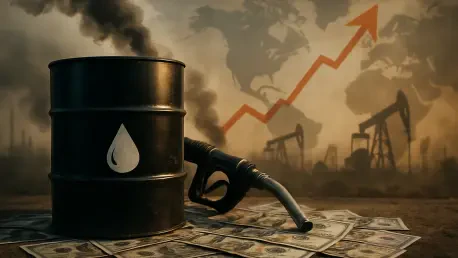

The global economy currently stands at a precarious crossroads as the fallout from intensified military confrontations in the Middle East sends shockwaves through every major financial corridor. Unlike previous cycles of unrest, the current disruption is not merely a regional localized issue but a systemic threat that has fundamentally rewritten the rules of international trade and energy security. Policymakers are now forced to navigate an environment where traditional economic models are being tested by the reality of a persistent supply-side shock.
Geopolitical Volatility and the Fragile State of Global Energy Markets
Navigating the current landscape of the energy sector requires an understanding of how quickly military escalations can dismantle decades of global stability. The recent assassination of high-ranking political figures and subsequent missile strikes have created a volatility premium that refuse to dissipate. Investors are no longer looking at minor price fluctuations; they are pricing in the possibility of a total regional realignment that could sideline major oil-producing nations for the foreseeable future.
The critical role of the Strait of Hormuz remains the most significant variable in this equation, acting as a global maritime chokepoint and economic lifeline for both East and West. With a substantial portion of the world’s daily petroleum consumption passing through this narrow passage, any perceived threat to its safety triggers an immediate reaction in the futures market. This vulnerability has turned the Strait into a geopolitical chess piece, where even minor naval maneuvers can lead to massive spikes in insurance premiums and freight costs.
Major market players are also adjusting to a high-tension environment where the influence of OPEC+ production strategies has become more unpredictable. While some member nations seek to capitalize on higher prices, others are wary of the long-term damage that sustained energy costs might do to global demand. Meanwhile, technological and logistical shifts in oil transport are accelerating as Western energy sanctions force a total reconfiguration of how crude moves from the wellhead to the refinery, often through more expensive and less efficient routes.
Escalating Price Pressures and Shifting Market Dynamics
Emerging Energy Trends and the Threat of Triple-Digit Crude
Analyzing the rapid ascent of Brent and WTI crude prices reveals a steady march toward the $100 threshold, a psychological and economic barrier that could trigger a global recession if breached for an extended period. The market has moved beyond the usual ebbs and flows of seasonal demand, entering a phase characterized by supply-side energy shocks. Natural gas prices have followed a similar trajectory, creating a dual-threat scenario for industrial sectors that rely on both fuel sources for production.
The transition from demand-driven pricing to these structural supply shocks has caused a sudden shift in consumer behavior toward defensive energy hoarding. Large-scale industrial buyers and national governments are aggressively filling reserves, further tightening the available market supply and driving prices higher. This behavior creates a feedback loop where the fear of future scarcity drives the very price increases that markets are trying to avoid.
Opportunities and risks are emerging in alternative energy supply chains as the world attempts to bypass Middle Eastern disruptions. While the crisis has accelerated interest in solar, wind, and nuclear power, these technologies cannot replace the immediate energy density of fossil fuels overnight. Consequently, the reliance on high-cost alternatives and the rapid build-out of new infrastructure are adding to the overall inflationary pressure across the global supply chain.
Market Performance Indicators and Global Economic Forecasts
Statistical breakdowns of current oil price volatility show that performance benchmarks are reaching levels not seen in years. These indicators suggest that the “new normal” for energy markets involves a baseline price significantly higher than the averages seen in the early 2020s. Growth projections for 2027 and beyond are already being revised downward as the shadow of sustained geopolitical instability looms over capital investment and consumer spending.
Evaluating the ripple effect of energy costs reveals a direct hit to both producer and consumer price indices. When the cost of moving a shipping container or fueling a delivery truck rises, those expenses are inevitably passed down to the end consumer. This trend is particularly evident in the food and manufacturing sectors, where energy-intensive processes make up a large portion of the final product cost.
Forward-looking analysis of regional economic performance indicates that energy-import-dependent nations in Asia and Europe are the most vulnerable. While net exporters may see a short-term boost in their national accounts, the broader global slowdown eventually reaches their shores as well. The interconnectedness of modern trade means that no economy is truly insulated from the inflationary drag of a prolonged energy crisis.
Structural Obstacles and the Threat of Persistent Stagflation
The global economy faces a genuine dilemma as leaders struggle to balance runaway inflation against the risk of economic stagnation. This phenomenon, often referred to as stagflation, is the nightmare scenario for economists because the tools used to fix one side of the problem often worsen the other. Raising interest rates to fight inflation can crush the remaining economic growth, while lowering them to stimulate the economy could send prices into an uncontrollable spiral.
Managing the bottleneck at major shipping routes has become a logistical nightmare, with the skyrocketing cost of freight and insurance adding layers of expense to every global transaction. Ships are being diverted around the Cape of Good Hope to avoid conflict zones, adding weeks to transit times and burning thousands of additional tons of fuel. These delays are creating secondary shortages in manufacturing components, further complicating the global recovery.
Strategies for central banks must now focus on mitigating second-round effects, where high energy prices begin to influence wage demands and general service costs. If the public begins to expect high inflation as a permanent fixture, it becomes much harder to dislodge. This requires a delicate communication strategy and a willingness to maintain restrictive policies even when political pressure for rate cuts becomes intense.
The Regulatory Response and the Burden of Fiscal Compliance
Government interventions have become increasingly common as administrations attempt to shield their populations through fuel excise tax cuts and energy subsidies. While these measures provide temporary relief at the pump, they place a massive burden on national budgets. The resulting fiscal deficits can lead to higher borrowing costs and long-term economic instability, representing a transfer of the energy crisis from the consumer’s pocket to the state’s balance sheet.
The impact of international trade barriers and new tariff structures is further complicating the global energy flow. In an effort to secure domestic supplies or punish geopolitical rivals, many nations are turning toward protectionism. These regulatory hurdles often backfire by creating inefficiencies in the market, making it more difficult for energy to reach the regions where it is most desperately needed.
Compliance and security measures in maritime law are also tightening during this period of active military conflict. Shipowners must navigate a complex web of new regulations designed to prevent the financing of conflict, all while ensuring the physical safety of their crews and cargo. This regulatory burden adds to the overhead of international trade, ensuring that the cost of doing business remains elevated.
Innovation and the Future Landscape of Global Macroeconomics
The transition toward energy independence has shifted from a long-term environmental goal to an immediate national security priority. Investment in renewable technology and decentralized energy grids is accelerating as nations seek to decouple their economies from the volatile Middle Eastern energy market. This shift is creating a new class of market disruptors—countries that can successfully leverage their natural resources and technological prowess to become net energy exporters.
Anticipating the pivot in central bank policies is crucial for understanding the next phase of global macroeconomics. We are seeing a move away from growth-oriented easing toward a posture of defensive stability. This means that the era of cheap credit is likely over, as banks prioritize the structural integrity of their currencies over the rapid expansion of their GDP.
The long-term effects of this crisis will likely be felt most acutely in the structural integrity of the Eurozone and Asian markets. These regions, which have built their industrial models on the back of affordable, imported energy, are now being forced to reinvent their entire economic foundations. This transition will be painful, but it may ultimately lead to a more resilient and diversified global economy.
The preceding years demonstrated that the global financial system was more interconnected and fragile than many realized. Policymakers eventually moved toward a model of strategic autonomy, prioritizing the security of supply chains over the raw efficiency of globalized trade. Investors shifted their focus toward “real” assets and infrastructure that could withstand geopolitical shocks, while central banks adopted a more hawkish stance to prevent the permanent de-anchoring of inflation expectations. These actions laid the groundwork for a more cautious, albeit stable, economic era where risk management became the primary driver of fiscal and monetary policy.