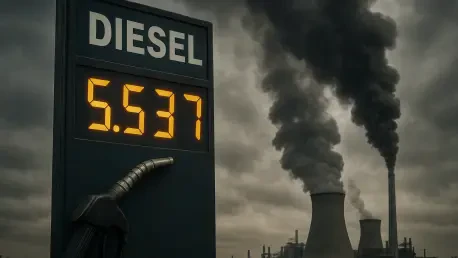

The unprecedented surge in diesel fuel prices throughout the late summer of 2026 has fundamentally restructured the American economic landscape by creating a massive financial burden for the logistics and agricultural industries. What began as a series of isolated market tremors quickly transformed into a pervasive national emergency, as the cost of the fuel that powers the world’s cargo ships, freight trains, and heavy machinery skyrocketed. When the national average reached a historical peak of $6.52 per gallon in September—representing a nearly 73% jump from previous benchmarks—the resulting “diesel tax” began to permeate every facet of daily life. This was not merely an increase at the pump; it was an added cost to every gallon of milk, every piece of lumber, and every delivery truck navigating the interstate.
The scope of this crisis reaches far beyond simple inflation. It is a convergence of geopolitical catastrophes that have dismantled the traditional global energy hierarchy. From external supply disruptions in the Middle East to the shifting political sands ahead of the U.S. midterm elections, the current climate is defined by volatility. This analysis serves to document the specific milestones of this energy shock, examining the debate over protectionist trade policies and the structural threats now facing the American supply chain.
Understanding the Impact of the 2026 Energy Shock
As the primary energy source for the heavy-duty logistics and agricultural sectors, diesel functions as the invisible lifeblood of the domestic economy. While gasoline prices often dominate consumer headlines, diesel is the more accurate barometer for industrial health. The current shock has illustrated that when diesel prices soar, the entire cost of living follows in lockstep. Unlike personal transport, the movement of bulk freight cannot be easily curtailed or substituted, leaving businesses with no choice but to pass these record-breaking costs directly to the consumer.
This crisis has effectively forced a “diesel tax” on the public, where the price of construction, public transportation, and food production has become dictated by global energy volatility. The suddenness of the price hike caught many sectors unprepared, leading to emergency surcharges and service disruptions across the country. Understanding why this happened requires a look at the systemic failures and international conflicts that removed the world’s supply safety net, leaving the American economy vulnerable to this sudden and sharp escalation.
The Escalation of the Global Diesel Supply Crisis
The journey to record-breaking fuel costs was paved by a relentless sequence of international events that compromised global refining capacity and distribution networks. These developments created a deficit that traditional market mechanisms were unable to resolve.
Early 2026: The Intensification of the Iranian Conflict
The beginning of the year was marked by a dramatic escalation of hostilities involving Iran, which culminated in the strategic and physical closure of the Strait of Hormuz. This specific waterway is vital because the surrounding region produces the heavy crude oil that is essential for high-yield diesel refining. Unlike lighter oils used for gasoline, the loss of this heavy crude hit the diesel market with unique severity. The closure essentially removed 20% of the global oil supply overnight, depleting the world’s supply cushion and leaving refineries struggling to maintain production levels for middle distillates.
Mid-2026: Ukrainian Strikes on Russian Infrastructure
As the conflict in Eastern Europe entered a more aggressive phase, Ukrainian forces carried out a series of highly effective military actions targeting Russian refining infrastructure. These precise strikes were aimed at the heart of Russia’s economic engine, neutralizing between 800,000 and 1,000,000 barrels of daily diesel production. This loss meant that even as global demand remained consistent, the supply deficit expanded to a point where existing reserves were no longer capable of bridging the gap. By the third quarter, the scarcity of physical diesel on the global market began to drive prices into uncharted territory.
September 2026: Record Highs and the Rural Backlash
By September, the compounding pressures reached a tipping point, and the national average for diesel hit the $6.52 per gallon mark. This triggered a full-scale political crisis that shifted the national gaze away from traditional gasoline and toward the fuel powering the American heartland. Farmers and small business owners, operating on thin margins, found themselves facing costs that threatened their very survival. This economic pain transformed the energy market into the most contentious issue of the midterm elections, as voters in rural districts demanded immediate and forceful federal intervention to mitigate the damage.
Analyzing the Turning Points and Resulting Political Patterns
The most significant turning point in this saga was the transition of the energy crisis from a supply-chain disruption into a polarized ideological debate over energy protectionism. A clear pattern has emerged where the tension between providing immediate domestic relief and maintaining long-term economic stability has paralyzed typical legislative processes. While the visible metric of success for many is the price at the pump, the deeper underlying pattern shows a growing shift toward isolationism as a primary response to global energy volatility.
There is a glaring absence of any immediate technological solution to this problem. Refineries are complex facilities that cannot be reconfigured for different types of crude overnight, and the massive agricultural fleet of the United States cannot transition to alternative fuels in a single growing season. This lack of flexibility has left the government with few tools, leading to an increased focus on controversial trade bans. The pattern suggests that energy security is now viewed through the lens of national security, forcing the U.S. to reconsider its role in the global market during times of active warfare.
Examining Economic Nuances and the Risks of Protectionism
The most debated solution currently on the table is a total ban on U.S. diesel exports. Proponents of this measure, including several influential senators from major agricultural states, argue that the U.S. must prioritize the needs of its own citizens above global trade obligations. They argue that keeping domestic fuel production within the country is the only logical way to drive down costs for struggling domestic sectors. However, this proposal has exposed deep fissures between political actors and economic experts.
Energy specialists and Treasury officials have warned that an export ban would likely deliver a “one-two punch” of negative unintended consequences. First, there are the technical limitations of the refining industry; if storage tanks reach capacity because exports are banned, refineries must slow down their total output. Since diesel is refined alongside other fuels, this would paradoxically lead to shortages in gasoline and jet fuel. Second, experts point to the “Brazil effect,” a reference to a 1973 soybean ban that caused the U.S. to lose its dominant market share. By enacting an export ban today, the U.S. risks being labeled an unreliable trade partner, which could ultimately lead to the decline of the domestic fossil fuel industry as international buyers seek more dependable suppliers. This conflict between short-term political survival and long-term industrial health remains the most dangerous nuance of the current crisis.
Detailed analysis of the 2026 diesel shock showed that the market reached a point of exhaustion where geopolitical events finally overwhelmed domestic resilience. The milestones documented from the Iranian conflict to the strikes in Eastern Europe demonstrated a systemic vulnerability in the global refining network. Policy discussions evolved to consider strategic refinery modernization and the diversification of heavy crude sources as essential pillars of national security. Future considerations were directed toward establishing more robust diesel-specific strategic reserves to prevent a repeat of the $6.52 peak. Decision-makers began exploring diplomatic avenues to secure shipping lanes while simultaneously evaluating the risks of isolationist trade policies that threatened to alienate global partners.