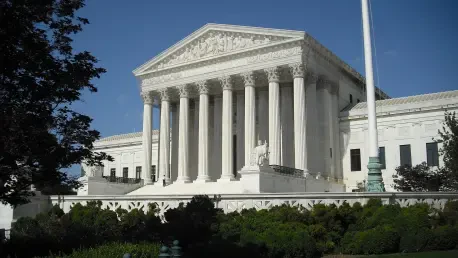

The long-standing constitutional line separating the military from domestic law enforcement faced its most significant test in recent memory as the nation’s highest court intervened in a tense standoff between the White House and the city of Chicago. In a decisive order, the Supreme Court rejected an emergency request from the Trump administration to deploy National Guard troops to the city, marking a significant legal setback for the president and raising fundamental questions about the limits of executive power on American soil. This confrontation forced a national conversation on a critical issue: under what circumstances can the federal government deploy troops within the United States against the explicit objections of state and local officials?
When Presidential Power Meets a City’s Will: A Constitutional Showdown
The conflict between the federal government and Illinois officials crystallized a fundamental debate over the principles of federalism and the separation of powers. The administration’s move was framed as a necessary response to urban unrest, but it was met with fierce resistance from local leaders who viewed it as an unconstitutional intrusion into state affairs. This standoff was not merely a political disagreement; it was a constitutional challenge that asked the judiciary to define the boundaries of presidential authority in matters of domestic policing, a role traditionally reserved for state and local governments.
This case quickly became a flashpoint in a larger national debate concerning the use of federal forces in American cities. The Supreme Court’s involvement signaled the gravity of the legal questions at stake, elevating a regional dispute into a landmark test of executive power. The outcome hinged on whether the administration could justify its actions under existing federal law or if its proposed deployment represented an unprecedented overreach that threatened the delicate balance between federal and state sovereignty.
The Unprecedented Clash Over Federal Authority
The administration’s focus on Chicago did not occur in a vacuum. It was the culmination of a sustained political campaign targeting Democratic-led cities over issues of crime and immigration enforcement. President Trump had repeatedly singled out Chicago, using it as a symbol of urban challenges to justify a more aggressive federal law enforcement posture. This tense political climate set the stage for a direct confrontation, with the city becoming a focal point for the administration’s “law and order” agenda.
This proposed deployment followed a pattern of similar actions in other cities, notably Portland, Oregon, and Washington, D.C., where federal agents were deployed during periods of civil unrest. These prior instances had already sparked legal challenges and public outcry, establishing a contentious precedent of federal intervention that tested the limits of presidential power. The Chicago case, however, was distinct because it prompted a direct and preemptive legal block that escalated all the way to the Supreme Court. At the heart of the legal opposition was the Posse Comitatus Act, a post-Reconstruction federal law that generally prohibits the use of the U.S. military to execute domestic laws, a statute designed specifically to prevent the kind of federal overreach alleged by Illinois officials.
Anatomy of a Supreme Court Rejection
The Supreme Court’s decision was delivered not through a lengthy, signed opinion but via a brief, unsigned order. This preliminary action simply upheld a lower court’s injunction that had already blocked the deployment. While not a final ruling on the constitutional merits of the case, the order effectively halted the administration’s plans indefinitely, representing a decisive, if temporary, victory for the state and city.
The core of the legal failure for the administration was its inability to provide a sufficient legal justification for the deployment that could overcome the strict limitations of the Posse Comitatus Act. Attorneys for Illinois successfully argued that the White House had not identified a proper legal authority, such as an insurrection or a complete breakdown of civil order, that would trigger the narrow exceptions to the act. The court’s majority implicitly agreed that the circumstances in Chicago did not meet this high threshold. Nevertheless, the decision was not unanimous. The presence of three dissenting justices signaled a deep ideological divide within the court on the scope of executive authority in times of perceived domestic crisis, highlighting the contentious and unresolved nature of these legal questions.
Voices from Opposing Sides: Reactions to the Landmark Ruling
In the aftermath of the ruling, Illinois Governor JB Pritzker hailed the decision as a “victory for American democracy.” He framed the court’s order as a crucial check on presidential overreach, stating that the administration had attempted to usurp state authority for political purposes. This perspective was echoed by civil liberties advocates, who warned that allowing such a deployment would set a dangerous precedent for the militarization of domestic law enforcement.
In sharp contrast, the White House defended its position, arguing that the intended deployment was necessary to protect “federal personnel and property” from potential unrest. A spokesperson contended that the president was acting within his authority to ensure public safety and that the ruling would not deter the administration from pursuing its broader agenda. This justification underscored the administration’s belief that federal interests could, at times, override the objections of local governments.
The Ripple Effect: What This Ruling Means for Federal-State Relations
This Supreme Court order marked a pivotal moment in the ongoing struggle over the balance of power between the White House and state governments. By refusing to grant the administration’s emergency request, the court reinforced the legal barriers preventing the executive branch from unilaterally deploying troops for domestic law enforcement. The ruling served as a powerful reminder that presidential authority, even in matters of national security, is not absolute and remains subject to both legislative statutes and judicial review.
Though significant, the preliminary order was not the final word on the matter. The underlying legal battle over the interpretation of the Posse Comitatus Act and the Insurrection Act is likely to continue, setting the stage for future confrontations. Legal experts noted that the court’s refusal to intervene left the core constitutional questions open for future litigation, ensuring that this debate would persist beyond this specific case. The decision effectively pushed the unresolved issues back to the lower courts, where a more detailed and prolonged legal fight was expected to unfold.
Ultimately, the clash over the Chicago deployment contributed to a broader redefinition of the boundaries of modern federalism. It forced a critical examination of how federal and state authorities should cooperate—or compete—in the realm of domestic law enforcement. The ruling underscored the enduring strength of states’ rights in the American legal system and reinforced the principle that federal intervention into local affairs requires a clear and compelling legal justification. The case left a lasting imprint on the dialogue surrounding presidential power, ensuring that the limits of federal authority would remain a central topic of legal and political debate for years to come.