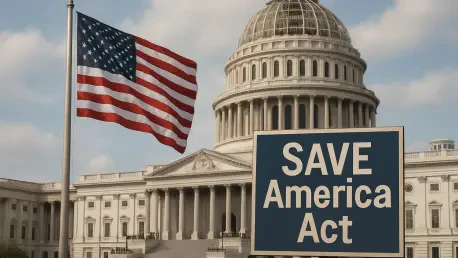

The political landscape has shifted into a state of unprecedented friction as the executive branch effectively freezes the gears of the federal government to force a landmark legislative victory. This March 2026 ultimatum positions the “SAVE America Act” as the single barometer for all future government business, creating a high-stakes standoff. Observers note that this move transforms election reform from a policy debate into a total administrative blockade.
The Ultimatum: A New Era of Executive-Legislative Brinkmanship
The administration has declared that no further legislation will receive a presidential signature until Congress adopts its preferred voting regulations. This strategy represents a significant departure from traditional negotiation, placing the entire federal agenda in a state of suspended animation. Legal experts characterize this as a “signature blockade” designed to bypass conventional committee deliberation in favor of direct executive pressure.
By establishing this litmus test, the executive branch has signaled that procedural compromise is no longer an option for the current term. Such a maneuver risks a total systemic collapse if neither side yields, yet proponents argue it is the only way to ensure the integrity of future contests. Critics, meanwhile, view the standoff as a dangerous precedent that could permanently alter the balance of power between the branches of government.
The Mechanics of a National Stalemate
Redefining the Ballot Box: The “Gold Standard” of Election Reform
The proposed legislation introduces strict requirements for proof of citizenship and mandatory photo identification at every polling station. Policy analysts highlight that the near-total elimination of mail-in voting represents a massive shift toward traditional, in-person participation models. While these measures aim to bolster security, researchers warn they could significantly impact the participation rates of various voter demographics in upcoming cycles.
The debate is further complicated by the inclusion of socially conservative riders that extend beyond the scope of voting mechanics. Provisions banning gender-affirming care and restricting participation in sports have become focal points for intense partisan debate. These additions serve to solidify support among the administration’s base but create additional friction for moderate legislators who are wary of secondary policy battles.
Congressional Gridlock and the Filibuster Barrier
In the Senate, a narrow 53-47 Republican majority faces the daunting task of overcoming the 60-vote filibuster threshold. Legislative strategists observe that while there is pressure to dismantle the filibuster, leadership remains divided on the long-term consequences of such a procedural revolution. The result is a legislative body capable of debating the bill but currently unable to move it toward a final vote.
Speaker Mike Johnson faces a parallel challenge in the House, where a razor-thin majority requires nearly perfect party discipline. Party leaders must navigate the internal friction between those demanding an immediate victory and those concerned with the viability of more extreme provisions. In contrast, the opposition has signaled a willingness to accept a total government shutdown rather than concede on what they describe as restrictive voting policies.
Real-World Consequences: The DHS Funding Crisis and Civil Unrest
The direct impact of this stalemate is most visible in the current funding crisis facing the Department of Homeland Security. Without an approved budget, border control operations and national stability initiatives have moved into an emergency status. Security experts warn that the lapse in funding undermines the very safety the administration seeks to protect, creating a paradox of governance.
Recent reports of violence involving federal agents and subsequent demands for mass deportations have further intensified the partisan divide. As civil unrest grows in specific regions, the pressure on lawmakers to resolve the standoff increases. However, the administration remains firm in its belief that legislative victories must take precedence over the immediate functionality of executive departments.
Constitutional Constraints and the Ten-Day Rule
Constitutional scholars have pointed toward the ten-day rule as a potential exit ramp for this legislative gridlock. Under the Constitution, if the President does not sign a bill within ten days while Congress is in session, it automatically becomes law without a signature. This mechanism suggests that lawmakers could potentially bypass the executive blockade if they remain in session and force the enactment of essential funding.
There is also the matter of the pocket veto, which only applies if Congress adjourns during the ten-day window. If the administration attempts to withhold signatures while Congress is active, judicial challenges are almost certain to follow. This creates a legal gray area where the limits of executive obstruction will likely be tested in the highest courts, setting a new precedent for future governance.
Strategic Implications for the 2026 Midterm Elections
Political consultants are closely monitoring the 62% disapproval rating regarding the administration’s handling of inflation and the cost of living. There is a concern that focusing heavily on social measures and election reform may alienate the general electorate who are more concerned with economic stability. Balancing the demands of the base against the financial anxieties of swing voters has become the primary challenge for GOP leadership.
As the November elections approach, the success of this high-pressure strategy remains uncertain. If the blockade leads to a perceived stabilization of the voting process, it could be a winning narrative for the incumbent party. Conversely, if the government remains paralyzed by legislative demands, it might result in a significant electoral backlash from voters tired of systemic gridlock.
The Future of American Governance Amidst Absolute Priorities
The long-term effects of using the entire federal budget as a bargaining chip remain a subject of intense debate among political scientists. This approach proved that the traditional legislative process was vulnerable to extreme executive pressure, yet it also highlighted the durability of procedural defiance in the Senate. Leaders ultimately weighed the potential for reform against the risk of total institutional failure.
Legislators eventually determined that navigating this high-pressure environment required a mix of constitutional maneuvering and strategic compromise. The standoff demonstrated that while a signature blockade can force a national conversation, the daily needs of a functioning government often dictated the final outcome. Future administrations will likely look back at this period as a case study in the limits of absolute priorities.