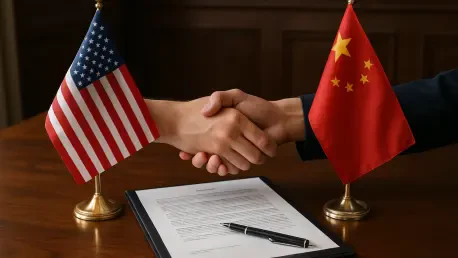

A single, extensive phone conversation between the leaders of the world’s two largest economies recently produced two profoundly different narratives, one focused on the immediate promise of American commerce and the other on the enduring principle of Chinese sovereignty. This divergence in priorities, revealed in the official readouts from Washington and Beijing, sets a complex and tense stage for President Donald Trump’s upcoming April visit to China. More than just a diplomatic prelude, the call exposed the fundamental friction point in the relationship: the clash between a transactional dealmaker seeking tangible victories and a strategic power guarding its non-negotiable “red lines.” At stake are not only billions of dollars in trade but the very stability of the global geopolitical order.
Two Leaders One Call Two Different Priorities
Following what President Trump described as a “long and thorough” discussion with President Xi Jinping, the American summary focused almost exclusively on economic transactions. The emphasis was on China’s commitments to purchase American oil, gas, and agricultural goods, showcasing a clear, transaction-oriented mindset. This approach, according to some analysts, is seen by Beijing as a manageable, even preferable, style of diplomacy. Neo Wang, lead China macro analyst at Evercore ISI, suggested that a U.S. leader focused on commercial wins is a “gift” compared to one driven by ideology.
In sharp contrast, Beijing’s official statement on the same call placed a geopolitical issue front and center, declaring Taiwan to be “the most important issue” in the entire bilateral relationship. President Xi’s firm language, urging the United States to handle arms sales to the island “with prudence,” was a direct response to Washington’s recent approval of a multi-billion dollar defense package for Taiwan. This strategic messaging serves as a powerful reminder that while economic deals are welcome, they will not come at the expense of what China considers its core national interests.
The Billion-Dollar Handshake Soybeans Jets and Tariff Relief
For the Trump administration, the potential rewards of the upcoming summit are concrete and substantial. The phone call secured a massive Chinese commitment to purchase 20 million tons of American soybeans for the current season, with another 25 million planned for the next. This agricultural deal is seen as a precursor to an even larger prize: a landmark agreement for up to 500 Boeing aircraft, which analysts like Neo Wang anticipate will be a centerpiece of the April visit.
Such a large-scale commercial agreement would deliver a significant “headline victory” for President Trump. A successful summit, built around these tangible economic wins, could pave the way for Washington to remove the remaining 10% tariffs on certain Chinese goods. This creates a powerful incentive for both sides to find common ground, with the U.S. eyeing economic revitalization and China seeking relief from trade pressure.
A Red Line Drawn in the Taiwan Strait
While Washington calculates the value of the deal in dollars and cents, Beijing is measuring it against its unwavering territorial principles. President Xi’s pointed focus on Taiwan was not a peripheral comment but the central pillar of his message. By reasserting China’s sovereignty over the island, he was deliberately setting the boundaries for all future negotiations. This stance is a clear signal that any comprehensive agreement must include American respect for China’s position on Taiwan.
According to David Meale, practice head for China at Eurasia Group, this is a calculated diplomatic maneuver. Beijing is “defining where the red lines are” without creating a confrontation that could derail President Trump’s visit. It is a subtle but firm declaration that while soybeans and jets are on the table, Taiwan is not. This fundamental disagreement remains the most significant obstacle to a lasting and comprehensive deal.
The Global Chessboard Bargaining Chips from Tehran to Moscow
The conversation extended far beyond bilateral trade, touching upon critical global flashpoints where the two powers hold significant influence. President Trump confirmed that Iran was a key topic, a discussion made more urgent by his administration’s diplomatic outreach to Tehran and the recent deployment of a U.S. naval task force to the region. As the largest buyer of Iranian oil, China’s cooperation is a crucial piece of the puzzle, and both leaders likely have “asks of each other” regarding how to manage escalating tensions in the Middle East.
Similarly, the war in Ukraine was a subject of discussion, with President Trump reportedly seeking Beijing’s help in pressuring Moscow. Reva Goujon, a director at Rhodium Group, characterized this as part of Trump’s “carrot and stick approach,” using the prospect of a trade deal as a carrot to enlist Chinese support on other global fronts. Interestingly, topics that have previously caused significant friction, such as China’s control over rare earth minerals and the recent crisis in Venezuela, were conspicuously absent from the readouts, suggesting a deliberate effort to avoid contentious issues before the leaders meet in person.
Contrasting Playbooks for a High-Stakes Game
The diplomatic tones adopted by the two leaders were as revealing as the content of their conversation. President Trump was enthusiastic and personal, describing the call as “excellent” and his relationship with President Xi as “extremely good.” This approach reflects his “Art of the Deal” playbook, which prioritizes personal rapport and immediate, headline-grabbing agreements. It’s a strategy focused on closing the deal and celebrating a win.
President Xi, in contrast, employed a formal and measured approach, emphasizing the need for “reciprocity” and mutual respect for each side’s “concerns.” This reflects China’s long-game strategy, which values stability, patience, and the careful management of core interests over short-term gains. His cautious language underscores a fundamental difference in how each nation views the path forward: one sees a series of transactions, while the other sees the careful navigation of a complex, long-term relationship.
The groundwork for a monumental trade deal had been laid, yet the final price remained uncertain. The path to an agreement was paved with American soybeans and Boeing jets, but it was bordered by an unmovable red line drawn through the Taiwan Strait. As the April summit approached, the central question was whether a deal could be struck that satisfied both the transactional appetite of one leader and the strategic imperatives of the other. The outcome of that negotiation would not only define the future of U.S.-China relations but also shape the geopolitical landscape for years to come.