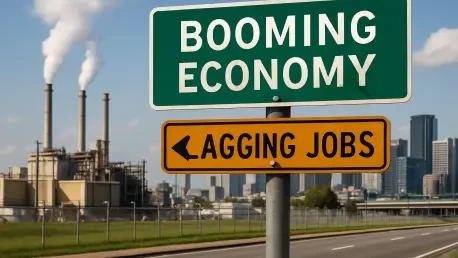

The U.S. labor market concluded 2025 by presenting a deeply perplexing economic puzzle, where signs of vigorous growth and consumer confidence clashed sharply with an unexpectedly anemic corporate hiring landscape. Data released by the Bureau of Labor Statistics painted a contradictory picture, forcing analysts, policymakers, and the public to question the very nature of the current economic expansion. On one hand, key indicators pointed to a booming economy, yet on the other, the engine of job creation appeared to be sputtering. This divergence has created a complex environment, characterized by record-high consumer spending and robust GDP projections alongside a corporate sector that has grown increasingly hesitant to expand its workforce. The central mystery is not whether the economy is growing, but why that growth is failing to translate into the widespread job gains that have historically accompanied such expansions, leading to a scenario that feels prosperous on paper but precarious for the average job seeker. This situation has left many wondering if the traditional relationship between economic output and employment has fundamentally changed.
A Tale of Two Surveys
The Corporate Hiring Slowdown
A closer examination of the nonfarm payroll figures, which track employment at businesses and government agencies, reveals a clear and concerning trend of deceleration. The addition of just 50,000 jobs in December fell significantly short of the 73,000 that economists had forecast, but the weakness was even more pronounced when considering revisions to previous months. November’s initial gains were revised downward to a mere 56,000, while October’s data was adjusted to show a staggering loss of 173,000 positions, a far more severe decline than first reported. This pattern of sluggish growth defined the entire year, with monthly payroll increases averaging a paltry 49,000 in 2025. This figure represents a dramatic drop from the much healthier average of 168,000 jobs per month seen in 2024. The total annual gain of just 584,000 jobs marked the worst performance for a year without a recession since 2003, prompting some economists to declare that the nation was experiencing a “hiring recession,” a period where corporate recruitment effectively grinds to a halt despite the absence of a broader economic downturn.
Household Employment Resilience
In stark contrast to the grim picture painted by corporate payrolls, the household survey, which polls individuals directly and is used to determine the unemployment rate, offered a surprisingly optimistic view. This survey indicated that the official unemployment rate unexpectedly declined to 4.4% from 4.5% in the previous month. The positive news extended to a broader measure of unemployment, often referred to as the U-6 rate, which accounts for not only the unemployed but also discouraged workers and those working part-time for economic reasons; this measure saw a significant drop to 8.4%. These figures suggest that while large companies and government entities were not adding staff in large numbers, individuals were still successfully navigating the labor market and securing employment through other means. This could point to growth in small businesses, freelance work, or other sectors not fully captured by the establishment survey. However, the data was not without its complexities, as the labor force participation rate edged down slightly to 62.4%, indicating that a small fraction of people had stopped looking for work altogether, which also contributed to the lower unemployment rate.
Navigating the Economic Paradox
The Jobless Boom Phenomenon
This unusual economic condition, widely described by analysts as a “jobless boom,” is sustained by several powerful underlying forces. The broader economy demonstrated considerable momentum heading into the new year, with the Federal Reserve Bank of Atlanta’s GDPNow model projecting an impressive 5.4% annualized growth rate for the fourth quarter of 2025. This growth was fueled in large part by the American consumer, who shattered spending records during the holiday season, signaling high levels of confidence and financial health. Furthermore, wage growth remained a bright spot, with average hourly earnings increasing by 3.8% on an annual basis, slightly outpacing expectations and helping to support household purchasing power. This created a bifurcated reality: a favorable environment for investors and Wall Street, where corporate profits could rise without the associated costs of expanding payrolls, but an unsettling one for Main Street, where the lack of new job opportunities created a sense of economic insecurity despite the positive headline numbers. The economy was expanding, but the benefits of that expansion were not being distributed through the traditional channel of robust job creation.
Implications for Monetary Policy
The conflicting signals from the December jobs report have placed the Federal Reserve in a challenging position, complicating its path forward on monetary policy. Following a series of three interest rate cuts in the latter half of 2025 aimed at preemptively stimulating the economy, the central bank now faces a dataset that provides no clear mandate for further action. The weak hiring figures might argue for additional rate cuts to encourage business investment and expansion, but the falling unemployment rate, solid wage growth, and strong GDP projections suggest that the economy does not require more stimulus and that further easing could risk stoking inflation. Consequently, financial markets are now pricing in a period of inaction from the Fed, with the consensus view being that policymakers will adopt a wait-and-see approach. The next potential rate cut is not anticipated until at least June, pending clearer economic trends. Adding a layer of context, this report was the first to be released on schedule in three months, following significant delays caused by a 43-day government shutdown that had hampered the Bureau of Labor Statistics’ data collection capabilities.
Charting a Course Through Uncertainty
The close of 2025 presented an economic narrative that defied simple explanations and challenged conventional wisdom. The divergence between strong economic output and weak corporate hiring underscored a potential structural shift in the labor market, where productivity gains, automation, and evolving business models allowed for growth without a proportional increase in headcount. This “jobless boom” served as a critical reminder that headline GDP and unemployment figures alone may no longer be sufficient gauges of the nation’s economic well-being. Navigating this new terrain required a more nuanced analysis from policymakers, who had to weigh the benefits of a robust, efficient economy against the societal need for broad-based employment opportunities. The path forward involved looking beyond traditional indicators to understand the changing nature of work itself and developing strategies that fostered inclusive growth in an era of unprecedented economic contradictions.