
The Unsettled Bond Market: A New Era of Risk
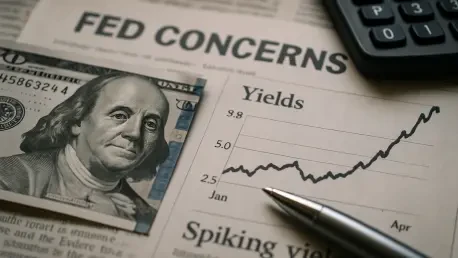
In a clear signal of growing unease among investors, U.S. Treasury yields surged on Friday, driven not by typical economic reports but by a potent mix of geopolitical drama and institutional instability. The across-the-board rise, which saw the 10-year Treasury yield climb over six basis points to 4.227%, reflects deep-seated concerns about the Federal Reserve’s autonomy and unpredictable political maneuvers. This analysis dissects the unusual forces driving yields higher, exploring how political headlines are temporarily eclipsing traditional economic indicators and what this shift means for investors.
Understanding the Bedrock: Why Treasury Yields Matter
Historically, the U.S. Treasury market has served as a reliable barometer of economic health, with yields rising on signs of growth and falling during periods of uncertainty. These yields influence everything from mortgage rates to corporate borrowing costs, making them a cornerstone of the financial system. For decades, investors have priced this debt based on predictable factors like inflation expectations and Federal Reserve policy. The current spike, however, is being fueled by a different set of anxieties, shifting the focus from economic data to political risk and challenging the long-held assumptions that have guided bond market analysis.
Dissecting the Drivers of Market Anxiety
Geopolitical Jitters and the Greenland Gambit
A significant source of market nervousness stems from an unexpected push to acquire Greenland from Denmark, a move described as critical to national security. This unconventional foreign policy objective, intensified by threats of tariffs and a high-stakes meeting that ended without a resolution, has injected a rare and unpredictable variable into the market. Investors view such geopolitical instability as a direct risk, forcing them to demand higher compensation—in the form of higher yields—for holding U.S. debt. The episode underscores how erratic diplomatic tensions can create tangible financial consequences.
The Federal Reserve Under a Political Microscope
Compounding the geopolitical uncertainty are growing concerns over the independence of the Federal Reserve. A criminal investigation into Chairman Jerome Powell, coupled with rampant speculation about his potential successor, strikes at the heart of the central bank’s credibility. The Fed’s autonomy is a critical pillar of economic stability, ensuring monetary policy is set based on data rather than political pressure. Any perception that this independence is eroding spooks investors, leading to a risk premium being added to Treasury yields and creating a cloud of uncertainty over future monetary policy.
An Economic Data Vacuum Amplifies Market Nerves
The impact of these political developments was amplified by a quiet day on the economic calendar. With little new data to guide decisions, investors became hypersensitive to headlines. In this vacuum, the drama surrounding Greenland and the Federal Reserve took center stage, having an outsized influence on market movements. All eyes are now turning to the upcoming personal consumption expenditures (PCE) index, the Fed’s preferred inflation gauge. This report will provide the first major piece of hard data to either validate or counteract the market’s anxiety.
What’s Next on the Horizon for Yields?
Looking ahead, the trajectory of Treasury yields will likely be shaped by the interplay between these emerging political risks and traditional economic indicators. The upcoming PCE data will be a critical test; a soft inflation reading could temper recent yield increases, while a high number could send them higher. However, as long as geopolitical uncertainty and questions about the Fed’s leadership persist, yields will remain susceptible to headline-driven volatility. Investors must now prepare for a landscape where non-economic factors could continue to play a significant role in dictating market direction.
Navigating a Market Ruled by New Risks
The key takeaway for investors is that the rulebook for analyzing the bond market is being rewritten. While economic fundamentals still matter, political and institutional risks have become undeniable drivers of yield movements. To navigate this new environment, investors should monitor geopolitical developments and news related to the Federal Reserve with the same diligence they apply to economic reports. For long-term portfolios, this shift reinforces the importance of diversification and may warrant strategies that hedge against heightened political volatility.
A Concluding Thought on a Shifting Landscape
The recent spike in Treasury yields served as a stark reminder that markets are not immune to politics. The potent combination of an unconventional foreign policy gambit and unprecedented pressure on the Federal Reserve has unsettled a market that thrives on predictability. This episode highlights a broader trend where political risk has become an increasingly dominant factor in financial calculations. For investors and policymakers alike, grasping this new reality is essential to navigating an increasingly complex global economy.