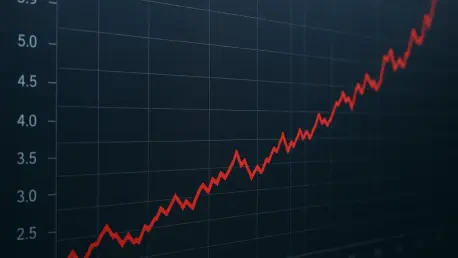

A shift in market sentiment suggests that the front end of the yield curve has fully priced in immediate rate hikes, shifting the focus to the duration of the current restrictive policy. The global financial landscape has entered a volatile phase as the 30-year United States Treasury bond recently surpassed the 5.5% mark, a milestone that effectively rewrites the playbook for fixed-income investors. This surge represents the highest yield seen since the early 2000s, reflecting a profound transformation in how the market interprets the durability of the American economy. While the Federal Reserve has maintained a steady hand on interest rates, the sheer momentum of long-dated yields indicates that the market is grappling with a lack of historical anchors. Investors who previously sought the safety of long-term government debt are now facing a reality where traditional support levels have evaporated, leaving yields to climb in what experts describe as a technical vacuum. This transition is a fundamental repricing of risk and capital.
Navigating the Technical Vacuum: The Economic Resilience
The Absence of Market Anchors: Technical Resistance
Strategists from RBC Capital Markets have observed that the current fixed-income market is operating within a unique “vacuum,” characterized by an absence of established technical resistance levels. In typical market cycles, investors look for specific psychological price points or historical yield percentages that serve as anchors, effectively acting as ceilings that prompt a pause or reversal in trends. However, as the 30-year Treasury yield broke through the significant 5.5% barrier, it entered territory that hasn’t been charted in over two decades. This lack of resistance creates a self-sustaining upward momentum where the market lacks the traditional stop-gaps that usually stabilize bond prices during periods of volatility. Without these anchors, yields have drifted higher almost continuously, driven by a collective realization that the old rules of engagement no longer apply. This phenomenon highlights a market that is searching for a new equilibrium point and finding very few reasons to stop.
The Resilience of Growth: Consumer Confidence Data
The immediate catalyst for this recent movement was reinforced by the University of Michigan’s consumer confidence data, which provided a surprising glimpse into the underlying strength of the American consumer. While the headline index technically reached a four-month low, the specific figures regarding expectations and current conditions surpassed the estimates of most prominent economists. This data reinforced a broader market consensus that the economy remains remarkably resilient, even as it faces the pressure of aggressive interest rate hikes. For bond investors, this economic durability is a double-edged sword; it suggests that a recession, which would normally drive demand for the safety of Treasuries and lower yields, is not on the immediate horizon. Consequently, the incentive to hedge against a downturn by purchasing long-term bonds has diminished significantly. This lack of defensive buying interest allows yields to climb further as the market adjusts to an environment where economic growth persists.
Divergence from Historical Drivers: The Yield Curve Shift
Breaking the Link: Energy Prices and Yields
For several decades, a reliable positive correlation existed between long-term Treasury yields and oil prices, but this historical linkage recently suffered a significant breakdown. While oil prices saw a notable drop to ninety-two dollars per barrel, yields continued their ascent, indicating that the market is now more concerned with structural inflation than temporary commodity fluctuations. This divergence was accompanied by a “bear steepener” dynamic, where long-term rates rose faster than short-term ones, signaling that the era of cheap borrowing has ended. Investors no longer bet on a quick recession to force rate cuts; instead, they adjusted to a “higher-for-longer” policy that kept the long end of the curve under constant pressure. This decoupling shows that the market is preparing for a reality where inflation stays embedded in the economy, forcing the Federal Reserve to maintain high costs regardless of short-term energy dips. This shift reflects a move away from transient data toward structural economic shifts.
The Shift in Global Capital: Future Strategic Outlook
Major financial institutions responded to this new reality by revising their forecasts and placing large-scale trades to hedge against duration risk. Sophisticated investors used the futures market to bet on a wider gap between short-term and long-term borrowing costs, signaling a collective effort to protect portfolios from the danger of falling bond values. As the market looked ahead, the focus remained on identifying new anchors that eventually stabilized the financial landscape in a post-transition world. Actionable next steps involved a thorough diversification into assets that can benefit from a steeper yield curve or provide protection against embedded inflation. Investors who moved toward more dynamic hedging models were able to mitigate the impact of the 30-year yield’s breach of the 5.5% threshold. Ultimately, by re-evaluating risk hurdles and adapting to a higher cost of capital, organizations were better positioned to thrive in an environment where historical norms no longer applied.