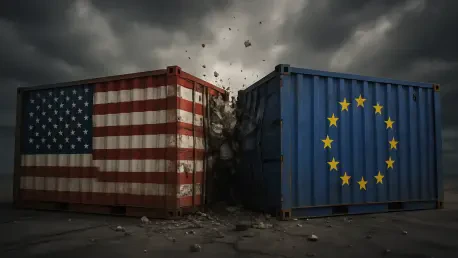

With the specter of new U.S. tariffs looming over Europe, we sit down with Priya Jaiswal, a leading authority on international business and European markets, to unpack the potential fallout. The proposed levies, tied to a push for U.S. sovereignty over Greenland, threaten to disrupt a transatlantic trade relationship worth trillions. In our conversation, Priya will dissect the acute vulnerabilities of Germany’s powerhouse auto sector, explore how French luxury brands might leverage their prestige to weather the storm, and analyze the significant, yet often overlooked, impact on the pharmaceutical and energy industries. We will also delve into the strategic calculus of potential European retaliation and what these tensions signal for the future of global trade.
The European auto sector, particularly in Germany, is seen as acutely vulnerable to new tariffs. What specific supply chain disruptions are most concerning for brands like BMW or Volkswagen, and what immediate steps might they take to mitigate a levy that could rise to 25%?
The concern for the German auto sector is absolutely palpable, and for good reason. Their entire business model is built on highly globalized, just-in-time supply chains that crisscross the Atlantic. A part for a BMW X5 assembled in South Carolina might come from Germany, which in turn relies on components from elsewhere in Europe. A sudden tariff of 10%, rising to 25%, throws a massive wrench into those finely tuned logistics. The most immediate fear is a margin collapse. It’s not as simple as just raising prices for the American consumer. In the short term, manufacturers will likely have to absorb a significant portion of that cost, which is why we saw their stocks plunge by over 2.5% on the news. To mitigate this, they’ll be scrambling to assess their supply chain exposure, potentially accelerating plans to localize more production in North America, and engaging in intense lobbying efforts to highlight the damage these tariffs would do to their U.S. operations and employees.
French luxury giants possess significant pricing power. How might these proposed tariffs test that strength, and beyond price hikes, what strategies could brands like LVMH or Kering employ to protect their market share amid a potential economic downturn sparked by these trade tensions?
That’s the billion-dollar question for the luxury sector. Yes, brands like those under the LVMH and Kering umbrellas have incredible pricing power; their customers are less price-sensitive. They can pass on a 10% tariff more easily than a car manufacturer. However, the real threat isn’t the direct cost but the indirect effect—the potential for these trade tensions to trigger a broader economic slowdown. Even the wealthiest shoppers can pull back on spending when their investment portfolios are hit and consumer confidence plummets. We saw the market’s anxiety reflected in the immediate stock drops of around 3.5% for LVMH. Beyond simply raising prices, these brands will likely double down on brand storytelling and exclusivity to reinforce their value. They might also strategically shift marketing focus to other growth regions to offset any softness in the U.S. and work on operational efficiencies to absorb some of the tariff impact without alienating their core clientele.
Given that pharmaceutical products are the EU’s single largest export category to the U.S., what are the potential ripple effects of these tariffs on drug pricing and availability for American consumers? How might companies like Novo Nordisk or Sanofi adjust their U.S. operations?
The pharmaceutical link is a critical, and often underestimated, aspect of this trade relationship. We’re talking about a staggering 84.4 billion euros in EU pharma exports to the U.S. in just the first three quarters of last year. Tariffs on these products would almost certainly translate into higher costs for American patients and healthcare providers, creating immense political and social pressure. The ripple effects could also include disruptions to the supply of essential medicines, creating potential shortages if the logistics become too costly or complex. For giants like Novo Nordisk or Sanofi, whose stocks dipped on the news, the strategic response would be multi-faceted. They would need to review their entire supply chain, potentially increasing production at U.S.-based facilities where possible, and likely engage in high-stakes negotiations and lobbying efforts to seek exemptions for life-saving drugs.
These tariffs threaten countries with large U.S. trade surpluses, like Germany. Beyond direct manufacturing, how might these levies indirectly impact the European energy sector, and what does this signal for broader global commodity and equity markets if retaliatory measures are enacted?
The indirect impacts are where the systemic risk really lies. For the energy sector, it’s not about a direct tariff on oil and gas. Instead, the threat of a trade war between two of the world’s largest economic blocs spooks the market about a slowdown in global demand. If industries are producing less and consumers are buying less, the need for energy to power factories and transport goods falls. That’s why we saw oil prices dip and energy stocks like Norway’s Equinor fall around 3.4%. This is a classic leading indicator of economic fear. As Ozan Özkural noted, this isn’t an isolated event. It creates a ripple effect that touches everything: commodity prices drop on fears of lower demand, equity markets become volatile, and even debt and private credit markets tighten as risk aversion grows. It signals a fundamental shift where geopolitical friction becomes a primary driver of market instability.
With European leaders reportedly considering retaliatory measures, what form could this response take to be effective without escalating into a full-blown trade war? Could you walk us through a few potential economic counter-moves and their likely impact on U.S. industries?
European leaders are walking a very fine line. They need to project strength and deter further action, but a tit-for-tat escalation helps no one. The most likely response would be a carefully calibrated and targeted set of retaliatory tariffs. They won’t be random. They will be strategically aimed at U.S. exports that are economically and, more importantly, politically sensitive. Think agricultural goods from key electoral states, or iconic American products. The goal is to create domestic political pressure within the U.S. to de-escalate. Another avenue is to initiate formal disputes through international bodies, though this is a much slower process. The impact on U.S. industries could be sharp and concentrated. A U.S. farmer who suddenly loses access to a key European market feels the pain immediately, creating a powerful lobbying voice against the initial tariffs. It’s a high-stakes chess match where the goal is to inflict just enough pain to change behavior without starting an all-out economic conflict.
What is your forecast for the future of U.S.-European trade relations under these conditions?
My forecast is for a period of sustained volatility and heightened uncertainty. The era of predictable, rules-based trade relations is being challenged, and we are entering a phase where trade policy is increasingly used as a tool for geopolitical leverage, as seen in this Greenland dispute. I anticipate a series of tense negotiations and brinkmanship. While a full-blown, catastrophic trade war is in neither side’s interest and will likely be avoided, we should expect a “new normal” characterized by friction, strategic decoupling in sensitive sectors, and a much greater focus on supply chain resilience. Businesses on both sides of the Atlantic will need to build more flexibility into their operations, as the assumption of smooth, tariff-free trade can no longer be taken for granted. The relationship will become more transactional and, unfortunately, more contentious.