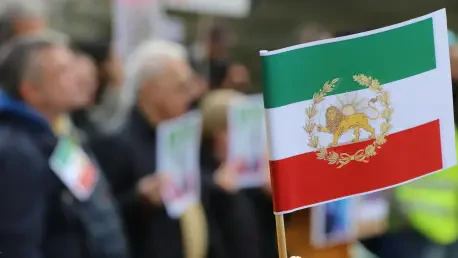

A nation teeters on the precipice, caught in the crushing grip of widespread internal rebellion and the looming shadow of foreign military intervention, creating a highly combustible situation with profound implications for regional stability. Iran is engulfed in the most significant and sustained wave of anti-government unrest in three years, a national crisis initially sparked by severe economic distress that has now exposed decades of deep-seated public anger against the ruling theocracy. The regime has responded with a brutal crackdown, but this internal conflict is dangerously amplified by crippling sanctions and explicit threats of military action from the United States under the Trump administration. This confluence of internal dissent and external pressure has raised critical questions about the durability of the Iranian government and the future trajectory of the nation.
The Anatomy of a National Uprising
The Spark and the Tinderbox
The initial catalyst for the widespread demonstrations was a specific economic grievance: the catastrophic free fall of Iran’s currency, the rial, which collapsed to approximately 1.4 million to the U.S. dollar, prompting shopkeepers in Tehran’s Grand Bazaar to take to the streets. However, this economic spark quickly ignited a much larger and more volatile “tinder of discontent.” According to Naysan Rafati of the International Crisis Group, the unrest rapidly evolved from a narrow financial protest into a widespread expression of “wider anti-regime, anti-system sentiment.” This transformation reveals a “general, very deep malaise” that transcends class and geography, indicating that the foundational causes of the uprising are far more profound than immediate monetary hardship. The movement’s swift expansion demonstrated that years of simmering frustration over political repression, social restrictions, and economic mismanagement had finally reached a boiling point, turning a localized protest into a national challenge to the regime’s authority.
The sheer scale and human cost of the demonstrations have been immense, underscoring the depth of the national crisis. According to data compiled by the Human Rights Activists News Agency (HRANA), the protests have spread to over 348 locations across all 31 of Iran’s provinces, a testament to the movement’s nationwide reach. The human toll has been severe, with rights groups confirming at least 45 deaths, including eight children and two members of the security forces. However, an anonymous doctor in Tehran provided a starkly higher, albeit unverified, estimate, claiming that at least 217 protester deaths, predominantly from live ammunition, had been recorded in just six hospitals around the capital. The state’s response has also included mass detentions, with HRANA documenting over 2,250 arrests in an effort to suppress the movement through overwhelming force. With the deadliest clashes reported in the western provinces, funerals for the deceased have frequently become new flashpoints for confrontation, perpetuating a cycle of protest and repression.
The Regime’s Iron Fist Playbook
The Iranian government has responded to the crisis with a familiar and brutal playbook, combining overwhelming force with minimal concessions and a narrative that blames foreign enemies for the unrest. The leadership’s stance has been unequivocal. Supreme Leader Ayatollah Ali Khamenei declared that the government would “not back down” and insisted that “rioters must be put in their place,” a statement analysts widely interpreted as a license for security forces to escalate their violent crackdown. This hardline position was reinforced by the Supreme National Security Council and judiciary chief Gholamhossein Mohseni Ejei, who both promised “no leniency” for protesters, labeling them as “saboteurs” and agents of foreign powers. One of the most significant tools of this repression has been the imposition of a near-total internet and telephone blackout across the country, a tactic previously reserved for military conflicts. This move effectively isolates the populace, hampering communication among protesters and preventing the flow of information about the crackdown to the outside world.
Alongside its campaign of violent repression, the regime has attempted to manage the crisis through a dual strategy of minor economic relief and aggressive blame-shifting. The government offered a small monthly food subsidy of about $7 per household, a token gesture framed within a narrative of national sacrifice in the face of external aggression. Officials have consistently described the situation as a “full-fledged economic war” that requires painful “economic surgery,” thereby deflecting responsibility for the country’s financial collapse. The regime explicitly accuses the United States and Israel of employing “hybrid methods” to destabilize the country, framing the legitimate grievances of its citizens as integral components of a foreign-backed plot. While Iranian President Masoud Pezeshkian has called for restraint and dialogue, his voice appears to be marginalized by the dominant hardline approach, which prioritizes projecting strength and loyalty over addressing the root causes of public discontent.
The Vise of Internal Decay and External Pressure
A System on the Brink
The explosive cocktail of public anger fueling the protests is the direct result of a shattered economy, a crisis born from a combination of crippling external pressure and systemic internal failure. Devastating U.S. sanctions tied to Iran’s nuclear program have been a primary driver of the economic collapse. This pressure was severely compounded by the economic damage from a recent “12-day war last summer with Israel and the United States,” during which U.S. forces reportedly struck key Iranian nuclear sites. The sanctions have effectively isolated Iran from global financial markets, turning it into what analyst Alex Vatanka of the Middle East Institute calls a “one customer country,” overwhelmingly dependent on China for its vital oil exports. This extreme economic vulnerability has hollowed out the nation’s finances, decimated household savings, and created the desperate conditions that have driven millions of Iranians into the streets in protest against the government’s inability to provide basic economic stability.
While external pressures have been a major factor, the regime’s long-standing corruption and systemic mismanagement are critical co-conspirators in the nation’s economic ruin. According to Vatanka, the ruling theocracy consistently “puts ideology and certain foreign policy priorities ahead of economic development,” a practice that has starved the domestic economy of necessary investment and reform for decades. This has led to a severe liquidity crisis, as foreign investors have fled the hostile business environment and Iranians themselves have moved their capital out of the country in search of safety and stability. The government’s inability or unwillingness to address endemic corruption, reform its bloated state-run enterprises, and create a transparent economic system has eroded public trust and exacerbated the financial hardship felt by ordinary citizens. This internal decay has created a fragile foundation, making the country exceptionally vulnerable to the external shocks that have now pushed it to the brink of collapse.
Washington’s High-Stakes Game
A defining and highly volatile feature of this crisis is the overt threat of U.S. military intervention, which adds a dangerous international dimension to Iran’s domestic turmoil. President Trump’s declaration that “the United States of America will come to their rescue” and that the U.S. is “locked and loaded and ready to go” has transformed the landscape of the conflict. These are not perceived as empty threats. Their credibility is bolstered by recent U.S. military actions, including “Operation Midnight Hammer,” the targeted strike on Iranian nuclear facilities, and the successful capture of Venezuela’s deposed president, Nicolas Maduro, an ally of Tehran. This aggressive posture from Washington has placed the Iranian regime in an incredibly perilous position, forcing it to confront what analyst Naysan Rafati describes as a two-front war: managing widespread “dissent from below” while simultaneously preparing for “the possibility of action from abroad,” creating a uniquely dangerous and unpredictable geopolitical standoff.
Ultimately, the confluence of internal revolt and external coercion left Iran at a critical juncture. The leadership in Tehran found itself cornered, relying on its traditional methods of repression to quell a domestic uprising fueled by economic despair and political discontent that those very methods failed to address. Simultaneously, the administration in Washington appeared to be pursuing a “patient game” of regime change, leveraging a strategy of “maximum pressure” through economic sanctions and occasional “kinetic action” to exploit the regime’s vulnerabilities. This unique combination of pressures emboldened protesters who felt they had international support while pushing the government into an increasingly defensive and aggressive stance. The trajectory of the nation hinged on the actions of both the leadership in Tehran as it confronted this profound domestic challenge and the administration in Washington, which was leveraging the crisis to advance its strategic goals, leaving the ultimate outcome deeply uncertain.