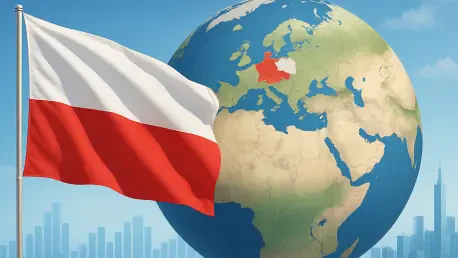

Priya Jaiswal is a globally recognized authority in banking, business, and finance, known for her sharp market analysis and deep understanding of international development. With a career spanning portfolio management and global trade trends, she has become a leading voice on how emerging economies transition into powerhouses. Today, we discuss the remarkable ascent of Poland, a nation that has moved from post-communist ruins to becoming the world’s 20th largest economy with an annual output exceeding $1 trillion. Our conversation explores the institutional reforms that bypassed the “oligarch trap,” the strategic pivot of local manufacturers into green tech, and the “reverse brain drain” bringing high-tech talent back to Warsaw and Poznan. We also address the demographic hurdles and infrastructure needs that will define the next chapter of this European growth champion.
Poland’s per capita GDP has climbed from roughly one-third of the European average in 1990 to nearly 85% today. What specific institutional reforms prevented the rise of oligarchs during this transition, and how did these legal frameworks ensure credit remained available for emerging businesses?
The avoidance of the “oligarch trap” was not an accident but the result of a deliberate, aggressive implementation of a strong institutional framework. Unlike some of its neighbors, Poland prioritized the creation of independent courts and a robust anti-monopoly agency to ensure that the “rules of the game” were fair for everyone, not just those with political connections. This was paired with very stringent banking regulations that prevented the financial sector from being drained by corrupt actors, ensuring that credit remained accessible to legitimate small and medium enterprises. You can see the success of these reforms in the numbers; per capita GDP skyrocketed from a mere $6,730 in 1990 to an impressive $55,340 by 2025. By effectively “downloading” the legal and cultural norms of the West, Poland created a transparent environment where entrepreneurship could flourish without being choked off by systemic corruption.
Some domestic manufacturers gained a significant European market share by pivoting to electric vehicle technology long before larger competitors. How do local entrepreneurs manage the financial risks of such early adoption, and what role did access to the EU’s single market play in scaling these specialized operations?
Local entrepreneurs in Poland have a unique history of operating in “enclaves of private entrepreneurship,” dating back to the car repair shops of the communist era where they learned to be incredibly resourceful. A prime example is Solaris, which took a massive gamble in 2011 by producing electric buses at a time when Western giants were hesitant to move away from traditional engines. These entrepreneurs managed risk by being more agile than their larger competitors, who had far more to lose if the technology failed to gain immediate traction. Joining the EU in 2004 was the true catalyst, as it provided the credibility and the massive, borderless market needed to scale these operations. Today, the success of such risks is evident, with Polish firms capturing nearly 15% of the European electric bus market by leveraging the free movement of goods and services.
A high percentage of the younger population now holds university degrees, yet labor costs remain significantly lower than in neighboring Germany. How does this combination influence foreign investment decisions, and what steps are necessary for the workforce to move from manufacturing parts to leading high-end innovation?
The fact that roughly half of young Poles now hold university degrees creates what economists call an “unbeatable combination” for international investors. You have a workforce that is often better educated than their German counterparts but can be hired for significantly lower wages, making Poland an ideal destination for sophisticated engineering and IT hubs. However, to move from being a “supplier of spare parts” to a global leader in high-end innovation, there must be a shift toward investing heavily in domestic R&D and higher education. We are currently seeing the “third wave” of development where the focus is no longer just on hosting foreign factories, but on fostering homegrown technological progress. This requires a sustained commitment from both the government and the private sector to fund laboratories and specialized university programs that can compete on a global scale.
Highly skilled professionals are increasingly leaving roles at global tech giants to return home for projects involving artificial intelligence and quantum computing. What unique sense of mission drives this reverse brain drain, and how are local supercomputing centers integrating these technologies into the broader economy?
There is a palpable “sense of mission” among returning professionals who feel they can have a more direct impact on their country’s future than they could at a massive corporation like Microsoft or Google. Engineers are returning to work on cutting-edge projects, such as the AI factory and quantum computer being developed at the Poznan Supercomputing and Networking Center. This facility is one of only ten on the continent being integrated with EU-financed quantum technology, signaling that Poland is no longer just catching up but is actually ahead in certain digital sectors. These centers act as hubs, integrating advanced computing into the broader economy by providing the infrastructure for local startups and traditional industries to optimize their operations. It’s an emotional home-coming for many who see the rapid 3.8% annual growth since 2004 as a sign that the most exciting career opportunities are now located in Warsaw or Poznan rather than Silicon Valley.
Despite rapid growth, challenges like a shrinking workforce and a low birth rate threaten long-term stability. How can the economy adapt to support a rising number of retirees, and what practical steps must be taken to address housing affordability and urban-rural inequality for the next generation?
To support an aging population, Poland must lean into its role as a high-value, high-tech economy where increased productivity compensates for a smaller number of workers. Practical steps include a wider social acceptance of the role immigrants play, such as the millions of Ukrainians who have already integrated into the workforce and are contributing to the nation’s GDP. On the domestic front, the government must tackle the “housing gap” to ensure that young families can afford to stay in urban centers where the best jobs are located. Reducing urban-rural inequality is also essential; we cannot have a two-speed economy where the cities thrive while the countryside stagnates. By investing in regional infrastructure and ensuring that the “ladder of added value” is accessible to everyone, Poland can maintain its social cohesion even as the demographic profile shifts.
What is your forecast for Poland’s economy?
I expect Poland to solidify its position as a top-tier global economy, likely climbing even higher than its current 20th-place ranking as it fully matures into a high-tech hub. While the era of “easy growth” based on low labor costs is ending, the country is successfully transitioning into a leader in AI, green energy, and advanced manufacturing. If the nation continues to prioritize innovation and successfully integrates its immigrant population to offset demographic declines, we will see Poland becoming a primary driver of European growth for the next two decades. The “Polish Miracle” is far from over; it is simply entering a more sophisticated and influential phase. The momentum created by three decades of consistent reform suggests that Poland will soon be an indispensable member of the G20, regardless of the formal title.