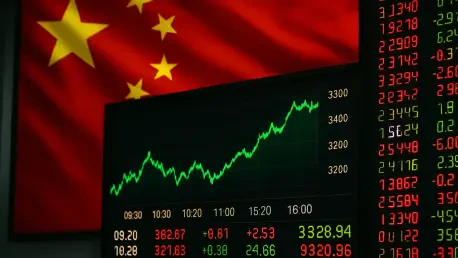

After a prolonged period of being deemed “uninvestable” by a significant portion of the global investment community, China’s stock market is staging a formidable comeback, fueled by a powerful combination of decisive government intervention and significant domestic advancements in artificial intelligence. The narrative of deep-seated pessimism is giving way to one of cautious optimism, as the MSCI China index’s recent surge suggests this is not a temporary rally but the dawn of a sustained, multi-year “slow bull” market. This profound reversal in market performance and investor sentiment is being driven by fundamental shifts in capital flows, economic strategy, and corporate behavior, signaling that a pivotal moment has arrived for Chinese equities on the world stage.
A Confluence of Policy and Capital
A primary engine behind the market’s resurgence is a significant shift in domestic capital allocation, as Chinese households, renowned for their high savings rates, have begun to channel their vast financial resources away from traditional bank deposits and into the equity market. This migration of capital is not accidental but is being actively encouraged by deliberate monetary policy, particularly interest rate cuts that have successfully diminished the appeal of holding cash in savings accounts. This trend is further corroborated by macroeconomic indicators, such as the narrowing growth differential between M1 (liquid cash) and M2 (M1 plus savings deposits), which historically signals a turn towards investment and consumption. This domestic capital rotation is a powerful reflection of recovering confidence among local investors, who are now providing the foundational support for a more robust and resilient market.
This wave of domestic investment is powerfully complemented by direct and unwavering government support, which has become a crucial pillar of the market’s stability. State-affiliated funds have consistently intervened during periods of market weakness, strategically purchasing shares to establish a firm floor under prices and broadcast an unambiguous official commitment to a healthy market. This reliable policy backstop is creating a fertile environment for growth, especially as corporate earnings momentum begins to improve in tandem with a brightening broader economic outlook. Consequently, Chinese equities are now better positioned to close the performance gap with other major global markets, compelling international investors who are currently “underweight” on China to reconsider their allocations and diversify into a market that is entering what could be a distinctly favorable period.
The Anti-Involution Revolution
For years, a deep-seated structural issue known as “involution” has constrained the Chinese economy, creating a vicious cycle of excessive industrial capacity where companies produce far more than the market can absorb. This chronic oversupply, particularly rampant in sectors such as solar energy, batteries, and chemicals, has historically triggered intense price wars, fueling persistent deflationary pressures and severely suppressing corporate profitability. Research has shown that this dynamic is a key reason why corporate earnings growth has lagged behind nominal GDP growth, trapping many industries in a race to the bottom that erodes value. This long-standing challenge has been a major deterrent for investors, but it is now at the center of a new, transformative economic strategy aimed at breaking the cycle for good.
In response to this challenge, Chinese policymakers have launched what is being termed the “Anti-Involution Revolution,” marking a strategic pivot away from a model of “growth at all costs” towards a more sustainable approach centered on quality, efficiency, and return on investment. This new phase of “supply-side reform” actively encourages companies in over-leveraged sectors to cull excess supply, rationalize production, and focus on innovation rather than volume. The ultimate goal is to restore pricing power, improve profit margins, and reverse the deflationary trend that has hampered the economy. From an investment perspective, this presents a compelling opportunity, as many of the cyclical sectors targeted by these reforms are still valued cheaply by the market. As these anti-involution efforts gain traction, these companies are poised for a significant re-rating.
Forging the Basket of Tomorrow
China’s strategic imperative for technological self-reliance has firmly positioned artificial intelligence at the heart of its national economic blueprint, sparking a new wave of innovation and investment. In a notable departure from the proprietary, “closed source” models favored by Western tech giants, Chinese AI firms have largely embraced an “open source” strategy. By making their underlying code widely available, they aim to accelerate development through collaboration, foster a vibrant ecosystem, and hasten the global adoption of their technologies. This approach is proving highly effective, with recent data indicating that Chinese firms now power a substantial portion of all global open-source AI usage. This rapid ascent establishes the nation not merely as a participant but as a formidable force in producing globally competitive AI models that are reshaping industries.
This technological ascendancy is profoundly reshaping China’s capital markets and creating a new frontier for investors. The beneficiaries of the nation’s AI push extend far beyond traditional semiconductor manufacturers to encompass a diverse and exciting “basket of tomorrow.” This new cohort includes innovative companies focused on real-world applications such as autonomous driving, intelligent security, and humanoid robotics, with projections suggesting the market for embodied AI robots alone could reach immense valuations by 2030. The rally in this space is being powered not by the established internet giants, but by newer, more agile companies focused on “hard” technology. With China’s AI-related capital expenditure projected to reach hundreds of billions of dollars over the next several years, this emerging theme offers substantial and durable long-term growth potential for discerning investors.
A New Era of Shareholder Returns
A crucial and welcome evolution in China’s corporate landscape is the rising emphasis on “shareholder return,” marking a significant shift in governance and capital allocation priorities. Chinese regulators are now actively encouraging cash-rich companies, especially mature state-owned enterprises, to return more of their “lazy” capital—unused cash sitting idly on balance sheets—to investors through a combination of increased dividends and share buybacks. This development is an integral part of China’s broader economic transition, moving away from a singular focus on the velocity of growth toward an appreciation for the quality and sustainability of that growth. For many established industry leaders, the era of rapid market-share acquisition is concluding, compelling them to offer a competitive “total return” that combines capital appreciation with tangible cash returns to maintain investor loyalty.
This emerging “culture shift” toward prioritizing shareholder value is being reinforced by the prevailing macroeconomic environment. As policymakers have worked to suppress financing costs to stimulate the economy, Chinese bond yields have fallen significantly. This has created an advantageous situation where the dividend yields of many blue-chip stocks are now considerably more attractive than the yields available on investment-grade corporate bonds, naturally steering income-seeking investors towards high-dividend equities. Evidence of this multi-year narrative is already apparent in the meaningful increase in payout ratios and buyback activity among Chinese state-owned enterprises. Furthermore, this trend is expanding beyond the “old economy” to include maturing “new economy” technology companies, as exemplified by Baidu’s decision to initiate its first-ever dividend payment, a landmark event signaling a profound and positive evolution in corporate mindset.
Navigating the Path Forward
Despite the overwhelmingly positive outlook, a note of caution was warranted as the market navigated its recovery. The dynamism that propelled the rebound also carried a propensity for overheating, and extreme optimism could have driven share prices up too quickly, creating a speculative bubble, particularly in a market with high retail participation. Regulators historically demonstrated a willingness to intervene to curb excessive speculation, making a steady, “slow bull” market a more probable scenario than a euphoric and unsustainable run-up. Persistent risks, primarily centered on the struggling property market, were also acknowledged. While the sector had yet to find a definitive bottom, the policy direction was viewed as corrective and gradual, with a clear intention to avoid a massive stimulus that could reinflate the bubble. Instead, the focus remained on a structural rebalancing of the economy toward sustainable, technology-led growth, a strategy that ultimately proved to be a constructive long-term foundation for the market’s performance.