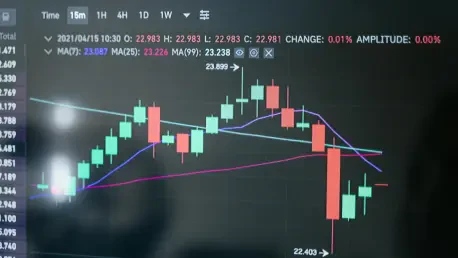

A brutal eight-day period of intense market volatility culminating on February 5, 2026, has sent shockwaves through the digital asset space, wiping out billions in value and forcing a dramatic reset in market dynamics. The rapid price correction for major cryptocurrencies was profoundly amplified by a cascade of forced selling, a direct consequence of overleveraged trading strategies. This event not only reshaped the technical landscape for assets like Bitcoin and Ethereum but also triggered a significant shift in market sentiment and institutional behavior, serving as a stark reminder of the inherent risks that define the cryptocurrency market. The fallout has left traders and investors to navigate a landscape marked by fear, uncertainty, and the search for a stable floor after one of the most significant deleveraging events in recent memory.
The Anatomy of a Market Collapse
The core of the market downturn was the precipitous decline of its two leading assets. Bitcoin experienced a staggering $20,000 drop in value, plummeting from a high of $90,000 to a low of $70,000, representing a severe 23% decrease over the eight-day window. Ethereum’s fall was even more pronounced in percentage terms, as it shed nearly $1,000 of its value, crashing from $3,050 to $2,070 in a painful 32% loss. This violent price action was the catalyst for a massive deleveraging event that resulted in over $7 billion in liquidations. These were not voluntary sales but forced closures of both long and short leveraged positions, catching traders on both sides of the market completely off guard. This highlights a critical dynamic: the crash was not merely a reaction to selling pressure but was intensely magnified by the forced unwinding of derivatives, which accelerated the downward price spiral.
The sheer scale of the deleveraging event underscores the systemic risk posed by excessive leverage within the cryptocurrency derivatives market. When prices began their descent, initial liquidations of long positions added more selling pressure, driving prices down further. This, in turn, triggered more liquidations in a self-reinforcing cycle, often referred to as a liquidation cascade. The $7 billion figure represents the total value of positions that were automatically closed by exchanges because traders could no longer meet the margin requirements for their bets. This mechanism, designed to protect exchanges, becomes a powerful accelerator during periods of high volatility. The event served as a harsh lesson for market participants, demonstrating how quickly gains can be erased and how leveraged bets can turn a standard market correction into a catastrophic collapse, wiping out capital across the ecosystem.
Technical Levels and On-Chain Revelations
From a trading perspective, the crash carved out a new and uncertain technical landscape. For Bitcoin, the psychological support level at $75,000 was decisively breached, with the price subsequently finding a tenuous footing at the $70,000 mark. The ability of this level to hold will be a critical factor in determining the market’s short-term trajectory. A failure to maintain this support could open the door to further downside. For Ethereum, the situation is similarly precarious. The crash pushed its price well below key moving averages, with its 50-day Exponential Moving Average at approximately $2,800 now transforming from a floor of support into a formidable ceiling of resistance. Should selling pressure resume, technical analysts identify the next major support zone for ETH near the $1,900 level, indicating significant potential for further decline if bearish momentum continues.
Synthesizing the price action with on-chain data provides a more complete picture of the market’s internal dynamics during the turmoil. A notable on-chain metric was the massive spike in trading volume, with daily volumes exceeding 500,000 BTC across major exchanges, signaling a period of intense capitulation and panic selling. Concurrently, data revealed a surge in large whale transactions, with wallets holding significant amounts of Bitcoin moving over 100,000 BTC onto exchanges. This activity is often interpreted in two ways: it could represent final capitulation from long-term holders finally selling their positions, or it could be strategic accumulation by sophisticated entities positioning for a market bottom. Furthermore, the weakening of the ETH/BTC ratio to 0.029 provides an objective measure of Ethereum’s significant underperformance relative to Bitcoin, showing that investors fled to the relative safety of the market leader during the crisis.
Shifting Tides in Sentiment and Strategy
The dramatic price declines precipitated an equally dramatic collapse in market sentiment. The Fear and Greed Index, a widely followed gauge of investor emotion, plummeted to a reading of 25 out of 100, a level that signifies a state of “extreme fear” among market participants. This negative sentiment was not confined to retail traders but was mirrored in the institutional space, where a clear trend of risk-off behavior emerged. Reports from financial analysts indicated that hedge funds were actively reducing their exposure to the volatile crypto market. This anecdotal evidence was substantiated by hard data showing significant outflows from Bitcoin Exchange-Traded Funds (ETFs), which bled over $2 billion in the week preceding February 5. This coordinated retreat by both retail and institutional capital created a powerful headwind that made any attempt at a price recovery difficult.
An overarching trend underscored by the crash is the growing correlation between the cryptocurrency market and traditional financial markets. During the same period as the crypto collapse, the S&P 500 experienced a notable 5% dip, suggesting that digital assets are increasingly viewed and traded as high-beta risk assets that are sensitive to broader macroeconomic factors. This tightening linkage presents new challenges and opportunities. For institutional investors, it means that crypto can no longer be viewed in a vacuum and must be integrated into a broader risk management framework. For sophisticated traders, this cross-market relationship offers new analytical tools; for instance, monitoring indicators like Nasdaq futures may provide leading signals for a potential recovery in Bitcoin’s price, as institutional capital flows are often coordinated across different asset classes.
An Uncertain Path Forward
The market crash left a landscape defined by heightened volatility and strategic re-evaluation. For traders navigating the aftermath, the primary recommendation from analysts revolved around disciplined risk management, a lesson harshly reinforced by the $7 billion liquidation event. The significant widening of volatility indicators, such as the Bollinger Bands for the BTC/USD pair, signaled the potential for continued sharp price movements in either direction, making the rigorous use of stop-loss orders essential to prevent catastrophic losses. For long-term investors, the downturn was perceived by some as an opportunity for dollar-cost averaging, allowing for the accumulation of assets at substantially lower prices. This period of extreme fear often precedes market bottoms, though timing such a recovery is notoriously difficult.
Despite the widespread losses, the analysis identified pockets of relative strength and potential opportunities for capital rotation. For instance, Solana (SOL) declined by only 20% compared to Ethereum’s 32%, suggesting a possible shift in investor focus toward alternative high-performance blockchain networks. In the DeFi sector, although the Total Value Locked (TVL) dropped by 15%, its subsequent stabilization hinted that a bottom might be forming. Looking ahead, the market remained on a knife’s edge. A potential rebound could have been catalyzed by favorable macroeconomic developments, but the persistent risk of another liquidation wave loomed large. A breach of the $70,000 support for Bitcoin could have triggered another cascade, pushing its price toward the next major support level of $65,000. Navigating this environment required a diversified and cautious approach.