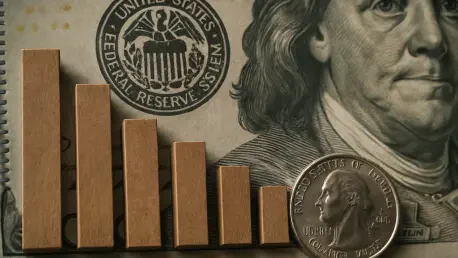

In a move that reverberated through financial markets, the Federal Reserve has once again adjusted its monetary policy, enacting a 25-basis-point reduction in its benchmark interest rate, which sets the new federal funds target range between 3.50% and 3.75%. This decision, the third such cut this year, was widely anticipated by economists and investors who have been closely monitoring signs of a slowing economy. However, the apparent consensus in the markets belied a significant division within the Federal Open Market Committee itself. The 9-3 vote to lower rates revealed a fractured committee grappling with conflicting economic signals, underscoring the profound uncertainty surrounding the nation’s economic trajectory. This internal disagreement highlights the central challenge facing policymakers: navigating the narrow path between stimulating a cooling labor market and re-igniting persistent inflationary pressures, a dilemma that will define the economic landscape for the foreseeable future.
Decoding the Rationale and Internal Rifts
The Federal Reserve’s official statement accompanying the rate cut paints a picture of an institution performing a delicate balancing act, carefully weighing its dual mandates of achieving maximum employment and maintaining price stability. While the committee acknowledged that overall economic activity is still expanding at a “moderate pace,” it pointed to increasingly clear evidence of a cooling labor market as a primary motivator for its action. Recent data shows that job gains have been slowing, and the unemployment rate has ticked upward, signaling potential weakness. This softening in the labor market was judged to have increased the “downside risks to employment,” prompting the preemptive rate cut. Compounding the complexity of the decision is the concurrent observation that inflation “remains somewhat elevated.” This presents a classic policy conundrum: the tools used to support employment, such as lower interest rates, can simultaneously risk aggravating inflation, forcing the Fed to make a difficult judgment call on which risk is more immediate and severe.
This complex economic backdrop fueled a notable level of dissent among the voting members of the committee, exposing three distinct perspectives on the appropriate course for monetary policy. The majority sided with a modest 25-basis-point cut, but the split vote was telling. On one side, committee member Stephen I. Miran argued for a more aggressive approach, advocating for a larger 50-basis-point reduction. His position was rooted in a belief that the weakness in the labor market required a more forceful response to prevent a more significant downturn. In stark contrast, two other members, Austan D. Goolsbee and Jeffrey R. Schmid, voted against any cut at all. Their preference to hold rates steady stemmed from concerns that further easing of monetary policy could undermine the fight against inflation, which has yet to return to the Fed’s long-term target. This three-way split illustrates that even among the nation’s top economic experts, there is no clear agreement on how to interpret the current data or what policy path will best serve the economy’s long-term health.
Charting the Uncertain Path Forward
In its communications following the decision, the Federal Reserve appears to be signaling a transition into a holding pattern, suggesting a potential pause in rate adjustments for the near future. Analysis from economist Tiffany Wilding of PIMCO suggests that the committee now views its policy stance as “neutral,” meaning it is neither stimulating nor restricting economic growth. This interpretation implies that Chair Jay Powell may be aiming to keep rates on hold for the remainder of his term, which is set to conclude in 2026, providing a period of stability and observation. However, this pause is highly conditional and entirely dependent on incoming economic data. The consensus among analysts is that the Fed remains poised to act decisively with further rate cuts if the labor market continues to show signs of deterioration into early 2026. This data-dependent approach means that while the immediate intention may be to hold steady, the door remains wide open for additional easing if economic conditions warrant it, keeping markets on high alert for every new employment report and inflation reading.
The central bank’s recent policy adjustment ultimately ushered in a new phase of economic uncertainty, with its future direction hinging on both evolving data and potential shifts in leadership. Despite the Fed’s signaling of a pause, rising unemployment figures had already revived market speculation for another quarter-point cut in December, a sentiment echoed by Sam Williamson, a senior economist at First American. Looking further ahead, the long-term trajectory for interest rates became even more ambiguous with discussions surrounding the next Fed chair. Kevin Hassett, rumored to be a leading candidate for the position, publicly indicated a more dovish stance than the current leadership. He stated his belief that there was “plenty of room” for rate cuts beyond the standard incremental adjustments, suggesting a potential pivot toward a more aggressive easing cycle in 2026. This confluence of a fragile labor market, persistent inflation, and the prospect of a leadership change with a different policy philosophy left the economic outlook decidedly unsettled. The Fed’s latest move, therefore, was less a final resolution and more the beginning of a complex new chapter in its ongoing effort to steward the economy.