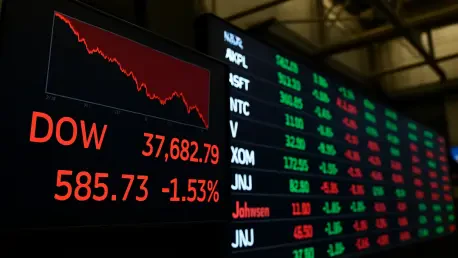

The U.S. stock market has entered the final stretch of 2025 in a state of quiet anticipation, with major indexes hovering near all-time highs while trading activity remains notably subdued during the holiday-shortened week. This period of calm belies an undercurrent of tension as investors weigh impressive year-to-date gains against emerging headwinds and the significant potential for a market-moving catalyst. With momentum appearing to stall, all eyes are turning to a single, pivotal event: the release of the Federal Reserve’s latest meeting minutes. This document is widely expected to provide critical clarity on the central bank’s monetary policy outlook, holding the power to either ignite a new phase of the ongoing rally or trigger a substantial pullback from current elevated valuations. The market finds itself at an inflection point where the next major move seems imminent, and the Fed’s words will almost certainly be the deciding factor in setting the tone for the beginning of the new year.
A Market at a Crossroads
Despite the strong performance that has characterized the market for much of the last two years, a palpable sense of caution has settled among investors, underscored by a notable slowdown in upward momentum. The Dow Jones Industrial Average, in particular, has faced significant pressure, largely hindered by a downturn in the high-flying artificial intelligence sector that has been a primary engine of growth. A recent 1.7% decline in the shares of industry leader Nvidia served as a stark warning sign for the broader tech sector, which has been instrumental in driving the market’s impressive rally through 2023 and 2024. Compounding this challenge is the characteristically low trading volume seen during the holiday season, which has made it more difficult for the major indexes to sustain their upward trajectory. This environment of stalled progress suggests that while the foundation of the rally remains, its continuation is far from guaranteed and is increasingly dependent on fresh, positive catalysts to overcome emergent pockets of weakness in key growth areas.
The broader market landscape presents a picture of robust success, with the Dow up over 14% for the year and the S&P 500 showing an even more impressive gain of nearly 17.5%, placing it tantalizingly close to a new record. However, this strength is juxtaposed with a growing need for prudence among market participants. The CBOE Volatility Index (VIX), often referred to as the market’s “fear gauge,” is currently lingering near a low of 14, a level that can indicate complacency but also presents a unique strategic window. With volatility so low, the cost of options is relatively inexpensive, creating an opportune moment for investors to secure protection for the substantial gains they have accumulated. This has led to a strategic pivot where the focus shifts from chasing further gains to safeguarding existing profits. The prevailing wisdom suggests that while the market is in a strong position, the potential for a sudden shift in sentiment requires a more defensive posture heading into the new year, especially with a key Federal Reserve announcement on the horizon.
The Federal Reserve’s Decisive Role
In a week largely devoid of major economic data releases, the upcoming publication of the Federal Reserve’s meeting minutes has become the undisputed focal point for investors, poised to act as the primary catalyst for the market’s next significant move. This report is expected to offer an invaluable glimpse into the central bank’s internal deliberations and its collective thinking on the future path of monetary policy. Investors are parsing every word for signals that might confirm or contradict the Fed’s current “dot plot,” which projects a cautious path forward with two quarter-point interest rate cuts over the next two years. A more dovish tone, suggesting a greater willingness to ease policy sooner than anticipated, could provide the fuel needed to propel the market to new highs. Conversely, any indication of a more hawkish, patient stance—emphasizing a continued fight against inflation—could easily trigger a sharp sell-off, as high-flying stocks are particularly vulnerable to a higher-for-longer interest rate environment.
Given the market’s elevated position and the uncertainty surrounding the Fed’s next move, the implementation of protective strategies became a critical consideration for informed investors. The low-volatility environment presented a cost-effective opportunity to hedge against potential downside risks without sacrificing significant upside potential. Strategic investors considered a range of options to safeguard their portfolios, which had benefited immensely from the sustained rally. This included the acquisition of put options on tech-heavy indexes to shield against a correction led by the sector that had driven so much of the market’s gains. Furthermore, the use of cost-effective put spreads on major indices like the S&P 500 offered a precise way to insure portfolios against a hawkish surprise from the Federal Reserve or the continuation of weakness in key growth sectors. These measures were not a prediction of a downturn but a prudent acknowledgment of the risks inherent in a market awaiting its next major directive.