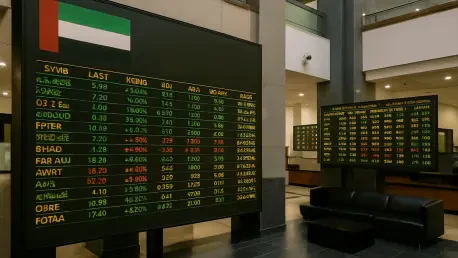

The recent reopening of the Dubai Financial Market and the Abu Dhabi Securities Exchange following a strategic two-day suspension highlights the extreme sensitivity of regional equities to global friction. On Wednesday, March 4, 2026, investors returned to a landscape fundamentally altered by escalating tensions involving major international powers, triggering an immediate and sharp downward adjustment across both indices. This suspension, mandated by regional regulators, was not an admission of market weakness but rather a calculated move to provide participants with sufficient time to evaluate a rapidly shifting geopolitical environment. By the time trading resumed, the accumulated pressure of several days of global volatility and regional uncertainty had to be integrated into valuations within a single session. Experts have framed this subsequent movement as a necessary and orderly process of price discovery, ensuring that local equity prices accurately reflect the new risk premiums associated with the current diplomatic climate.
Quantitative Corrections and Market Resilience
The Dubai Financial Market General Index experienced the most significant brunt of the initial selling pressure, closing its first post-suspension session with a 4.7% loss. This contraction represents the index’s most substantial single-day decline in years, reflecting a concentrated effort by institutional and retail investors to de-risk their portfolios simultaneously. In the capital, the FTSE ADX General Index followed a similar trajectory, though it exhibited a slightly more tempered downward momentum by closing 2% lower. While the intraday data showed the ADX plummeting by as much as 3.6% at its lowest point, the fact that it clawed back a portion of those losses before the closing bell suggests that buyers were willing to step in once specific valuation thresholds were met. This synchronized decline illustrates the “catch-up” effect inherent in modern financial systems when exchanges are forced to pause during period-defining news cycles, condensing a backlog of sentiment shifts into a high-intensity trading window.
The two-day hiatus acted as a psychological pressure cooker for the investment community, as global developments continued to unfold while local platforms remained inaccessible. Consequently, the reopening was characterized by a surge in volume as traders rushed to execute orders that had been building up during the weekend and the subsequent suspension. Financial analysts emphasize that this rapid repricing is a hallmark of an efficient market responding to external shocks rather than a sign of internal systemic failure. By allowing the markets to reset in a controlled environment, regulators prevented the kind of cascading panic that often accompanies unmanaged volatility. The orderly nature of the selloff, despite its depth, indicates that the UAE’s financial infrastructure is capable of absorbing significant shocks without compromising the integrity of its settlement systems or liquidity pools. This resilience is a critical factor for international investors who prioritize market stability when navigating the complexities of emerging and frontier markets during times of crisis.
Sector Performance and Technical Support Levels
The breadth of the selloff was evident as nearly every major sector faced downward pressure, yet the impact was most pronounced within the foundational pillars of the UAE economy. Real estate giants and major banking institutions, which serve as primary proxies for domestic economic health, frequently hit the “lower price limit” of 5% during the session. These limits are specifically designed by the exchanges to act as circuit breakers, preventing uncontrolled freefalls and allowing for a moment of reflection before further trading occurs. For companies like Emaar Properties and Emirates NBD, the decline was a direct reflection of a more cautious outlook on future demand and higher risk premiums. The logistics and utilities sectors, including entities such as DEWA and Aramex, also saw valuations drift lower as the market braced for potential disruptions in regional trade routes and a possible slowdown in infrastructure expansion should the geopolitical instability persist for an extended period.
Despite the severity of these daily percentage drops, technical analysts have identified several “floor” levels that suggest the long-term structural integrity of the markets remains surprisingly intact. Both the DFM and the ADX managed to close the session above their respective 200-day Exponential Moving Averages, a benchmark used by institutional managers to distinguish between temporary corrections and the onset of a prolonged bear market. Specifically, the Dubai index stayed above the 6,010 level, while Abu Dhabi maintained its position above the 10,060 mark. These technical benchmarks are vital because they signal to the broader investment community that the current downturn is a localized reaction to an external shock rather than a fundamental breakdown of the national economic narrative. If the indices can successfully consolidate around these levels in the coming weeks, it would provide a strong foundation for a potential recovery once the immediate geopolitical “fog of war” begins to lift and sentiment stabilizes.
The Paradox of Energy Prices and Economic Fundamentals
Geopolitical volatility in the Middle East often presents a complex paradox for the UAE stock markets, particularly concerning the role of global energy prices. As tensions rise near the Strait of Hormuz—a maritime artery responsible for a significant portion of global oil transit—crude prices typically surge due to supply concerns. In a traditional economic sense, higher oil prices are a fiscal boon for the UAE, bolstering government reserves and providing the capital necessary for state-led diversification projects. However, the current market reaction shows that immediate geopolitical risk is currently outweighing the potential long-term benefits of increased energy revenues. Investors are prioritizing risk management and capital preservation over the fiscal upside, fearing that prolonged instability could dampen regional growth and increase operational costs for non-oil businesses. This tension between high commodity prices and equity valuation suggests that the market is currently in a state of hyper-sensitivity where political outcomes matter more than balance sheets.
In contrast to the prevailing market fear, the underlying economic fundamentals of the UAE have remained remarkably robust, creating a disconnect between equity prices and actual corporate performance. Recent data indicates that the non-oil private sector continues to expand at its fastest rate in a year, driven by strong domestic demand and a thriving services industry. Analysts from major financial institutions point out that corporate earnings across most listed firms have been consistently strong, and the national property market continues to enjoy sustained momentum. This suggests that the current selloff is almost entirely driven by “sentiment” and “short-term anxiety” rather than a deterioration in the quality of the assets themselves. For those taking a longer view, this discrepancy between a company’s fundamental value and its current stock price represents a potential opportunity, provided that the geopolitical situation does not escalate into a conflict that physically disrupts the UAE’s commercial infrastructure or its status as a global logistics hub.
Strategic Outlook and Institutional Considerations
Moving forward, the primary focus for market participants will shift from the immediate shock of the reopening to the long-term stabilization of trading volumes and liquidity. The first few sessions following a major trading halt are rarely indicative of a definitive trend, as they are primarily occupied with clearing a backlog of orders and finding an equilibrium price that satisfies both buyers and sellers. As the dust settles, investors will be closely monitoring liquidity conditions to ensure that the market remains deep enough to facilitate large trades without causing excessive price slippage. Furthermore, the safety of maritime shipping routes remains a critical variable, as any prolonged threat to regional trade would have a direct impact on the logistics and energy sectors. Global equity trends in the United States and Europe will also play a role, as the UAE markets do not operate in a vacuum and are increasingly influenced by the risk appetite of international asset managers who view the Gulf as a key component of their emerging market allocations.
The regulatory response to the recent volatility has demonstrated that the UAE’s financial infrastructure is well-equipped to handle periods of extreme stress through the use of strategic pauses and price limits. By preventing a chaotic reaction through the two-day suspension, authorities allowed for a more measured integration of global news, which likely saved the market from a much deeper, panic-driven collapse. For disciplined investors, the current environment serves as a rigorous stress test of the market’s structural integrity and its ability to decouple from purely emotional trading. Looking ahead, the focus must remain on the interplay between short-term geopolitical anxiety and the enduring strength of the UAE’s non-oil economy, which has proven its resilience during previous cycles of instability. The ability of the exchanges to maintain key technical support levels suggests that the market is already looking toward a period of consolidation, paving the way for a recovery once the geopolitical landscape becomes a more predictable and known quantity.