
A stark divergence characterized the U.S. financial markets on Tuesday, where a broad sell-off in the technology sector sent major stock indices tumbling while precious metals mounted a powerful recovery from recent lows. This split narrative underscored a complex and uncertain market environment, with investors weighing concerns over elevated corporate valuations and future earnings potential against a backdrop of shifting macroeconomic signals. The day’s activity revealed a clear rotation of capital, as market participants moved away from high-growth tech names and sought refuge in traditional safe-haven assets, highlighting a growing sense of caution that has begun to permeate Wall Street. This dynamic was further complicated by a series of company-specific news events that created significant winners and losers, adding another layer of volatility to an already jittery trading session and leaving investors to ponder whether this was a momentary correction or the beginning of a more significant market shift.
Technology Giants Lead a Market Retreat
The technology sector served as the primary catalyst for the market’s decline, as its influential large-cap stocks exerted considerable downward pressure on the overall indices. The tech-heavy Nasdaq composite experienced the most significant drop, falling a substantial 1.4%, while the broader S&P 500 shed 0.8%, marking its fourth loss in the last five trading sessions and pulling it further away from its recent all-time high. The Dow Jones Industrial Average saw a more moderate decline of 0.3%. Fueling this negative sentiment was a growing apprehension among investors that the stock prices of leading technology firms had become excessively inflated following a prolonged period of market dominance. This concern was reflected in the performance of industry titans like Nvidia and Microsoft, which saw their shares fall by 2.8% and 2.9%, respectively. The sell-off was not confined to these giants, extending to software companies and other firms perceived as vulnerable to competition from emerging artificial intelligence technologies.
An interesting trend highlighted by the day’s trading was the market’s disproportionate reliance on a small number of mega-cap stocks for its overall direction. Despite the S&P 500’s headline decline, the majority of the individual stocks within the index actually posted gains, indicating that the negative performance of a few highly valued companies was sufficient to drag the entire index lower. This dynamic was exemplified by the performance of companies like ServiceNow, which slumped 7%, contributing to a significant year-to-date loss of 28.3%. However, not all technology-related companies suffered from the downturn. Palantir Technologies offered a compelling counter-narrative to the prevailing gloom, with its stock soaring an impressive 6.8%. The data analytics firm’s surge was driven by a quarterly profit report that surpassed analyst expectations and a robust forecast for 61% revenue growth in the upcoming year, demonstrating that strong fundamentals could still attract investor interest even in a challenging sector environment.
Commodities Shine as Safe Havens Recover
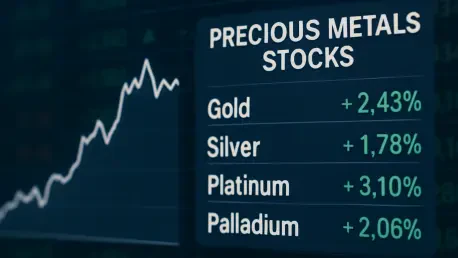
In stark contrast to the weakness observed on Wall Street, the commodities market witnessed a vigorous and decisive recovery in precious metals. Gold and silver prices, which had experienced a sudden and dramatic reversal in the prior week, bounced back strongly from their recent lows. Gold’s price climbed a notable 6.1% to settle at $4,935.00 per ounce, reclaiming significant ground. Silver, which had been subjected to even more extreme volatility, rallied by an impressive 8.2%. This powerful rebound followed a period of intense selling pressure that saw gold prices plummet from a peak near $5,600 to below $4,500, while silver plunged by a staggering 31.4% in a single day. The preceding rally in metals, which had been sustained for over a year, was fueled by persistent investor demand for safe-haven assets amid a landscape of global economic anxieties, including ongoing trade tariffs, a weakening U.S. dollar, and high levels of government debt.
Market analysts offered several compelling explanations for the recent turbulence that has whipsawed the precious metals market. Many traders believe the initial, sharp sell-off was triggered by rising expectations that the Federal Reserve would maintain high interest rates for an extended period to combat persistent inflation, a move that typically makes non-yielding assets like gold less attractive. Others contend that after such a rapid and significant price appreciation over the past year, a substantial correction was simply inevitable, as the fundamental force of “simple gravity” took hold in the market. This viewpoint is supported by strategists from Barclays, who noted in a recent report that market positioning against the U.S. dollar had become overly extended, making a pullback in correlated assets like gold and silver not just possible, but highly likely. The subsequent rebound suggests that underlying demand for these assets remains strong despite the recent bout of volatility.
Individual Stocks React to Corporate Developments
The day’s corporate news cycle produced several significant stock movements, with individual companies experiencing dramatic swings based on their latest earnings reports and strategic announcements. PayPal endured a particularly rough session, with its shares plummeting a staggering 20.3% after the payments company delivered weaker-than-expected quarterly results and simultaneously announced a major change in leadership. The company’s board cited profound dissatisfaction with the “pace of change and execution” over the past two years as the primary reason for appointing a new CEO, a move that clearly unsettled investors and amplified concerns about its future growth trajectory. In the pharmaceutical sector, Pfizer’s shares fell 3.3% in a mixed reaction to its earnings. While the company’s latest quarterly profit exceeded Wall Street’s expectations, its long-term profit forecast for 2026 came in below what analysts had anticipated, casting a shadow over its future prospects.
On the positive side of the corporate ledger, several companies delivered news that sent their stocks soaring. Consumer goods giant PepsiCo rose 4.9% after its quarterly profit and revenue figures managed to narrowly beat analyst forecasts. The company also announced strategic price cuts for popular snack brands like Lay’s and Doritos, a move aimed at attracting inflation-conscious consumers and maintaining market share in a challenging economic environment. DaVita, a provider of dialysis services, emerged as another one of the day’s major gainers. The company’s stock rallied an impressive 21.2% after it reported a quarterly profit that was significantly stronger than expected, signaling robust operational performance. Meanwhile, in the banking sector, merger and acquisition activity drove volatility, as the U.S.-traded shares of Spain’s Banco Santander declined by 6.4% following its announcement of a $12.3 billion cash-and-stock acquisition of Webster Financial. Conversely, Webster Bank’s parent company rallied 9% on the news of the deal.
A Divergent Close in a Shifting Global Landscape
The day’s trading ultimately concluded with a clear victory for the bears on Wall Street, reflecting the weight of the technology sector’s decline. The S&P 500 finished down 58.63 points at 6,917.81, while the Dow Jones Industrial Average closed at 49,240.99, down 166.67 points. The tech-heavy Nasdaq composite bore the brunt of the losses, ending the session at 23,255.19, a loss of 336.92 points. In the bond market, there was a slight easing of yields, as the 10-year Treasury yield moved down to 4.26%, suggesting a modest flight to the safety of government debt. The day’s events highlighted a market grappling with a significant rotation, where past leaders faced scrutiny over their high valuations, and traditional havens like precious metals found renewed appeal. This divergence suggested that investors were actively reassessing risk and recalibrating their portfolios in response to a complex mix of corporate performance and macroeconomic uncertainty.
International stock markets presented a mixed but revealing picture of global investor sentiment. Asian markets rebounded sharply from the previous day’s losses in a powerful display of resilience. South Korea’s Kospi index surged an extraordinary 6.8%, marking its best single-day performance since early 2020. This impressive rally was driven largely by a powerful 11.4% surge in its heavyweight component, Samsung Electronics, and came just one day after the index had suffered its worst decline in nearly ten months. Other Asian markets also performed well, with Japan’s Nikkei 225 rallying 3.9% and markets in Shanghai and Hong Kong posting more modest gains. In stark contrast, European markets were far more subdued and ended the day on a flat note, with France’s CAC 40 edging down by less than 0.1%. This regional divergence underscored the varied economic pressures and investor outlooks influencing markets across the globe.