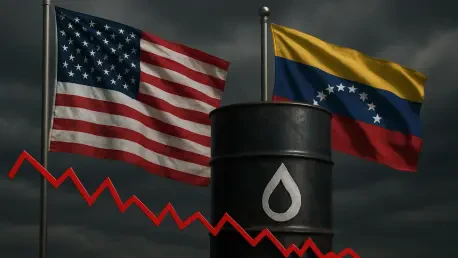

A presidential order for a naval blockade of all “sanctioned oil tankers” en route to Venezuela has sent a significant shockwave through global energy markets, abruptly reversing a downward trend in crude prices and injecting a fresh dose of geopolitical volatility into an already uncertain financial landscape. This decisive action, which came on the heels of a U.S. seizure of a Venezuelan tanker, triggered an immediate and sharp reaction. Oil prices surged by over 1%, with the U.S. benchmark West Texas Intermediate (WTI) crude climbing to $56.00 per barrel and the international benchmark Brent crude reaching $59.63. The sudden spike brought an end to a period where concerns about oversupply had driven crude to its lowest prices since 2021. The ripple effects were felt across the energy sector, inflicting heavy losses on major industry players such as APA Corporation, Marathon Petroleum, and Halliburton, whose stock values had been predicated on a different market reality. This sudden geopolitical flare-up now forces investors to recalibrate their expectations, balancing supply-side risks against ongoing economic concerns.
A Divergent Picture in Global Equities
This geopolitical development unfolded against a backdrop of deeply mixed performance in Asian equity markets, where technology shares emerged as a key driver of gains in an otherwise cautious trading environment. In South Korea, the Kospi index managed to advance by a solid 0.7%, a rally largely fueled by strong performances from semiconductor giant SK Hynix and the globally recognized tech behemoth Samsung Electronics. Similarly, Chinese markets registered modest increases, with both Hong Kong’s Hang Seng and the Shanghai Composite index ticking upward by 0.2%. However, this optimism was not universal across the region. In contrast, Tokyo’s Nikkei 225 index shed 0.3% as traders anxiously awaited an impending interest rate decision from the Bank of Japan. Compounding the bearish sentiment was a government report revealing a significant 6.8% decline in machinery orders, a critical indicator that signals weakening factory activity and potentially slower economic growth ahead. Australia’s S&P/ASX 200 also edged 0.2% lower, reflecting the broader sense of regional uncertainty and a more risk-averse investor posture.
In the United States, financial markets are grappling with a profound level of uncertainty, particularly concerning the future trajectory of interest rates, leading to a session of indecisive trading. U.S. stocks concluded the day with a mixed performance, as the broad-based S&P 500 and the blue-chip Dow Jones Industrial Average both registered declines, while the technology-heavy Nasdaq Composite managed to eke out a small gain. This market indecisiveness is a direct consequence of a series of contradictory economic reports that have painted a confusing picture of the nation’s economic health. For instance, while one report indicated that the U.S. unemployment rate had reached its most challenging level since 2021, another simultaneously revealed that employers had added a surprising number of jobs, exceeding analyst expectations. Adding another layer of complexity, fresh data on retail sales suggested an underlying strength in consumer spending, a pillar of the U.S. economy. Even the high-flying artificial-intelligence technology sector displayed mixed results, highlighting ongoing investor questions about the long-term profitability and valuation of AI-related investments.
The Federal Reserves Tightrope Walk
The conflicting economic data has created a challenging environment for the Federal Reserve, leaving investors to parse every new report for clues about future monetary policy. On one hand, the signs of a cooling labor market have fueled hopes among some investors that the central bank may be inclined to pursue interest rate cuts in 2026 to stimulate economic activity and avert a deeper slowdown. However, this optimistic outlook is tempered by the persistent and significant concern of high inflation. An upcoming report on consumer prices is widely expected to show that inflation remains stubbornly elevated, a reality that complicates any potential move toward easing monetary policy. Furthermore, preliminary data already indicates that selling prices for businesses are climbing at one of their most rapid rates since mid-2022, even as broader business activity shows signs of slowing. This places the Federal Reserve in an exceptionally difficult position, forcing it to navigate the narrow path between taming inflation without inadvertently triggering a recession—a delicate balancing act that has markets on edge.
This atmosphere of economic ambiguity and policy uncertainty was clearly reflected in the currency markets, where the U.S. dollar exhibited divergent behavior against its major counterparts. The dollar strengthened against the Japanese yen, a classic safe-haven currency, which often occurs during periods of heightened geopolitical tension as investors seek the relative security of U.S. assets. In contrast, it weakened slightly against the euro, suggesting that the risk assessment among global investors is far from uniform and is being influenced by a complex interplay of regional economic factors. The combination of a sudden energy price shock, divergent equity performance from Asia to North America, and conflicting domestic economic signals has created a highly unpredictable market environment. In this climate, traditional economic correlations appear to be breaking down, forcing traders and analysts to scrutinize every new piece of data for insight into the Federal Reserve’s next move and the broader direction of the global economy, leaving markets in a state of heightened alert.
A Week of Volatility and Reassessment
The week’s developments served as a stark reminder of how quickly geopolitical events could overshadow underlying economic narratives and reshape market dynamics. The sudden imposition of a naval blockade on Venezuelan oil tankers immediately shifted the focus from economic data points to the tangible risks of supply disruptions, demonstrating the profound influence of executive actions on global commodity prices. This escalation effectively reset the calculus for investors in the energy sector and beyond. The market’s sharp reaction underscored a deep-seated anxiety about the fragility of global supply chains and the potential for further geopolitical flare-ups. The conflicting reports on U.S. employment and inflation, which had previously been the central focus, were suddenly viewed through a new lens of heightened risk, leaving the Federal Reserve’s path forward even more fraught with uncertainty and complicating the outlook for investors navigating a period of intense volatility.