
In this discussion, we are joined by Priya Jaiswal, a distinguished authority in international business and market analysis with a deep focus on the intersection of energy and geopolitics. As the conflict between the U.S. and Iran continues to rattle global markets, Jaiswal provides a crucial perspective on the recent $60 billion in agreements signed during the U.S.-Iraq Business Summit. Her expertise in portfolio management and international trends offers a window into how these multi-billion-dollar deals are not just business transactions, but vital strategic maneuvers designed to reshape the flow of energy across the globe.
This interview explores the ambitious efforts to bypass the volatile Strait of Hormuz through a series of new pipeline projects connecting Iraq to Turkey and Syria. We discuss the significant market fluctuations that have seen oil prices swing between $67 and $110 a barrel, the logistical hurdles of building transcontinental infrastructure, and Iraq’s broader goal of evolving from a nation of short-term contractors into a hub for long-term global investment.
The current $60 billion in partnerships between U.S. firms and the Iraqi government cover a vast array of sectors from energy to healthcare. How do you see these massive investments reshaping the long-term economic stability of Iraq amidst the ongoing regional conflict?
These agreements represent a seismic shift in how Iraq views its role on the world stage, moving from a position of crisis management to one of strategic partnership. By channeling $60 billion into healthcare, communications, and infrastructure, Prime Minister Ali al-Zaidi is attempting to build a social and economic foundation that can withstand the tremors of the ongoing U.S.-Iran war. During the summit at the U.S. Chamber of Commerce, there was a palpable sense that these deals are meant to create a tangible “peace dividend” for a population that has been caught in the crosshairs for decades. For Iraq, the goal is to move beyond the “contractor” mindset and foster deep-rooted investments that provide long-term stability and jobs. This massive influx of American capital and expertise is a bold gamble that economic integration can serve as a shield against the regional volatility that has historically defined the country.
With about a fifth of the world’s oil traditionally flowing through the Strait of Hormuz, the push for alternative routes is urgent. How realistic is the goal of making this strategic chokepoint an “afterthought” given the logistical and temporal challenges?
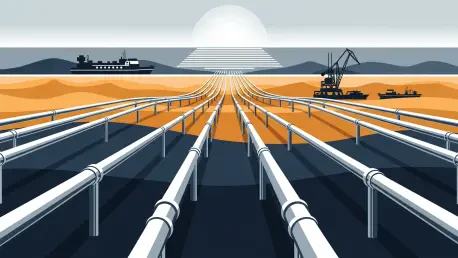
Making the Strait of Hormuz an “afterthought” is a monumental task when you consider that roughly 23 million barrels of oil were shipped through that narrow passage every day before the conflict began. While the vision shared by officials is ambitious, the logistical reality is sobering; Goldman Sachs estimates that constructing pipelines across just one nation takes at least two and a half years. These proposed routes must navigate the complex borders of multiple countries, each with its own security concerns and bureaucratic hurdles. However, the plan to have seven different pipelines carrying 14 million barrels per day by the end of 2028 is a serious attempt to reclaim control over global energy security. If successful, this would account for 60% of the volume currently at risk, significantly diluting the leverage any single actor has over the world’s oil supply.
The rehabilitation of the Iraq-Syria pipeline is a cornerstone of this new strategy. What are the geopolitical implications of integrating Syria and Turkey into this energy corridor, particularly given Syria’s recent history?
The integration of Syria and Turkey into this energy corridor is a masterstroke of pragmatic geopolitics, turning former conflict zones into essential transit hubs. The project, which seeks to connect Basra in southern Iraq to Haditha and then onward to the ports of Ceyhan in Turkey and Baniyas in Syria, is projected to carry 2 million barrels of oil per day. It is fascinating to see Syria, still grappling with the scars of a 14-year civil war, being promoted as a bastion of stability and a vital alternative for energy shipments. The reopening of a key border crossing in April, which had been shuttered for more than a decade, was a symbolic and practical victory for regional trade. By involving a U.S.-led international consortium to execute the technical and financial aspects, the project aims to create a shared economic interest that could theoretically discourage further military escalation in these transit zones.
As oil prices continue to fluctuate significantly—climbing from $67 before the war to peaks of $110—how do the specific agreements signed by Chevron aim to stabilize these “gyrations” in the global market?
The market is currently on a knife-edge, with West Texas crude rising 5% to $88 a barrel just this past Friday as news of renewed conflict filtered through the trading floors. Chevron’s three new agreements are designed to act as a stabilizing force by addressing both the supply of oil and the security of its delivery. Two of these deals are laser-focused on boosting Iraqi oil production, which is essential for maintaining global supply levels during wartime. The third agreement, arguably the most critical for market confidence, involves investing in a new export pipeline to create a viable alternative route to world markets. By diversifying the ways oil can exit Iraq, Chevron is helping to build a “relief valve” for the global economy, ensuring that a flare-up in the Persian Gulf doesn’t automatically lead to the $110 price spikes we saw in early April.
What is your forecast for the energy security of the Middle East over the next five years?
My forecast is that we are witnessing the beginning of a “Pipeline Renaissance” that will permanently alter the energy map of the Middle East by prioritizing overland security. Over the next five years, the success of the $60 billion in U.S.-Iraqi partnerships will serve as the benchmark for whether the region can successfully decouple its economic survival from the vulnerability of maritime chokepoints. We should expect to see the global “risk premium” on oil slowly diminish as the 2028 goal of transporting 14 million barrels per day through alternative routes draws closer. While the journey will be expensive and fraught with diplomatic challenges, the shift toward integrated regional infrastructure is the most viable path to a future where energy security is no longer held hostage by the geography of a single strait. If these pipelines are completed, Iraq will transition from a battlefield into a central pillar of the global energy supply chain.