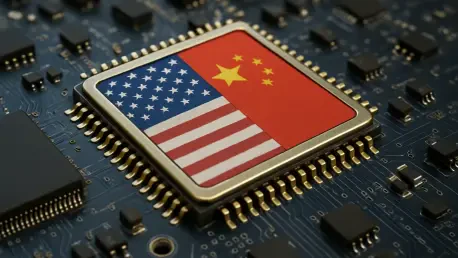

With a market cap of $4.5 trillion, Nvidia stands at the center of a geopolitical chess match, and the recent White House decision to permit the sale of its advanced H200 AI chips to China has sent shockwaves through both Wall Street and Washington. To unpack this complex decision, we spoke with Priya Jaiswal, a leading expert on international finance and technology policy. Our discussion explores the delicate balance between boosting American manufacturing and inadvertently arming a strategic competitor, the tangible risks to national security, and the future of the global AI race.
The administration recently approved the sale of Nvidia’s H200 chip to China but held back more powerful models like the Blackwell series. Could you walk us through the strategic thinking behind drawing the line at this specific chip and how it attempts to navigate the tension between U.S. economic interests and national security?
This is a classic high-wire act, an attempt to thread a very fine needle. The H200 is an incredibly powerful piece of hardware, but it’s deliberately a step behind Nvidia’s absolute cutting-edge technology, like the Blackwell and upcoming Rubin chips. The strategy appears to be this: allow U.S. industry leaders like Nvidia to profit from the massive Chinese market, which in turn funds American research and development and, as the president’s social media post framed it, supports “American Jobs.” By providing a capable, but not a state-of-the-art, chip, the administration is betting it can keep Chinese AI development dependent on U.S. technology while simultaneously preventing their military from getting their hands on the truly “transformational” hardware. It’s what Nvidia itself calls a “thoughtful balance,” but it’s a precarious one that assumes we can perfectly control where this technology ends up and how it’s used.
A group of Democratic senators issued a stark warning that these chips could make China’s military “more lethal.” Based on the H200’s capabilities, could you paint a picture of how this technology might realistically be leveraged by the Chinese military to enhance its capabilities against the U.S. within the next few years?
The senators’ concerns are far from hypothetical. Imagine, for a moment, a Chinese military drone swarm. With chips like the H200, the AI guiding that swarm becomes exponentially smarter. Its ability to process visual data in real-time, distinguish between civilian and military targets with terrifying accuracy, and coordinate complex autonomous attacks would be vastly improved. Then consider cyberattacks. These chips could power AI algorithms designed to probe for weaknesses in our critical infrastructure—the power grid, financial systems, communication networks—with a speed and sophistication that current defenses would struggle to counter. The technology wouldn’t just be an incremental upgrade; it could fundamentally change the speed and scale of their offensive capabilities, making their weapons systems and cyber warfare operations far more effective and, as the senators rightly pointed out, more lethal.
We know from the Chinese AI firm DeepSeek that their single biggest hurdle has been access to advanced chips. How does this policy, which allows H200 sales to “approved customers,” concretely shift the competitive landscape for firms like them against their U.S. counterparts?
This decision is like opening a floodgate that was previously just a trickle. For a company like DeepSeek, which openly admitted this was its primary bottleneck, gaining access to a steady supply of H200s is a complete game-changer. It dramatically shortens their development timelines. Training large-scale AI models, which used to take them an prohibitively long time on inferior hardware, can now be done in a fraction of that time, allowing them to iterate and innovate much faster. This directly helps them close the performance gap with U.S. leaders like OpenAI, Google, and Microsoft. While we are still ahead, this approval essentially removes the biggest competitive disadvantage Chinese firms faced, accelerating their ability to not just copy but create rival AI technologies.
President Trump’s announcement emphasized the benefits for “American Jobs” and “U.S. Manufacturing.” Looking past the immediate bump in Nvidia’s stock, what are the tangible, step-by-step economic effects we should be watching for to see if that promise materializes?
The immediate effect is, of course, a surge in revenue for Nvidia, which is what we saw in the after-hours trading. The first step in this translating to broader economic benefit is seeing Nvidia reinvest that capital domestically. This means expanding their U.S.-based design and engineering teams. The next step would be tangible investments in the domestic supply chain and manufacturing ecosystem, which strengthens our capabilities here at home. Finally, this success could spur similar growth for other American chipmakers like AMD and Intel, who are also now in line to sell their technologies abroad. We need to watch for announcements of new facilities, significant domestic hiring sprees, and increased orders to other U.S. suppliers. It’s a chain reaction, but it starts with that initial influx of capital from these approved foreign sales.
The Commerce Department is now tasked with “finalizing the details” for vetting these Chinese customers, not just for Nvidia but for AMD and Intel as well. To effectively prevent these chips from being used for military purposes, what specific criteria and verification processes do you believe are absolutely essential to establish?
This vetting process is the most critical and challenging piece of the entire policy. First, the criteria must establish an ironclad distinction between a purely commercial entity and any organization with ties, however distant, to China’s military or state security apparatus. This means deep-dive corporate due diligence that goes far beyond surface-level checks. Second, the verification process cannot be a one-time approval. It must involve stringent end-use monitoring, including potential on-site inspections and verifiable data logs, to ensure the chips are being used for their stated commercial purpose. Finally, there must be severe and immediate penalties for any diversion of this technology. Without a robust, ongoing verification and enforcement mechanism, the “approved customers” list becomes a loophole that completely undermines the policy’s national security objectives.
What is your forecast for the U.S.-China tech competition in the age of AI?
My forecast is that this tension between economic engagement and national security will only become more acute. We are entering an era of managed, and often contentious, competition. Decisions like this one on the H200 chip show that the U.S. is not pursuing a strategy of total technological decoupling. Instead, we are trying to maintain our lead by controlling the pace of China’s advancement, essentially keeping them a generation or two behind in critical areas. However, this is an incredibly difficult strategy to sustain. It risks underestimating China’s own innovative capacity and the potential for dual-use technology to bleed from the commercial to the military sector. The defining challenge for the U.S. will be calibrating these controls precisely, because a misstep in either direction—being too restrictive and harming our own industry, or too permissive and fueling a competitor’s rise—could have profound consequences for decades to come.