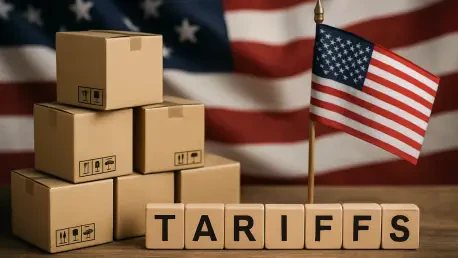

Despite years of adjustment and strategic repositioning within a complex global trade environment, American corporations are finding themselves caught in an economic vise, squeezed between the unyielding pressure of U.S. tariffs and the firm resistance of a price-sensitive consumer base. Early earnings reports paint a clear, if unsettling, picture: while many companies publicly declare the financial impact of tariffs to be “manageable,” their balance sheets tell a different story of eroding profitability. This growing tension reveals the fundamental challenge of the current trade landscape, where the costs imposed by tariffs have to be absorbed somewhere, and increasingly, it is the corporate bottom line that bears the brunt. The narrative that these costs can simply be passed along to the end customer is crumbling under the weight of economic reality, forcing businesses to navigate a precarious path between maintaining market share and preserving their profit margins in an increasingly fragile market.
The Corporate Squeeze
Eroding Profit Margins Despite Public Assurances
A significant consensus is emerging from the latest cycle of corporate earnings calls, revealing a stark disconnect between public statements and internal financial pressures. Bellwether companies, often seen as indicators of broader economic health, have consistently flagged the persistent challenges posed by tariffs. Firms like Procter & Gamble, industrial supplier Fastenal, and manufacturing giant 3M have all acknowledged the drag on their profitability, even as they attempt to project an image of control. The core of the issue lies in the fundamental difficulty of transferring these new, externally imposed costs directly to consumers. Attempts to implement price hikes are being met with significant resistance from a marketplace that has become acutely aware of value and is actively seeking alternatives. This consumer behavior effectively creates a ceiling on pricing power, leaving companies with little choice but to absorb a substantial portion of the tariff burden themselves, leading to a direct and measurable erosion of their profit margins quarter after quarter.
The resistance to higher prices is not uniform across all demographics but is particularly pronounced among lower- and middle-income households, which constitute a vast and critical portion of the consumer market. These groups, facing their own economic pressures, have demonstrated a diminished capacity and willingness to absorb further increases in the cost of goods. Their purchasing decisions are increasingly driven by a search for value, making them highly unreceptive to the price adjustments that companies are attempting to make to offset tariff expenses. This dynamic has transformed the marketplace into a high-stakes standoff. For corporations, the risk of losing market share to lower-priced competitors is a powerful deterrent against aggressive pricing strategies. Consequently, they are caught in a difficult position: raise prices and risk alienating a core customer base, or hold prices steady and watch profitability decline. This environment is forcing a fundamental reassessment of pricing models and supply chain logistics as the “new trade environment” proves to be far less manageable than initially hoped.
Strategic Responses and Their Limitations
In response to this challenging economic climate, corporations are deploying a range of strategies, yet the results have been decidedly mixed, often failing to fully counteract the financial strain. Many have opted for direct price increases, a seemingly straightforward solution. For instance, spice manufacturer McCormick & Co. raised its prices after experiencing higher-than-anticipated tariff costs, only to report a noticeable decline in its gross profit margin, indicating that the price hikes were insufficient to cover the new expenses. Similarly, consumer goods titan Procter & Gamble increased its U.S. prices by an average of 2% to 2.5% but still disclosed its fifth consecutive quarterly drop in margins. These examples highlight a critical flaw in the price-hike strategy: the increases are often not enough to fully offset the tariff impact, resulting in a net loss for the company. Recognizing this fragile consumer environment, some firms, like Tractor Supply, are now planning to be more “surgical” with any future price adjustments, a clear acknowledgment that broad, sweeping increases are no longer a viable option in the current market.
The limitations of corporate strategy extend beyond the simple mathematics of cost versus price. The fallout from tariffs is creating secondary effects that further complicate the business landscape, most notably a softening of overall consumer demand. This trend was underscored by Levi Strauss, a company with a powerful brand identity, which not only increased its forecast for the negative impact of tariffs on its margins but also issued a warning about weakening consumer spending. This signals that the problem is twofold: companies are struggling to manage direct costs while also facing a market where consumers are becoming more cautious with their spending in general. This dual pressure creates a difficult feedback loop where the very strategies used to combat tariffs, such as raising prices, may contribute to the decline in consumer demand that further hurts sales. As a result, businesses are left to navigate a trade environment where their traditional levers for managing costs and driving growth have become significantly less effective, and the long-term path forward remains uncertain.
The Broader Economic Toll
Quantifying the Consumer Burden
The cumulative effect of these corporate struggles is a tangible and quantifiable burden on the American consumer, a reality confirmed by extensive academic research. A detailed analysis from Harvard University professors, which meticulously tracked the prices of hundreds of thousands of goods, concluded that imported products are now approximately 5.8 percentage points more expensive than they would have been without the existing tariff regime. This figure provides a clear measure of the direct price inflation attributable to trade policy. Further illuminating the scale of this impact, the Yale Budget Lab calculated that the effective tariff rate on U.S. consumers has surged to 14.4%, a multi-decade high. This percentage represents the real, added cost that is now embedded in the price of a wide array of goods, from household staples to electronics and apparel. These are not abstract economic figures; they translate directly into reduced purchasing power for American families, effectively functioning as a broad-based consumption tax that disproportionately affects those with limited disposable income and ultimately dampens overall economic activity.
The transition from pre-tariff inventories to newly imported, higher-cost stock has made these price increases increasingly visible across the retail landscape, particularly on major e-commerce platforms where price comparison is seamless. Andy Jassy, the CEO of Amazon, confirmed this observable trend, noting that prices were definitively ticking up on the massive online marketplace as sellers exhausted their older, more cheaply acquired inventory. This real-world observation from the head of one of the world’s largest retailers provides a powerful corroboration of the academic data, demonstrating how the theoretical costs imposed at the port of entry are now fully manifesting on the digital and physical shelves where consumers shop. The depletion of this inventory buffer means that the full financial impact of the tariffs is no longer a future concern but a present-day reality for millions of shoppers. This direct pass-through of costs, even if partial, is reshaping household budgets and altering purchasing patterns as consumers are forced to make more difficult choices about their spending.
An Unsettled and Uncertain Future
Looking ahead, the policy landscape that governs this challenging trade environment remains clouded with uncertainty, offering little immediate relief for businesses or consumers. While there is a potential long-term legal challenge that could reach the U.S. Supreme Court and question the legal foundation for some of the existing tariffs, such a resolution is, at best, a distant prospect. Legal proceedings of this magnitude are protracted, and their outcomes are never guaranteed. In the interim, corporations are not waiting for a judicial solution but are instead focused on immediate adaptation and mitigation. The prevailing sentiment among corporate leaders was effectively articulated by General Electric’s CEO, Larry Culp, who stated that companies are still actively working to “navigate the new trade environment.” This choice of words is significant, as it signals that the process of adjustment is ongoing and far from complete. It suggests a continuous state of flux rather than a settled new normal, implying that the challenges posed by tariffs are an active, evolving problem that will continue to shape corporate strategy and impact financial performance for the foreseeable future.
The prolonged period of adjustment had ultimately solidified the complex reality of the U.S. tariff regime. It became evident that the financial burden was not borne by a single entity but was instead distributed unevenly across the economic landscape, with significant weight falling on both corporate profit margins and consumer wallets. Companies, despite their strategic efforts to mitigate the impact through price adjustments and supply chain reorganization, consistently found their profitability eroded by the stubborn resistance of a price-conscious market. This dynamic revealed that the ability to simply pass costs on to the end customer was severely limited. In the end, the economic pressures created a new, more challenging operational environment that reshaped corporate planning and consumer behavior in ways that would have lasting effects on the American economy.