
The ambition to transform Northern Europe into a decarbonized industrial powerhouse hinges on the physical integration of Denmark’s massive offshore wind potential with the energy-hungry manufacturing hubs located across the German border. This trans-border pipeline represents more than just a feat of engineering; it is the vital connective tissue for a European hydrogen economy that is only now reaching a point of tangible infrastructure deployment. As of 2026, the urgency to finalize the “Hyperlink” and “West Coast” projects has intensified, driven by the realization that intermittent renewable energy requires a robust transport mechanism to be commercially viable for heavy industry. While Denmark possesses the natural resources to produce hydrogen at scale, the cost of building hundreds of miles of specialized piping remains a barrier to private investment. Eyes are fixed on Berlin, where funding mechanisms are designed to derisk these projects and ensure that the green energy transition does not stall due to financial uncertainty or mismatched priorities.
Financial Strategies: Bridging the Capital Gap
The German government’s recent approval of the Hydrogen Core Network, or Wasserstoff-Kernnetz, serves as a cornerstone for the financial viability of the Danish-German pipeline. This initiative provides a regulatory and financial framework that allows network operators to invest in infrastructure with the assurance of long-term cost recovery through future grid fees. By front-loading the capital necessary for construction, Germany is effectively subsidizing the initial phase of the hydrogen market, which is essential given that current demand is still maturing. For Denmark, this commitment offers a level of certainty that was previously missing, allowing Energinet to move forward with planning phases that require substantial upfront expenditures. The financial architecture is designed to bridge the gap between 2026 and 2030, a period during which the infrastructure will be built before full-scale commercial operations can generate significant revenue. This proactive approach by German authorities demonstrates a realization that the success of their domestic industrial strategy depends heavily on imports.
Despite this progress, the path to a Final Investment Decision (FID) remains fraught with economic complexities that require more than just state-backed guarantees. Danish producers face the daunting task of aligning their production schedules with the completion of the pipeline, creating a “chicken and egg” scenario where neither side wants to commit without the other. To address this, current discussions are focusing on “backstop” mechanisms where governments agree to cover potential shortfalls if the hydrogen volumes do not materialize as quickly as anticipated. Such measures are crucial for attracting institutional investors who are otherwise wary of the volatile energy market and the high technological risks associated with hydrogen transport. The integration of Danish wind power into the German industrial grid is therefore not just a technical challenge but a sophisticated financial balancing act. Success depends on the ability of both nations to harmonize their subsidy regimes, ensuring that the cost of green hydrogen remains competitive with traditional fossil fuels even during the initial years.
Technical Integration: Aligning Production and Demand
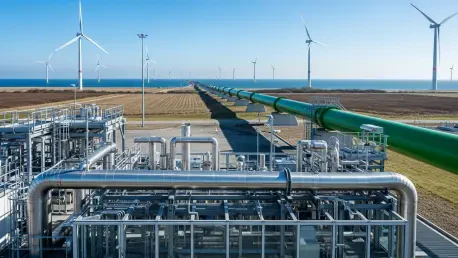
From a technical perspective, the pipeline must accommodate varying pressures and purity levels to serve diverse industrial users, from steel mills in the Ruhr region to chemical plants in Bavaria. Denmark’s strategy involves utilizing its expansive offshore wind farms in the North Sea to power large-scale electrolyzers, converting electricity into hydrogen at the source. This process avoids the bottleneck of limited electricity transmission capacity and utilizes the existing gas infrastructure where possible through retrofitting. The engineering required to repurpose natural gas pipelines for hydrogen is intensive, involving the replacement of valves and compressors to handle the smaller, more elusive hydrogen molecule. In 2026, pilot projects are already testing these retrofitted segments to ensure safety and efficiency. This technological synergy allows for a more flexible energy system where hydrogen acts as a storage medium, absorbing excess wind power during peak production times and releasing it when German demand spikes.
The path forward required a decisive shift toward harmonized regulatory standards and the implementation of robust risk-sharing facilities between the public and private sectors. Stakeholders identified that establishing clear pricing mechanisms and third-party access rules was essential for fostering a competitive market environment from the outset. Strategic focus moved toward the rapid scaling of electrolysis capacity in Denmark to ensure that the pipeline would be utilized to its full potential immediately upon completion. Technical teams prioritized the standardization of hydrogen quality to prevent industrial equipment damage, while policymakers worked to streamline the permitting process for cross-border infrastructure. These actions collectively ensured that the financial commitment from Germany was not merely a subsidy but a catalyst for a self-sustaining green energy economy. By addressing the logistical and economic hurdles through integrated planning, the two nations successfully laid the groundwork for a resilient and future-proof energy corridor.