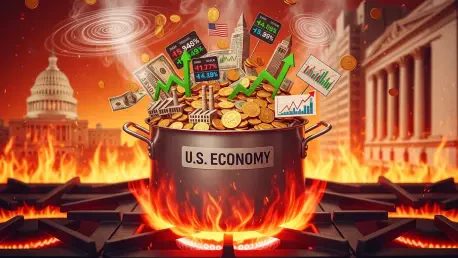

The current trajectory of the American financial system has entered a phase where traditional economic models struggle to provide a clear map for future stability and growth. While many global regions are currently grappling with stagnant productivity and mounting geopolitical tensions, the United States has transitioned into a period of aggressive overheating driven by a combination of massive technological shifts and historic fiscal outlays. This momentum is strikingly visible in the rapid expansion of nominal GDP and the continued upward revision of corporate profit forecasts across diverse sectors. From the heavy industrial base to the high-frequency trading floors of Wall Street, the atmosphere is one of frantic expansion that ignores standard warning signs. The sheer scale of this economic resilience has pushed the domestic market into a unique acceleration phase, creating a scenario where the standard cooling mechanisms of high interest rates and tight monetary policy have yet to dampen the enthusiasm of corporate leaders or the spending habits of the general public.
Technological Investment and Fiscal Stimulus
A primary driver of this current economic velocity is the unprecedented wave of capital expenditure targeting the build-out of artificial intelligence and its necessary physical infrastructure. Major technology conglomerates are pouring trillions of dollars into a vast network of sophisticated data centers and specialized semiconductor manufacturing facilities, which has sparked a secondary boom in the construction and power generation industries. This cycle of investment functions as a massive, localized growth engine that operates almost independently of traditional consumer sentiment or retail trends. As these digital foundations are laid, the ripple effects are felt in the demand for copper, specialized cooling systems, and high-capacity electrical grids, effectively creating an industrial renaissance. This surge in private spending on high-tech infrastructure provides a robust buffer against broader economic slowdowns, ensuring that even if consumer demand fluctuates, the industrial and technological backbones of the nation continue to expand at a record-breaking pace.
Complementing the surge in private tech investment is an extraordinarily expansive fiscal policy that shows little sign of retreating despite the prevailing inflationary environment. Persistent government spending, manifested through large-scale budget deficits and targeted subsidies for domestic manufacturing, continues to inject liquidity directly into the heart of the American economy. This fiscal tailwind has fundamentally altered the competitive landscape by creating a reliable floor for demand in sectors ranging from renewable energy to defense and transportation infrastructure. While the central bank attempts to pull the levers of monetary tightening, the fiscal side of the ledger remains wide open, essentially neutralizing the typical cooling effects that high borrowing costs would have on a mature economy. Consequently, businesses find themselves in a position where they can maintain historically high profit margins because the steady stream of government outlays prevents the usual erosion of purchasing power. This creates a complex environment where the public and private sectors are simultaneously fueling an engine that may be running too hot for long-term comfort.
The Impact of Rising Household Wealth
Beyond the realm of corporate investment and government policy, the significant appreciation of financial assets has created a potent wealth effect that is currently insulating the broader economy from a sharp decline. Over the last two years, the sustained rise in stock market valuations alongside a resilient housing market has substantially boosted the net worth of upper- and middle-income households across the country. This accumulation of paper wealth has translated into a persistent willingness to spend, even as the cost of living for basic necessities continues to climb. Consumers who feel wealthier due to their growing retirement accounts and home equity are less likely to pull back on discretionary expenditures, which in turn supports high employment levels and strong retail sales. This dynamic creates a self-reinforcing loop where asset appreciation fuels spending, which supports corporate earnings, thereby justifying even higher asset prices. As long as the perception of wealth remains intact, the consumer engine of the American economy is likely to remain engaged, regardless of any tightening measures.
However, this reliance on asset-driven consumption introduces a layer of vulnerability that often goes unnoticed during the peak of an economic expansion. The concentration of this wealth effect among specific demographic segments means that while top-tier spending remains robust, the underlying structural health of the entire consumer base may be more fragile than headline numbers suggest. If the market were to experience a sudden correction, the psychological impact on spending could be immediate and severe, potentially reversing the momentum that has characterized the current cycle. Furthermore, the rising cost of servicing debt—ranging from mortgages to credit cards—is beginning to put pressure on the margins of many households that do not benefit as directly from the appreciation of equities. The sustainability of this high-consumption environment hinges on the ability of the economy to maintain high employment and wage growth that can keep pace with the rising costs of maintaining an elevated lifestyle. This delicate balance is currently the linchpin of domestic stability, holding the disparate pieces of the overheating economy together as pressure builds.
Divergent Signals in the Financial Sector
One of the most perplexing features of the current landscape is the widening gap between the signals coming from the equity markets and those emanating from the bond market. Stock investors, largely focused on the transformative potential of artificial intelligence and the expansion of corporate margins, are pricing in a future of nearly limitless productivity gains and earnings growth. This optimism has driven major indices to levels that suggest a soft landing is already a certainty, with the risks of recession fading into the background of a high-tech golden age. Conversely, the bond market is flashing signs of deep concern, with Treasury yields climbing to multi-decade highs as investors demand greater protection against persistent inflation. Bondholders are essentially betting that the current pace of growth is unsustainable and that the structural shifts in the labor market and global supply chains will keep prices higher for longer than most equity bulls anticipate. This fundamental disagreement reflects a broader uncertainty about whether the economy can actually handle the transition to a world where capital has a significant and permanent cost.
This divergence is not merely a matter of differing timelines; it represents two completely different interpretations of the underlying health of the financial system. If the bond market is correct, the current stock market rally may be built on a foundation of overly optimistic assumptions regarding the Federal Reserve’s ability to lower rates without reigniting price pressures. High yields act as a gravitational pull on all financial assets, and the recent spike in long-term rates threatens to disrupt the valuation models that underpin the tech-heavy indices. As borrowing costs for corporations and local governments rise, the friction within the economy increases, making it more difficult for small and medium-sized enterprises to keep pace with their larger, more liquid competitors. This creates a bifurcated market where a handful of mega-cap companies can navigate the high-rate environment with ease, while the rest of the corporate world begins to feel the tightening of the noose. The tension between these two markets is a clear indicator that the overheating phase is entering a critical juncture where one side must eventually yield to the reality of the other.
Strategic Responses to Economic Volatility
The successful management of this overheating phase required a shift toward proactive risk assessment and a deeper integration of geopolitical factors into financial planning. Analysts determined that the primary challenge was not just inflation itself, but the potential for a disorganized tightening of financial conditions if the bond market continued its independent ascent. Policymakers and industry experts began to emphasize the importance of maintaining high levels of liquidity and investing in productivity-enhancing technologies that could offset the rising costs of labor and energy. The transition away from the era of easy money meant that capital allocation became a more rigorous process, favoring companies with durable business models and strong balance sheets. By focusing on fundamental value and operational efficiency, market participants positioned themselves to weather the volatility inherent in a diverging market landscape. This strategic pivot ensured that while the economy continued to run hot, the foundational elements of the financial system were fortified against eventual cooling.
Market participants moved toward defensive positioning by prioritizing assets with low debt-to-equity ratios and high pricing power to mitigate the effects of persistent interest rate pressure. It was discovered that the most resilient entities were those that could successfully integrate automated systems to reduce their dependence on an increasingly expensive labor pool. Investors also reallocated capital toward tangible assets and commodities that historically performed well during periods of fiscal dominance and monetary uncertainty. This collective shift in strategy highlighted a growing consensus that the current cycle required a departure from the growth-at-all-costs mindset of previous decades. By emphasizing sustainability and fiscal discipline, organizations managed to preserve their margins even as the broader macroeconomic environment grew increasingly unpredictable. Ultimately, the lessons learned during this period of divergent market signals provided a new framework for navigating high-growth, high-inflation scenarios. These adjustments proved essential for maintaining stability in a financial system where the traditional rules of engagement were constantly being rewritten by technological change.