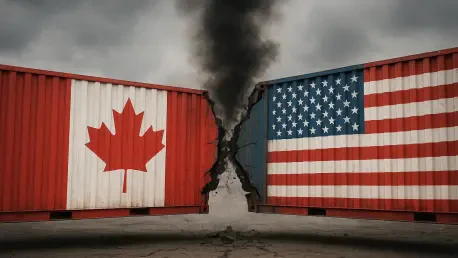

The seamless flow of heavy trucks across the Ambassador Bridge once symbolized a golden era of economic harmony, but that era ended abruptly as a political storm turned the international border into a rigid financial barricade. The handshake that once defined the world’s most integrated partnership has been replaced by a closed fist, as the United States and Canada pivot from cooperation toward confrontation. While decades of free trade transformed the 49th parallel into the world’s longest undefended border, the sudden imposition of 50% tariffs signals a volatile new era.
This isn’t just a disagreement over balance sheets; it is a fundamental breakdown of the trust required to keep a $2.6 billion-a-day trading relationship functional. The sudden friction has forced manufacturers to halt production lines as they wait for clarity on costs that changed overnight.
The Catalysts: A Modern Economic Standoff
The current friction stems from a dramatic collapse in negotiations between U.S. Trade Representative Jamieson Greer and Canadian Prime Minister Mark Carney. At the heart of the dispute is a diplomatic crisis where Washington claims a deal was sabotaged by Ottawa’s last-minute political demands. Conversely, Canada asserts the U.S. introduced uneconomic terms that undermined national sovereignty.
This impasse triggered immediate levies on $20 billion worth of Canadian imports, targeting everything from structural steel to cultural staples like hockey sticks. Greer characterized the move as a necessary response after the U.S. offered to halve duties on lumber and aluminum, only to face fresh demands from the Canadian side.
The Impact: Dissecting the Tit-for-Tat Cycle
The escalation follows a dollar-for-dollar retaliation logic that threatens to spiral beyond the initial 5% of bilateral trade currently affected. On the American side, the tariffs serve as a blunt instrument to force concessions in the dairy, automotive, and alcohol sectors. These are industries where the U.S. has long complained of Canadian protectionism and restricted market access.
Canada’s pledge to match every U.S. duty ensures that the cost of the conflict will be passed directly to the public. As the Canadian dollar fluctuates and markets react to the instability, the primary casualties are the small businesses that rely on seamless, duty-free supply chains to remain competitive.
Expert Perspectives: A Border in Crisis
Business advocacy groups and trade analysts warn that the reliability of the North American trade framework is now in question. The Canadian Federation of Independent Business has voiced significant alarm, noting that for many small enterprises, a 50% tariff is not a negotiation tactic; it is a business-ending expense.
Economists point to the weakening Canadian dollar as a harbinger of broader inflationary pressure. They suggest that if both nations continue to prioritize domestic political leverage over economic stability, the resulting trade wall will permanently alter consumer prices and industrial output across the continent. This shift forced many firms to reconsider the long-term viability of cross-border partnerships.
Strategic Resilience: Navigating Cross-Border Volatility
Surviving this trade war required a shift from just-in-time logistics to just-in-case resilience to ensure operational survival. Companies shifted toward domestic sourcing and alternative international partners to mitigate the 50% surge in import costs. Retailers prepared for sudden price hikes in consumer goods, using clear communication with customers to explain the impact of external tariffs.
Industry leaders leveraged trade associations to pressure both Washington and Ottawa back to the negotiating table, emphasizing the mutual damage of prolonged protectionism. Importers also utilized currency hedging to protect themselves against the volatility of the exchange rate as negotiations continued from 2026 into the future. These proactive measures became the only way to safeguard businesses against the ongoing diplomatic rift.