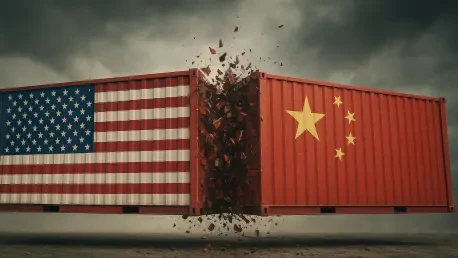

Domestic public sentiment regarding trade policy is shifting rapidly as 56% of registered voters now express disapproval of aggressive tariff strategies that drive up consumer prices. This statistical shift marks a profound departure from previous years when protectionist rhetoric enjoyed a broader mandate among the American electorate. As the administration pushes further into a strategy of economic coercion, the geopolitical landscape is being redrawn with sharp lines that prioritize national leverage over long-standing cooperative frameworks. This transition from conventional diplomacy to a more confrontational model of statecraft has created a ripple effect through global supply chains, affecting everything from basic commodities to advanced technological components. The current administration views these measures as essential tools to reclaim industrial dominance, yet the friction generated by these actions is testing the patience of domestic consumers who face higher costs at checkout counters today.
The High-Stakes Friction with a North American Neighbor
Disrupting Integrated Markets: The Impact of Targeted Tariffs
The recent collapse of trade negotiations with Canada has led to a dramatic pivot in cross-border relations, characterized by the implementation of heavy tariffs on roughly $20 billion worth of Canadian imports. Rather than applying a blanket tax that might dissipate its political impact, the administration has strategically targeted culturally and industrially significant goods, such as hockey sticks and wine, to maximize political visibility and pressure. This surgical approach aims to strike at specific regional economies within Canada, hoping to spark internal dissent that might force Ottawa back to the bargaining table on more favorable terms for Washington. By isolating these sectors, the U.S. government is attempting to demonstrate the high cost of non-compliance with its revised trade vision. However, the move has also disrupted specialized supply chains that have been integrated for decades, creating immediate logistical hurdles for many businesses on both sides of the border.
This hostility is further amplified by a “Build in the U.S.” mandate, backed by threats to double duties on automotive parts, which effectively signals the end of the preferential economic treatment Canada has historically enjoyed. The automotive sector, once the crown jewel of North American industrial cooperation, now finds itself at the center of a bitter dispute over local content requirements and labor standards. Under the new directive, manufacturers are being pressured to relocate production facilities to the American side of the border or face punitive levies that would make their products uncompetitive. This strategy represents a fundamental rejection of the previous integrated manufacturing model, favoring instead a fortress-like approach to industrial policy. As these mandates take hold, the certainty that once underpinned billions of dollars in cross-border investment is evaporating, replaced by a volatile environment where policy shifts can happen overnight via executive order.
The Dynamics of Retaliation: Analyzing Economic Risk and Power
In response to what they deem “unfair and uneconomic” demands, Canadian leaders have vowed to meet American pressure with “dollar for dollar” retaliation. This planned pushback focuses on critical U.S. exports, including steel, dairy products, and agricultural machinery, potentially sparking a prolonged trade conflict that neither side can easily exit. By selecting goods from politically sensitive states, Canada is employing its own version of targeted economic pressure, aiming to influence the American legislative process through the grievances of affected domestic industries. The retaliatory measures are designed to be proportional yet painful, highlighting the vulnerability of American exporters who have long viewed the Canadian market as their most stable international outlet. This escalatory cycle threatens to turn a manageable policy disagreement into a full-scale economic war, where the goal shifts from negotiation to mutual endurance while the dairy and steel industries are already reporting increased anxiety.
However, the power imbalance remains a stark reality; because Canada’s economy is deeply dependent on its southern neighbor, the fallout from a full-scale trade war is likely to be felt more acutely by the Canadian public than by the American consumer. While the U.S. can theoretically source many products internally or from other partners, Canada’s smaller domestic market offers fewer alternatives for its producers and consumers alike. This asymmetry is a core component of the administration’s “maximum pressure” calculus, betting that the economic pain will reach a breaking point in Ottawa before it causes significant political damage in Washington. Despite this, the strategy carries the risk of alienating a key security ally, potentially driving Canada to seek deeper trade ties with European or Asian partners to reduce its reliance on the U.S. market. The long-term cost of this friction may not be measured solely in lost trade volume, but in the erosion of a strategic partnership that has historically provided stability.
The Financial Siege and Legal Mechanisms of Pressure
Total Isolation: The Implementation of Economic D-Day
Moving beyond North American trade disputes, the administration has intensified its campaign against Iran by launching what officials call an “economic D-Day.” This strategy expands traditional oil embargoes into new and more aggressive frontiers, targeting gold, digital assets, and the aviation sector to effectively suffocate the Iranian economy. By broadening the scope of restrictions, the U.S. is attempting to close the loopholes that Tehran has used to survive previous rounds of sanctions. The inclusion of digital assets is particularly noteworthy, as it represents a direct challenge to the burgeoning crypto-ecosystem that many sanctioned regimes have viewed as a potential lifeline. This comprehensive approach seeks to render Iran’s sovereign wealth inaccessible and its currency practically worthless on the international stage. The administration’s rhetoric suggests that nothing short of total economic capitulation will be accepted, marking a shift toward a zero-sum game in Middle Eastern policy.
By threatening to sever the ties of any international bank or business that facilitates Iranian transactions, the U.S. is attempting to create a total financial vacuum around Tehran, forcing it into complete global isolation. This secondary sanctions regime effectively mandates that third-party nations choose between doing business with Iran or maintaining access to the massive American financial system and the dollar. Most global institutions, faced with such a lopsided choice, have opted to comply with Washington’s directives, even when their home governments officially oppose the U.S. stance. This extraterritorial reach of American law demonstrates the persistent power of the dollar as a weapon of statecraft, yet it also sows seeds of resentment among allies who feel their economic sovereignty is being trampled. The goal is to make the cost of engaging with Iran so prohibitively high that the country becomes a pariah state, unable to procure even basic industrial components or engage in standard maritime commerce.
Historical Efficacy: Navigating the Legacy of Smoot-Hawley
To navigate current legal hurdles, the administration is reportedly relying on Section 338 of the 1930 Smoot-Hawley Tariff Act, a move that carries heavy historical irony for modern economists. While the White House views this as a necessary and powerful tool for modern economic competition, historians remember Smoot-Hawley as a primary catalyst that worsened the Great Depression. By invoking this nearly century-old legislation, the administration is attempting to bypass more recent trade agreements and congressional oversight, asserting broad executive authority over international commerce. This legal maneuver allows for the rapid implementation of tariffs against nations deemed to be discriminating against American goods, but it does so by reviving a protectionist framework that the world had largely abandoned. The use of such an antiquated law suggests a desire to return to a pre-globalization era of trade relations, where national interests were pursued through blunt legislative instruments.
Legal experts anticipate significant court challenges to this strategy, as using nearly century-old legislation to bypass modern trade agreements lacks recent precedent and risks damaging long-term global trust. Critics argue that the specific provisions of Section 338 were never intended to manage the complexities of modern digital trade or highly integrated global supply chains. If the courts rule against the administration, it could trigger a chaotic period of regulatory uncertainty, where tariffs are implemented and then suddenly revoked, leaving businesses in a state of constant flux. Furthermore, the reliance on such controversial legal grounds may encourage other nations to dust off their own protectionist laws, leading to a breakdown of the rules-based international order that has governed trade for decades. The risk of long-term damage to the credibility of the U.S. as a reliable trading partner is substantial, as allies wonder if established treaties can be brushed aside.
Strategic Next Steps for the Global Trade Environment
The global shift toward geoeconomic coercion fundamentally altered the landscape of international relations, forcing businesses and governments to adapt to a world where trade functioned as a primary weapon. As the administration tested the limits of American economic dominance, the most effective responses involved diversifying supply chains away from high-friction regions to mitigate the risk of sudden policy shifts. For policymakers, the challenge remained in balancing the immediate goals of “maximum pressure” with the long-term necessity of maintaining a stable and predictable global financial system. The months following these developments saw a push toward regional trade blocs as nations sought protection from unilateral actions, leading to a more fragmented but resilient economic environment. Success in these aggressive tactics was eventually judged by their ability to produce lasting diplomatic breakthroughs without permanently damaging the legal and economic foundations of international cooperation.