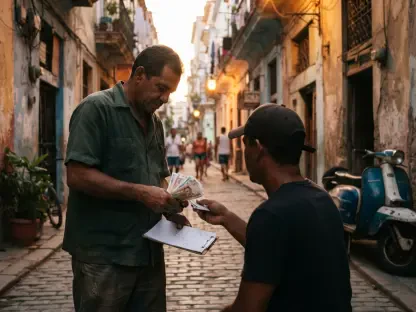

Monday’s market activity confirmed that the U.S. dollar has solidified its role as the primary benchmark for the island’s true economic performance during this period of crisis. This observation stems from the persistent devaluation of the Cuban Peso, which continues to lose ground against major foreign currencies in the parallel market. Unlike official figures, the street-level exchange rate provides a transparent reflection of a reality where supply and demand dictate survival. Throughout October 2026, the volatility of the national currency has reached high levels, creating uncertainty for both local entrepreneurs and households. As citizens navigate this landscape, the gap between earnings in the local currency and the rising costs of imported essentials has widened into a structural chasm that fiscal policies have struggled to address. This trend underscores a lack of confidence in the banking system, prompting capital migration toward stable international assets in an effort to preserve wealth.
Performance Trends of the Euro in the Informal Market
The Euro currently maintains its position as the most expensive asset within the informal market, consistently trading at a premium compared to the American dollar. Ending a recent trading session at a valuation of approximately 929 CUP, the Euro has demonstrated resilience despite minor daily fluctuations. This strength is largely attributed to its critical role in facilitating international travel and the procurement of high-value industrial goods that are nearly impossible to obtain through state-regulated channels. Investors and private sector participants view the Euro as a vital lifeline for maintaining operations that require European imports, which has kept demand high even as the local peso continues its downward spiral. Over the past several weeks, the bullish trajectory of this currency has remained unchecked, reflecting a broader preference for hard currency reserves over the rapidly depreciating national tender during these volatile months of regional financial instability.
Role of Digital Currency and Government Stores
In parallel with physical currencies, the Moneda Libremente Convertible, or MLC, remains a cornerstone of the digital economy despite its lower transaction volume. Valued at roughly 597 CUP, this digital asset serves as the exclusive medium of exchange within government-operated stores that stock basic household necessities. While it does not offer the same level of liquidity as physical cash, its necessity for purchasing specific commodities ensures a constant demand among the local population. However, the reliance on a digital currency strictly confined to state-run retail environments highlights the fragmented nature of the financial system. Citizens find themselves forced to manage a complex portfolio of assets, balancing the need for MLC to secure hygiene products against the superior utility of the dollar and euro for larger, more flexible transactions that take place within the burgeoning private sector, which increasingly dictates the island’s economic pace for the average consumer.
Failure of Official Reserves and Banking Systems
A profound disparity persists between official exchange rates dictated by the Central Bank and the actual prices paid by citizens on the street. While state institutions maintain symbolic valuations for the dollar and euro, these figures are largely irrelevant because the banking system lacks sufficient foreign reserves to satisfy actual demand. Consequently, individuals and private businesses are excluded from accessing hard currency through formal channels, leaving the informal market as the only viable mechanism for acquisition. This failure of the state to provide liquid exchange services has effectively outsourced monetary policy to the street, where prices are set by scarcity rather than administrative decree. The resulting partial dollarization has created a dual-track economy where those without access to remittances are left at a disadvantage, struggling to keep pace with an inflation rate that ignores official data and continues to pressure earners who rely solely on the national currency.
Data Collection and Real Time Economic Impact
Mechanisms used to track these currency fluctuations have become increasingly sophisticated, relying on automated tools that aggregate thousands of offers across social media networks. By filtering out non-serious bids and prioritizing recent transaction data, these indices offer a real-time window into the economic pressures facing the workforce. For the average state employee receiving a salary in pesos, the daily climb of the exchange rate translates directly into a loss of purchasing power for essential items like medicine and proteins. This erosion of wealth is a tangible crisis that forces families to make difficult choices between basic needs. Moreover, the prevalence of these informal rates in pricing local services further accelerates the inflationary cycle, as even small-scale producers must adjust their prices to account for the rising cost of foreign-denominated inputs. This structural inflation remains a significant hurdle for any recovery of the peso’s value.
Strategic Reforms for Future Monetary Stability
To address these systemic challenges, analysts emphasized that a transition toward more transparent and market-driven fiscal policies became necessary for stabilizing the national economy. Observers suggested that policy makers should have prioritized the creation of a legalized and regulated exchange system that integrated the informal market’s liquidity into the formal banking sector. These experts noted that such a move, combined with expanded incentives for domestic production, offered the most viable path toward reducing the heavy reliance on imported goods and the subsequent demand for foreign currency. Moving forward, the implementation of decentralized financial mechanisms and the adoption of more flexible labor market regulations appeared to be critical steps for restoring the purchasing power of the population. Ultimately, the focus shifted toward fostering a more inclusive economic framework that recognized the reality of the parallel market while working to bridge the gap for the people.