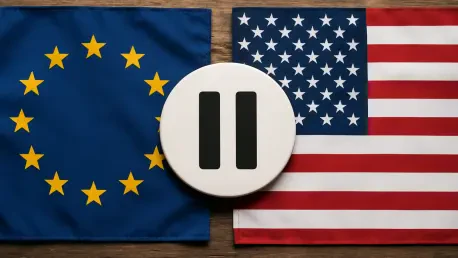

A palpable sense of relief swept across European financial markets on Thursday as a surprise diplomatic announcement from the World Economic Forum in Davos effectively dismantled the looming threat of a transatlantic trade war, unleashing a powerful wave of investor optimism. The news that the United States would suspend planned tariff escalations against the European Union acted as a potent catalyst, sending equities surging and reversing weeks of nervous, risk-averse trading. This sudden shift in sentiment was felt across the continent, with major indices posting significant gains and sectors most exposed to international trade leading the rally. The development provided immediate reprieve for investors who had been bracing for the economic fallout of heightened protectionism, illustrating the profound sensitivity of modern markets to geopolitical maneuvering and the immense value placed on stable trade relations between the world’s largest economic blocs. The broad-based nature of the rally underscored the widespread anxiety that had been priced into the market.
A Diplomatic Thaw Sparks Market Optimism
The pivotal moment for the market rally originated from President Donald Trump’s announcement of a significant diplomatic breakthrough with European allies concerning Greenland. While attending the forum in Davos, he revealed the establishment of a “framework of a future deal” with NATO Secretary General Mark Rutte, which, while vague, hinted at a new strategic partnership. This conceptual agreement reportedly involves the creation of a sophisticated “Golden Dome” missile defense system and U.S. access to Greenland’s vast mineral resources. However, the most immediate and market-moving consequence of this discussion was the White House’s decision to halt the impending tariff hikes that had been hanging over European exporters. This move was interpreted by investors not merely as a temporary truce but as a meaningful step away from the protectionist brinkmanship that had previously unsettled global economic stability and threatened to fracture long-standing alliances.
The optimistic interpretation of the U.S. announcement was further solidified by the measured and constructive responses from key European leaders, which helped to quell fears of a diplomatic impasse. Danish Prime Minister Mette Frederiksen, while firmly reiterating that Danish sovereignty over Greenland was non-negotiable, welcomed the renewed dialogue with the United States. She signaled an openness to discussing security collaborations, such as the proposed “Golden Dome” initiative, on the condition that Denmark’s territorial integrity is unequivocally respected. This nuanced position was seen as a sign of willingness to engage. Meanwhile, German Chancellor Friedrich Merz publicly urged his European counterparts to recognize the significance of the moment and “not write off the transatlantic partnership.” His comments reinforced a consensus view among European political and business circles that these developments represented a crucial opportunity to repair and strengthen relations, thereby reducing the geopolitical risk premium that had been weighing on the market.
Sector-Specific Fortunes and Market Divergence
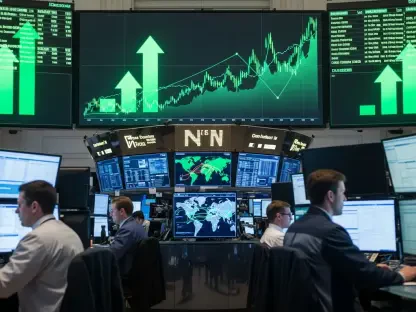
This improved geopolitical climate translated directly into robust gains across European equity markets. The pan-European Stoxx 600 index finished the trading session with a strong 1.1% advance, with a vast majority of its constituent sectors and all major regional exchanges closing firmly in positive territory. The sectors most directly exposed to the now-retracted tariff threat experienced the most significant relief rallies. Auto-linked stocks, which are heavily dependent on exports to the American market, surged by an impressive 2.3%, leading the gains. The healthcare sector, another major European exporter to the U.S., also rose by a healthy 1.7%. Concurrently, the easing of trade tensions had a discernible impact on safe-haven assets. The recent rally in gold, which had reached record highs amid investor uncertainty, began to cool, indicating a partial shift in sentiment away from safety. The U.S. dollar also continued its recent depreciation, with the dollar index (DXY) falling as the de-escalation prompted a reevaluation of the currency’s safe-haven appeal.
Despite the dominant upward trend driven by macroeconomic news, the day’s trading was also marked by dramatic, company-specific events that created significant outliers. Volkswagen was a standout performer, with its share price climbing a remarkable 6.2%. This impressive gain was fueled by the powerful combination of the positive tariff news, which directly benefits the German automotive giant, and the release of a strong preliminary results statement revealing a 20% year-on-year increase in net cash flow. In stark contrast, French video game developer Ubisoft experienced a catastrophic session, as its shares plummeted 36.6%. The sell-off followed a major corporate announcement that detailed a significant organizational restructuring, the closure of several studios, and the cancellation of six upcoming games, signaling deep-seated issues that completely overshadowed the positive market environment. The defense sector also presented a mixed picture, with Rheinmetall, Europe’s largest defense company, seeing its shares fall 3.2%, while the broader European Aerospace and Defense index traded flat, suggesting investor uncertainty about how the new “Golden Dome” framework would translate into specific contracts.
Navigating the Aftermath
The day’s trading session ultimately served as a powerful reminder of the market’s deep interconnection with global politics. The swift and decisive rally following the tariff suspension demonstrated how quickly investor sentiment could pivot from anxiety to optimism when perceived risks are removed. Sectors that had been under pressure for months found immediate relief, highlighting the economic importance of the transatlantic trade relationship. Yet, the starkly divergent paths of individual companies like Volkswagen and Ubisoft underscored a crucial, parallel truth: macroeconomic tailwinds cannot always overcome severe, company-specific headwinds. The dramatic events showed that while geopolitical developments could set the overall market tone, corporate fundamentals, strategic decisions, and operational health remained the ultimate arbiters of an individual stock’s fate. Investors were left to contemplate a landscape where broad market relief coexisted with pockets of intense corporate distress, reinforcing the need for diligent, bottom-up analysis even in a surging market.