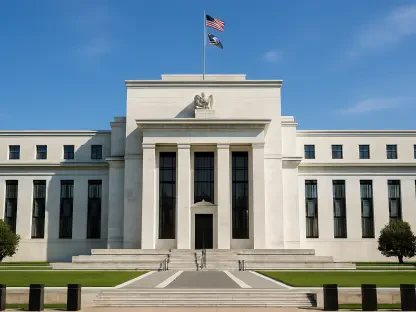

Responding to mounting signs of a cooling economy and a weakening jobs market, the U.S. Federal Reserve implemented its third consecutive interest rate reduction, a move that sent immediate shockwaves through the fixed-income markets. The Federal Open Market Committee announced a 25-basis-point cut to its key overnight lending rate, establishing a new target range of 3.5% to 3.75%. This widely anticipated decision prompted a significant rally in government bonds, causing their prices to rise and their yields to fall sharply. In the immediate aftermath of the announcement, the benchmark 10-year Treasury yield, a critical barometer for everything from mortgage rates to corporate borrowing costs, tumbled to 4.153%. The 2-year Treasury yield, which is particularly sensitive to shifts in federal funds rate expectations, experienced an even more pronounced drop, falling to 3.542%. This decisive shift toward a more accommodative monetary policy signals the central bank’s growing concern over maintaining economic expansion in the face of emerging headwinds.
A Divided Committee and Monetary Easing
While the rate cut itself aligned with market expectations, the details of the vote revealed a notable level of dissent within the Federal Open Market Committee, underscoring the complex and uncertain economic environment policymakers are navigating. The decision was reached on a 9-3 vote, a split that highlights a growing divergence of opinion on the appropriate path forward for monetary policy. The opposition was particularly striking for its diversity, coming from both ends of the policy spectrum. One governor cast a dovish vote, advocating for a more aggressive half-point reduction to provide a stronger stimulus to the economy. In stark contrast, two regional bank presidents registered hawkish dissents, arguing that holding rates steady was the more prudent course of action. Beyond the benchmark rate, the Fed also took further steps to ensure financial market stability by announcing an expansion of its short-term bond-buying program. The central bank committed to purchasing $40 billion in Treasury bills, a measure designed to inject additional liquidity into the system, complementing its earlier decision to halt the runoff of its massive balance sheet.
Future Policy and Market Expectations
The Federal Reserve’s latest action and accompanying statement were interpreted by investors as a clear signal that the door remains open for additional monetary easing in the near future. Following the announcement, financial markets swiftly adjusted their forecasts, with traders in the futures market significantly increasing their bets on further rate reductions over the coming year. Current pricing now indicates a strong probability of at least two more quarter-point cuts before the end of the year, reflecting a belief that the central bank will continue to act preemptively to sustain the economic expansion. One prominent economic analyst noted that the Fed would likely adopt a wait-and-see approach in the first quarter, pausing to assess the impact of its recent moves on economic data. However, the analysis concluded that should the economy fail to show signs of stabilization, another rate cut could be on the table as early as the second quarter, a sentiment that solidified the downward pressure on Treasury yields.