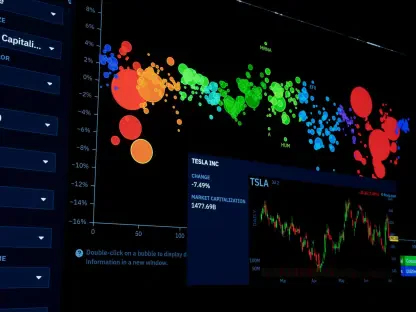

The persistence of record-breaking stock market indices despite stagnant industrial growth across major manufacturing hubs suggests that the link between financial performance and the real economy has entered a state of profound permanent detachment. Investors now prioritize intangible assets such as proprietary algorithms, data ecosystems, and sovereign credit cycles over traditional metrics like physical inventory or labor efficiency. This shift is particularly evident in the way large-scale capital flows are directed toward speculative technologies that promise future efficiency rather than current output. Consequently, the valuation of the world’s largest corporations has moved beyond the scope of their immediate quarterly earnings, reflecting instead a bet on total market dominance and the erosion of competition. This creates a feedback loop where capital breeds more capital through automated reinvestment, often ignoring the social and economic friction that defines the lives of billions who exist outside the high-finance bubble.
The Role of Artificial Intelligence: Driving the Valuation Gap
Large-scale implementation of specialized generative intelligence has fundamentally altered how markets evaluate potential, leading to a surge in wealth for those holding equity in dominant tech firms. These systems allow companies to scale services with minimal incremental costs, a trait that traditional manufacturing or agriculture simply cannot replicate in the physical world. As a result, the market capitalization of firms specializing in high-level computing and automated infrastructure has soared, even when the broader consumer base faces reduced purchasing power due to inflation. This dynamic creates a vacuum where investment capital is siphoned away from traditional small businesses and redirected toward hyper-scale platforms that offer the promise of infinite scalability. The concentration of wealth is no longer just a byproduct of success but a structural feature of a market that rewards digital efficiency over physical labor or logistical complexity.
Beyond the immediate tech sector, the financialization of the global economy has pushed assets into a realm where they are traded as derivatives of derivatives, further distancing them from the underlying goods. Modern trading platforms use predictive modeling to hedge against volatility, which paradoxically stabilizes the markets while the real-world environment remains precarious for workers and consumers. This stabilization is often artificial, supported by systemic liquidity that seeks the highest possible return in the shortest timeframe without regard for long-term industrial health. When wealth is generated primarily through the movement of capital rather than the creation of products, the resulting surge in net worth does not necessarily translate into improved living standards for the general population. Instead, it fosters a dual-track economy where the owners of capital see exponential growth while the participants in the labor market see their relative share of national income continue to decline.
Socioeconomic Implications: The Divide Between Capital and Labor
The widening gap between market performance and household income has profound implications for the social contract, as the benefits of increased productivity are captured almost entirely by asset owners. Traditional economic models suggested that a rising tide would lift all boats, yet the current data indicates that the rising tide is primarily elevating the super-yachts of the digital and financial elite. Wage growth in the manufacturing and service sectors has failed to keep pace with the aggressive appreciation of equity markets, leading to a situation where the cost of housing and education outstrips the earnings of the median worker. This imbalance is exacerbated by the trend of corporate share buybacks, where firms prioritize boosting their own stock prices over investing in workforce development or facility upgrades. This strategy ensures short-term gains for shareholders but weakens the foundational strength of the real economy, creating a fragility that is often masked by the glowing green numbers on trading screens.
By the time the global community reached the latter half of the decade, it was evident that the detachment of market values from the real economy had forced a significant pivot in international fiscal strategy. Policymakers eventually moved beyond traditional interest rate adjustments to embrace structural reforms that prioritized inclusive growth. They established new regulatory frameworks that penalized speculative high-frequency trading while offering tax credits for investments in physical infrastructure and workforce training. These measures helped ground the surging wealth in tangible societal improvements, such as modernized public transit and renewable energy networks. Investors began to value stability and long-term sustainability over the volatile promise of algorithmic scaling, which led to a more balanced distribution of gains. This period of correction proved that the financial system could be re-aligned with human needs. The era of unchecked market detachment finally gave way to a new paradigm where financial success was measured by its contribution to broad-based economic resilience.