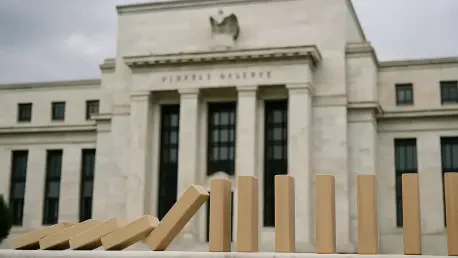

An extraordinary political standoff is unfolding in Washington, as a single Republican senator has thrown a wrench into President Donald Trump’s plans to reshape the Federal Reserve by vowing to block all of his nominees to the central bank. The dramatic move by Senator Thom Tillis of North Carolina stems from a highly controversial Department of Justice investigation into the current Federal Reserve Chair, Jerome Powell, for alleged perjury. This probe, widely viewed by lawmakers on both sides of the aisle as a thinly veiled attack on the Fed’s institutional independence, has ignited a firestorm on Capitol Hill. Senator Tillis has made his position unequivocally clear: until the investigation into Powell is fully and transparently resolved, no Trump appointee to the Federal Reserve will receive his crucial vote, a decision that carries immense weight and threatens to paralyze the appointment process for one of the world’s most powerful financial institutions.
A Stand on Principle
At the heart of this confrontation is a firm stand against what is being described as blatant political overreach into the nation’s monetary policy. Senator Tillis has framed his opposition not as a personal dispute, but as a necessary defense of institutional integrity. He has publicly stated that the investigation, which is being led by a U.S. Attorney known to be a confidant of President Trump, represents a direct and unacceptable threat to the long-held independence of both the Federal Reserve and the Department of Justice. By pledging to block all nominees, including the potential replacement for Chair Powell, Tillis is leveraging his position to force a resolution and shield the central bank from executive pressure. His actions underscore a deep concern that allowing such a politically charged probe to proceed without challenge would set a dangerous precedent, potentially eroding public trust in the impartiality of these critical government bodies for years to come.
The strategic importance of this blockade cannot be overstated, given the delicate balance of power within the Senate. As a member of the Senate banking committee, which holds a narrow 13-12 Republican majority, Senator Tillis’s defection is not merely symbolic; it is a mathematical certainty that can halt any nomination in its tracks. Without his support, the administration cannot advance a nominee out of the committee for a full Senate vote, effectively creating a stalemate. This move is particularly notable as it marks a rare and significant break from a senator who has typically been a reliable supporter of the president’s agenda. His willingness to draw a line in the sand on this issue signals the gravity of the perceived threat and has sent shockwaves through the Republican caucus, forcing a public reckoning over the boundaries of executive authority and the sanctity of independent federal agencies.
An Unlikely Bipartisan Alliance
The administration’s strategy appears to have backfired spectacularly, creating a rare moment of bipartisan unity in a deeply divided Congress. Democratic Senator Elizabeth Warren, who has historically been one of Jerome Powell’s most pointed critics, has emerged as one of his most vocal defenders in this specific conflict. She has joined Senator Tillis in vehemently condemning the investigation, accusing President Trump of abusing his executive authority “like a wannabe dictator” in an attempt to oust an independent chair. Warren argues that the president’s goal is to install a compliant “sock puppet” who will bend to his political will, particularly his frequent demands for lower interest rates to stimulate the economy. This unexpected alliance between Tillis and Warren illustrates that the concern over the politicization of the Fed transcends partisan politics, uniting ideological opposites in a common cause to protect institutional norms from what they see as an unprecedented executive power grab.
A Unified Front Against Political Overreach
The collective opposition ultimately solidified into a formidable barrier against the administration’s perceived efforts to exert undue influence over the central bank. Chair Powell himself reinforced this view when he characterized the Department of Justice’s probe as an “unprecedented action” and a transparent “pretext” for the administration to seize control over monetary policy. This sentiment was echoed across the political spectrum in the Senate, leading to the conclusion that the administration’s pressure campaign had not only failed but had also created a unified front determined to safeguard the Fed’s independence. This situation severely complicated the president’s plans to replace Powell, whose term as chair was set to expire in May, and to fill other potential vacancies on the Fed’s board. The standoff left the future leadership of the institution in a state of uncertainty, demonstrating the profound consequences that arose when political maneuvering clashed with the foundational principles of institutional autonomy.