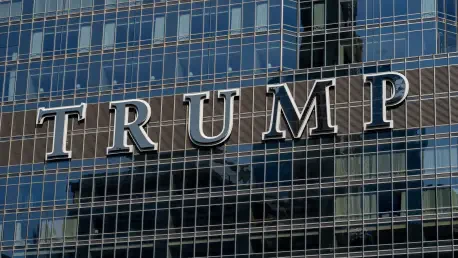

The disclosure of a massive nine-hundred-twenty-seven-page federal financial report has fundamentally altered the public perception of executive power and the boundaries of private enterprise in the United States. This document, released by the Office of Government Ethics, serves as a testament to the evolving nature of the presidency, where traditional real estate has taken a backseat to a multi-billion-dollar digital portfolio. For the first time in history, the nation is witnessing a sitting president whose wealth is largely tied to unregulated financial markets that the executive branch itself oversaw throughout the past year. The scale of this transformation is immense, reflecting a net worth that has grown to an estimated six billion dollars within just one year of the current term.
Unlike previous financial reports that focused on static assets like buildings or land, this disclosure highlights a rapid pivot toward governance tokens and international licensing agreements. The sheer volume of revenue generated within such a short timeframe challenges the historical norm of presidential financial distance. Analysts noted that the speed of this wealth accumulation is without precedent, as the Trump Organization successfully leveraged the global presidential brand to enter markets that did not exist during the inauguration. This shift represents a fundamental change in how the highest office in the land interacts with the global economy.
The Unprecedented Scale: The 2026 Financial Disclosure
The release of the federal financial disclosure has redefined the understanding of executive wealth, moving beyond the brick-and-mortar foundations of the past. The current administration is defined by a billion-dollar digital currency empire that has largely replaced traditional holdings as the primary source of growth. This document reveals that the President’s net worth has surged to approximately six billion dollars, driven by ventures that were essentially non-existent when the current term began. Such a rapid escalation in private wealth while holding public office invites intense questioning regarding the independence of the executive branch.
Furthermore, the document exposes how the monetization of the presidency has expanded into nearly every facet of the global marketplace. While past leaders often simplified their portfolios to avoid the appearance of bias, the current landscape shows an aggressive diversification strategy. The financial disclosure is not merely a list of assets; it is a roadmap of how a modern administration can integrate a private business brand with the prestige of the nation’s highest office. This integration creates a complex web of interests that complicates the traditional oversight role of Congress and the public.
The Digital Pivot: Why Global Assets Matter Now
The evolution of the Trump Organization from a domestic real estate firm into a global crypto powerhouse creates a new set of challenges for public governance. This topic is particularly relevant as the administration oversees the very industries—such as cryptocurrency and international trade—that fuel the President’s private bottom line. The reversal of strict regulatory policies on digital assets has directly preceded a windfall for the President’s own companies, World Liberty Financial and CIC Digital LLC. Understanding these connections is vital for an electorate navigating a landscape where personal business interests and national policy shifts are increasingly intertwined.
Moreover, the global nature of these digital assets means they are often shielded from the same level of transparency as physical property. Traditional real estate is subject to local taxes, zoning laws, and public records, whereas digital tokens can be traded across borders with minimal oversight. This shift toward intangible wealth allows for a level of financial mobility that was previously impossible for a sitting president. As the administration continues to champion the deregulation of these sectors, the distinction between a policy designed for the public good and one designed for private gain remains a central point of contention for legal scholars.
Revenue Streams: Mapping a Modern Global Enterprise
The financial disclosure breaks down the President’s income into three distinct categories that show how the brand has been monetized across various sectors. Cryptocurrency ventures led the way, generating one point two billion dollars through governance tokens and meme coins. This occurred despite significant losses for public investors who saw asset values crash by up to eighty percent following the initial hype. Simultaneously, the Trump Organization pursued an aggressive international expansion, securing millions in fees from deals in the United Arab Emirates, Saudi Arabia, and Vietnam. These international agreements signify a major transition toward a licensing-heavy business model.
In addition to digital and global ventures, the domestic portfolio saw a surge in profitability that coincided with the President’s return to power. Mar-a-Lago reported a fifty percent revenue increase as it became a hub for lobbyists and foreign dignitaries seeking proximity to power. Beyond the high-end real estate, the President has also capitalized on niche consumer goods, such as branded watches and sneakers. These varied revenue streams demonstrate a comprehensive monetization of the individual’s identity, ensuring that the brand remains profitable across multiple demographics and geographic regions.
Diplomacy and Commerce: Analyzing the Collision
Ethical scrutiny has intensified as observers note the correlation between private business deals and U.S. foreign policy outcomes. For example, the procurement of high-tech fighter jets by Saudi Arabia and tariff relief for Vietnam occurred in close proximity to lucrative real estate agreements in those nations. White House spokeswoman Anna Kelly maintains that no conflict of interest exists, stating that the President’s assets are held in a trust managed by his sons. However, critics argue that the lack of a traditional blind trust allows for a monetization of the presidency that is unprecedented in American history.
The presence of niche consumer goods like Trump-branded watches and Bibles further blurs the line between the office and the individual. When the President uses his platform to promote these items, it creates a unique marketing environment where the authority of the state is linked to retail sales. This collision of commerce and diplomacy raises questions about the motivations behind international agreements and domestic policy shifts. Even if no direct quid pro quo is proven, the appearance of such overlaps can weaken the public’s trust in the impartiality of the executive branch.
Oversight Frameworks: Strategies for Monitoring Executive Conflicts
The complexities of the 2026 disclosure demonstrated that the line between public service and private enterprise moved toward a more integrated model. Public watchdogs realized that the sheer complexity of digital assets necessitated more robust tracking mechanisms than those used in previous decades. The shift toward real-time auditing became a central proposal in legislative halls as reformers suggested that the divergence between personal profit and public outcomes remained the primary metric for evaluating executive ethics. Citizens recognized the importance of independent data verification to ensure that policy remained untainted by private interest.
Experts concluded that future legislative reforms had to address the unique nature of digital tokens and international licensing. The 2026 financial cycle proved that traditional disclosure laws were ill-equipped to handle the speed and anonymity of modern global enterprises. Watchdogs advocated for a framework that cross-referenced the timing of executive orders with private revenue spikes to provide a clearer picture of potential conflicts. Ultimately, the era of the modern global presidency required a new standard of transparency that prioritized the public’s right to know exactly how executive decisions influenced the President’s private bottom line.