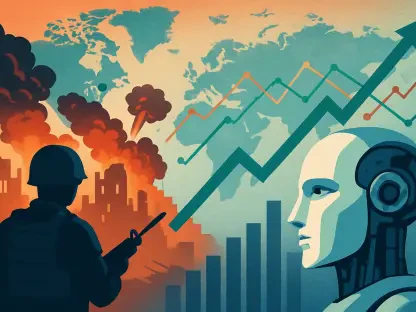

The rhythmic pulse of the American economy, once defined by the constant movement of workers seeking better horizons, has slowed to a faint and uncertain crawl as global instability takes hold. This research explores how current military tensions involving the United States, Israel, and Iran serve as a decisive catalyst for domestic economic paralysis. While the labor market has shown signs of fatigue for some time, the sudden escalation of conflict in the Middle East has introduced a level of systemic risk that traditional financial models struggle to quantify. By examining the intersection of war and workforce behavior, this study addresses the central challenge of the “low-hire, low-fire” cycle and illustrates how geopolitical fear discourages both corporate expansion and individual professional mobility.
Understanding this shift is vital because a stagnant labor market does more than just slow down the Gross Domestic Product; it effectively erases the primary mechanism for wage growth and career advancement. Before the recent conflict intensified, hiring rates in the United States had already dipped to their lowest levels in over a decade. This existing fragility meant that the economy lacked the resilience to absorb a major geopolitical shock. The resulting lack of labor “churn” signals a broader transition toward defensive economic strategies, where the goal is no longer to grow or innovate, but simply to survive an era of global unpredictability.
Background: A Market Already on the Brink
Even before the first missiles were exchanged, the American employment landscape was entering a period of profound exhaustion. The hiring frenzy of the early 2020s had given way to a cautious, almost static environment where the number of open positions began a steady decline. This cooling was not a sudden crash but a gradual tapering, leaving the market in a precarious state where any external pressure could trigger a complete cessation of movement. Consequently, the entry of the U.S. into a complex military alignment in the Middle East acted as the final cooling agent on an already chilled system.
The significance of this stagnation cannot be overstated, as it halts the natural progression of the workforce. When employers stop hiring and employees stop quitting, the entire ladder of professional development becomes blocked. Recent graduates find themselves staring at a “no vacancy” sign for entry-level roles, while mid-career professionals are forced to stay in positions they have outgrown because the risk of leaving is too high. This shift toward defensive positioning marks a departure from the traditional American economic identity of dynamism and risk-taking.
Research Methodology, Findings, and Implications
Methodology
The study utilizes a multifaceted approach, combining qualitative and quantitative analysis of data provided by the U.S. Bureau of Labor Statistics to track the specific velocity of hiring and turnover. By looking at the “quit rate” as a proxy for worker confidence, the research establishes a baseline for how much risk the average employee is willing to take. Furthermore, the analysis incorporates expert economic modeling, such as Nicholas Bloom’s “uncertainty shocks” theory, to explain how non-economic events like war can have a disproportionate impact on domestic business decisions.
To capture the sentiment of the corporate world, the study reviews recent outlooks from major financial institutions like Wells Fargo and the job-site Indeed. These sources provide a real-time pulse of how hiring managers react to headlines. Additionally, the research examines the direct correlation between energy price volatility in the Middle East and domestic corporate hiring behavior, noting that as the cost of a barrel of oil fluctuates due to conflict, the willingness of a firm to add to its payroll decreases in tandem.
Findings
The research identifies what can be termed a “superhero ice-blast” effect, where military conflict acts as a decisive deterrent to corporate decision-making. The findings reveal that firms are currently engaged in “job hugging”—a defensive strategy of hoarding existing labor due to the memory of past worker shortages. Because companies spent years struggling to find qualified staff, they are now loath to let them go, even if business slows. However, this same fear prevents them from opening any new roles, effectively eliminating the entry-level and mid-career openings that usually fuel the economy.
Moreover, the conflict has exacerbated existing pressures from recent trade tariffs and high interest rates, creating a multi-angle assault on market vitality. The data suggests that the uncertainty of war serves as a force multiplier for these other stressors. When a business owner is already dealing with expensive credit and disrupted supply chains, the threat of an escalating war in Iran provides the ultimate justification to freeze all non-essential spending. This has resulted in a market where the only thing moving is the calendar, as the usual flows of talent have been successfully suppressed.
Implications
Practically, these findings suggest that the traditional path to wage increases through job-hopping is currently blocked. In a standard economy, workers gain leverage by moving to competitors, but in a frozen market, this leverage disappears. This forces workers to prioritize job security over advancement, potentially leading to a decade of stagnant middle-class incomes. For the individual, the findings imply that loyalty is currently a survival strategy rather than a choice, as the safety net of a liquid job market has vanished.
Societally, the persistent state of stagnation could lead to a “lost generation” of new professionals who cannot find their footing during this geopolitical chill. The inability to secure that first crucial role can have compounding effects on lifetime earnings and professional confidence. Theoretically, the study reinforces the idea that geopolitical stability is not just a diplomatic luxury but a prerequisite for a dynamic, mobile domestic economy. Without a predictable global stage, the domestic engines of growth remain stuck in a defensive idle.
Reflection and Future Directions
Reflection
The study successfully integrated diverse economic stressors into a cohesive narrative, though it faced challenges in isolating the exact influence of military conflict from the lingering effects of previous trade policies. Decoupling the psychological impact of war from the mechanical impact of interest rates proved difficult, as both variables often moved in the same direction. While the “ice-blast” metaphor provided a clear visual for the stagnation, the research would have benefited from more granular data on how specific sectors, such as high-tech manufacturing versus retail services, reacted differently to the initial news of the conflict.
Future Directions
Future research should focus on investigating the long-term impact of “job hugging” on corporate innovation and overall productivity. There is a risk that by keeping the same teams in place for too long without fresh talent or internal movement, companies may become stagnant and less competitive on the global stage. Unanswered questions also remain regarding how a potential de-escalation of the Iran conflict would impact energy prices and whether a sudden drop in fuel costs would be enough to “thaw” the market or if the psychological damage is already too deep.
Conclusion: Navigating the New Economic Cold War
The American labor market became trapped in a cycle of defensive hoarding and cautious hiring, a state that was significantly worsened by the instability surrounding the conflict in Iran. The study demonstrated that corporate leaders prioritized survival over growth, effectively halting the labor “churn” that is necessary for a healthy and vibrant economy. These findings reaffirmed that external military shocks do not remain overseas; they manifest domestically as a profound reluctance to invest in human capital, turning a temporary slowdown into a sustained period of economic hibernation.
Moving forward, policymakers and business leaders had to recognize that domestic stability is inextricably linked to global peace and energy security. To thaw the market, it was not enough to merely adjust interest rates; a fundamental restoration of geopolitical predictability was required to give employers the confidence to hire once again. This research contributed to the field by illustrating how a “frozen” workforce is the inevitable result of a world in conflict, suggesting that the next era of economic planning must account for the reality that the labor market now reacts more to the movement of troops than to the movement of tickers.