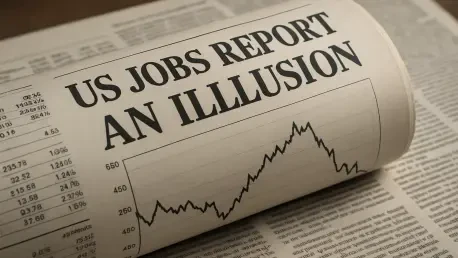

The latest employment data presents a perplexing riddle for economists and policymakers, where a surprisingly robust headline figure conceals a much more fragile reality beneath the surface of the U.S. labor market. An analysis of the economy in early 2026 reveals a complex and muddy picture, where a strong January jobs report masks significant underlying weaknesses and future uncertainties. While the addition of 130,000 nonfarm payrolls and a fall in the unemployment rate to 4.3% suggest newfound resilience, a deeper examination of the data points to a stagnant and fragile employment landscape. This positive news, which stands in stark contrast to the lackluster performance seen throughout 2025, is tempered by several troubling trends. A consensus viewpoint among economists is that this single month of growth is not enough to signal a robust recovery, posing a considerable policy challenge for the Federal Reserve as it navigates a landscape of conflicting economic signals.
Beneath the Surface of the Numbers
A critical look at the components of the January job growth reveals a concerning lack of breadth, raising questions about the sustainability of the recovery. The headline number, while encouraging, is heavily skewed by hiring in just a few specific sectors. Nearly all of the month’s gains originated from healthcare-related fields, a trend that highlights a dependency on a single area of the economy for job creation. This concentration raises serious concerns about the broader economy’s ability to generate diverse opportunities for new entrants to the workforce and for those displaced from other industries. Furthermore, the credibility of this initial estimate is undermined by a history of significant downward revisions. A look back at 2025 data shows a near-total stall in job creation, with an average monthly gain of just 15,000 and a net loss of 1,000 jobs in the last six months of that year. This pattern of initial optimism followed by subsequent corrections casts a long shadow of doubt on whether January’s strong figure will ultimately hold.
Compounding the issue of narrow job creation is the alarming trend of decelerating wage growth, which points toward a potential shift from a “jobless expansion” to an “income-less expansion.” While the focus often remains on the quantity of jobs, the quality and the purchasing power they provide are equally crucial for economic health. In January, average hourly earnings saw their slowest annual gain since July 2024, rising by a modest 3.71%. This slowdown in wage growth applies direct pressure on household incomes at a time when consumer spending is responsible for over two-thirds of all U.S. economic activity. The implications of this trend are significant, as stagnant wages can quickly translate into reduced consumer confidence and spending. Early warning signs are already emerging, with recent data on retail sales showing signs of flatness. This pressure on the American consumer represents a major danger sign for an economy that relies heavily on their ability and willingness to spend.
A Conundrum for Economic Policy
The current economic narrative is further complicated by the puzzling divergence between strong Gross Domestic Product (GDP) growth and the tepid state of the labor market. Typically, robust economic expansion is accompanied by a healthy level of hiring, yet the recent data defies this conventional wisdom. This disconnect has led to varied interpretations among experts. Economist Rick Rieder of BlackRock has suggested that this phenomenon—high growth without correspondingly high levels of job creation—could be an early indicator of a productivity boom, where companies are achieving more output with fewer workers. However, this potential silver lining is accompanied by a significant caveat. Rieder also cautions that interest-rate-sensitive sectors of the economy, along with lower-income consumers, remain under considerable pressure. This dual reality of high-level growth alongside localized fragility creates a difficult and uncertain environment for both businesses and households navigating the economic landscape.
These conflicting economic signals have created a significant dilemma for the Federal Reserve, where officials appear divided on the appropriate path for monetary policy. The January jobs report has only intensified this debate. On one side, some regional Fed presidents are advocating against further interest rate cuts, prioritizing the ongoing fight against inflation and pointing to the headline job growth as a sign of economic resilience. In stark contrast, other governors on the board are pushing for more accommodative policy, arguing that rate cuts are necessary to support a fragile economy and preempt a more significant slowdown. Financial markets have largely interpreted the latest jobs data as a reason for the Fed to delay any immediate rate cuts. Despite this short-term adjustment, expectations for at least two rate reductions by the end of 2026 remain priced in. Economists like Gregory Daco of EY-Parthenon anticipate that overall job growth for the remainder of the year will be highly subdued, likely not exceeding 50,000 per month.
An Outlook of Cautious Navigation
The January employment figures, when viewed in the broader context of persistent wage deceleration and revisions to past data, ultimately painted a picture of an economy that required careful stewardship. The initial excitement over the headline number gave way to a more sober assessment, highlighting that the labor market’s foundation was not as solid as a single report might have suggested. This realization reinforced the Federal Reserve’s complex task of balancing inflation concerns with the need to support a labor market that showed clear signs of underlying fragility. The path forward was defined by a need for caution, as policymakers and market observers alike recognized that the journey toward a truly robust and broad-based economic expansion was far from complete and fraught with uncertainty.