
A staggering $200 billion in tariff revenue has poured into U.S. coffers this year, a figure the Trump administration champions as a monumental victory for American economic security. This massive influx of funds, collected from new duties imposed on a vast array of imported goods, is being celebrated by officials as proof of a successful and assertive trade policy. However, beneath the surface of this financial triumph, a profound constitutional crisis is brewing. The unilateral nature of the tariffs has ignited a high-stakes legal battle that has now reached the Supreme Court, posing a fundamental question about the limits of presidential power and the authority of Congress.
A $200 Billion Question of Presidential Power
The administration’s celebration is rooted in hard numbers announced by U.S. Customs and Border Protection (CBP). The agency confirmed the collection of over $200 billion from the new duties between January 20 and December 15, framing the figure as a clear indicator of its success. “This milestone underscores CBP’s effectiveness in promoting secure, fair, and compliant trade, strengthening America’s national and economic security,” a statement from the agency read. CBP Commissioner Rodney Scott lauded his team’s efforts, adding, “By combining intelligence-led targeting, rigorous oversight and swift action, we are safeguarding the U.S. economy, protecting American industries and holding accountable those who seek to break our trade laws.”
This victory lap, however, is being conducted in the shadow of a legal storm. The method used to impose these tariffs has drawn fierce opposition, sparking a debate that cuts to the core of the U.S. system of checks and balances. The central question is not whether the tariffs are effective, but whether they are legal. The conflict pits the President’s executive authority against a power that the Constitution explicitly grants to the legislative branch, setting the stage for a judicial showdown with implications that will resonate long after the final dollar is counted.
The Anatomy of the 2025 Tariff Onslaught
It is crucial to understand that these new tariffs are entirely distinct from those enacted during Trump’s first term, which do not face the same legal jeopardy. The current controversy centers exclusively on duties imposed this year through more than 40 separate executive orders. This mechanism allowed the administration to completely bypass the legislative process, imposing sweeping economic measures without seeking any form of congressional approval or authorization.
The scope of these duties is broad and multifaceted. They include sweeping “reciprocal tariffs” applied to imports from the majority of the world’s nations, creating a new and complex landscape for global trade. Alongside these are more targeted “fentanyl tariffs” levied against products from Canada, China, and Mexico. The administration has justified these specific duties as a retaliatory measure, claiming the three nations failed to adequately curb the flow of the illicit narcotic into the United States. This use of trade policy as a tool for international law enforcement has added another layer of complexity to the already contentious situation.
A Constitutional Clash Between Executive and Legislative Power
The legal challenge mounted against the administration rests on a foundational principle of American governance. Opponents argue that the President has fundamentally overstepped his authority, pointing to the text of the U.S. Constitution, which vests the power to “lay and collect Taxes, Duties, Imposts and Excises” exclusively in Congress. This clause, they contend, was deliberately designed by the nation’s founders to prevent the executive branch from unilaterally imposing financial burdens on the populace and its commerce.
This argument has already found significant traction in the federal court system. The case first went before the Court of International Trade, which ruled against the administration’s unilateral actions. That decision was subsequently appealed, leading to a landmark ruling in August from the U.S. Court of Appeals for the Federal Circuit. In a decisive 7-4 decision, the appellate court affirmed the lower court’s finding, delivering a powerful and unambiguous statement on the separation of powers: “Tariffs are a core congressional power.” This legal precedent has significantly bolstered the case against the administration as it heads for its final hearing.
Corporate Rebellion Pushes the Case to the Supreme Court
The constitutional challenge is not merely an abstract legal debate; it is being driven by a powerful coalition of American businesses bearing the financial brunt of the duties. Major corporations, including retail behemoth Costco, have filed lawsuits against the administration. Their legal actions are not just aimed at blocking the future collection of these tariffs but also at clawing back the substantial sums they have already paid. These companies are demanding a full refund of all duties, transforming the legal battle into a matter with colossal financial stakes.
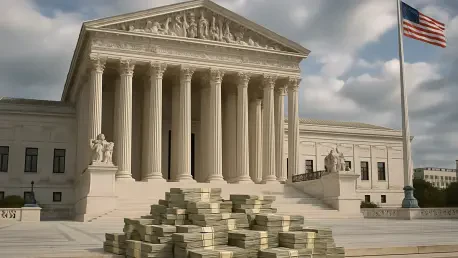
With the legal arguments sharpened and corporate interests mobilized, the case has journeyed to the nation’s highest court. The Supreme Court is now poised to deliver a final verdict on whether the President’s actions constitute a legitimate exercise of executive authority or a flagrant violation of the Constitution. A ruling against the administration could have staggering consequences, potentially compelling the U.S. government to refund the entire $200 billion collected to the importing companies. The decision will not only determine the fate of billions of dollars but also draw a new line in the sand regarding the boundaries of presidential power in the modern era.
Economic Headwinds and the First Signs of Strain
While the legal battle has intensified, the first cracks have begun to appear in the tariff revenue stream itself. In November, for the first time since the new duties were announced in April, monthly collections saw a decline. The total revenue dipped to $30.75 billion, down from a high of $31.15 billion in October. While modest, this downturn signals a potential shift in the economic landscape created by the tariffs.
Analysts attribute this drop to a pair of converging factors. On one hand, freight shipments to the United States have started to slow as businesses adjust their supply chains and purchasing strategies in response to the added costs. On the other hand, the administration itself has quietly lowered some of the duties it previously imposed, a tacit acknowledgment of the economic pressure they have created. This confluence of market reaction and policy adjustment demonstrates the tangible friction the tariff strategy is generating for international trade and the broader U.S. economy, adding a practical urgency to the constitutional questions awaiting a resolution.
The year’s financial narrative was dominated by the immense $200 billion revenue stream generated by a bold and aggressive trade policy. The administration had presented this as an unqualified success, a testament to its commitment to strengthening America’s economic posture. Yet this policy was constructed upon a precarious legal foundation, sparking a fundamental conflict over the separation of powers that ultimately landed at the steps of the Supreme Court. As legal precedent mounted against the executive branch and the first signs of economic headwinds appeared, the entire tariff program faced the prospect of being dismantled. The situation encapsulated a critical tension between executive ambition, legislative authority, and the economic realities faced by American businesses, with a definitive constitutional precedent hanging in the balance.