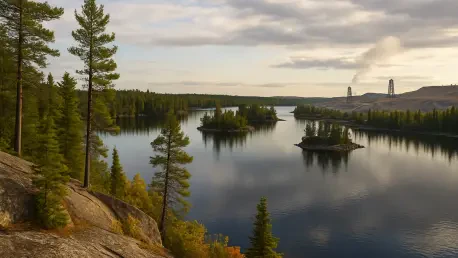

The silent, mineral-rich expanses beneath the Superior National Forest have long been the staging ground for a deep-seated American conflict between the hunger for industrial progress and the sanctity of untouched wilderness. For decades, the Duluth Complex in northeastern Minnesota has represented one of the most significant untapped copper-nickel deposits on the planet, yet its proximity to the Boundary Waters Canoe Area Wilderness has kept it locked behind a wall of federal protections. Today, the mining industry stands at a transformative crossroads where traditional extraction methods collide with modern national security imperatives. This shift is turning a local environmental debate into a high-stakes chess match over domestic resource sovereignty and the future of the American energy supply chain.
As the global demand for minerals like copper, nickel, and cobalt continues to climb, the United States is reevaluating the strategic value of its own soil. The current industrial landscape is heavily influenced by a push for a domestic supply chain that can bypass adversarial nations, positioning Minnesota’s geological formations as a focal point for massive industrial investment. While the Superior National Forest has historically been viewed through the lens of conservation, the rise of the green energy sector has reframed these lands as a critical asset. Industry leaders and policymakers are increasingly viewing domestic extraction not merely as a business venture, but as a technological and strategic necessity for the twenty-first century.
The Shift in American Mineral Extraction and Public Land Policy
The recent legislative pivot toward reopening these lands highlights a fundamental change in how the federal government approaches public land management. Historically, the policy regarding the Boundary Waters watershed has been characterized by a protective stance, aiming to buffer the pristine wilderness from the potential runoff of sulfide-ore mining. However, the narrative is shifting as the definition of environmental responsibility expands to include the sourcing of materials for the energy transition. This evolution suggests that the industry is no longer just fighting for permits; it is fighting to prove that modern mining can exist as a pillar of a sustainable future.
The Superior National Forest is now the center of a debate that tests the limits of “green” development. Proponents of the resolution argue that relying on foreign mines with lower environmental standards is a net negative for the planet. By bringing production to Minnesota, they suggest that the United States can enforce the highest regulatory standards while securing the materials needed for high-capacity batteries and wind turbines. This argument effectively links domestic resource independence with global ecological stewardship, creating a complex political environment where traditional conservationists find themselves at odds with the industrial requirements of the energy transition.
Emerging Trends and Economic Projections in the Duluth Complex
Strategic Resource Independence and the Clean Energy Transition
The primary driver for lifting the long-standing mining ban is the urgent, escalating need for minerals essential to a cleaner energy grid. Technologies such as electric vehicle batteries and renewable energy storage require vast quantities of cobalt and copper, materials that are currently sourced largely from volatile international markets. This shift in consumer behavior and federal policy toward sustainable tech has created a market environment where domestic mining is framed as an environmental necessity on a global scale. The goal is to create a closed-loop system where American minerals power American innovation, reducing the carbon footprint associated with international shipping and unregulated foreign extraction.
Furthermore, the industrial push is supported by a belief that the United States must lead in the development of next-generation mining techniques. By focusing on the Duluth Complex, the industry aims to demonstrate that high-tech extraction can be performed with minimal surface disruption. This trend toward “invisible” or low-impact mining is gaining traction among investors who are wary of the reputational risks associated with traditional open-pit operations. Consequently, the transition to green energy is acting as a catalyst for a broader technological overhaul within the mining sector itself, pushing companies to adopt more sophisticated, automated, and contained methods of extraction.
Economic Forecasting and Regional Growth Potential
Market data suggests that realizing the proposed underground mining projects could serve as a massive economic engine for northeastern Minnesota. Financial projections indicate that a single large-scale project, like the $1.7 billion underground facility currently proposed, could generate hundreds of high-paying union jobs in a region that has faced decades of economic stagnation. Beyond direct employment, the “spinoff” effect is expected to create over a thousand secondary positions in logistics, maintenance, and local services. This influx of capital would likely revitalize local infrastructure and provide a much-needed boost to the regional tax base, supporting schools and public works.
Forward-looking perspectives suggest that if the Duluth Complex is fully developed, it could serve as a global model for sustainable industrial hubs. The concentration of valuable minerals in this region attracts significant venture capital and international investment, potentially turning a quiet corner of Minnesota into a global leader in mineral science. This economic growth is not just about the minerals themselves but also about the ecosystem of innovation that grows around them. As the industry matures, the region could see a rise in specialized research facilities and processing plants, further solidifying its role as a cornerstone of the national industrial strategy.
Navigating Environmental Risks and Technical Obstacles
Despite the economic enthusiasm, the push to open the Superior National Forest faces intense scrutiny due to the specific chemistry of the region. The extraction of sulfide-ore minerals carries the inherent risk of creating sulfuric acid when the ore is exposed to air and water. In a water-heavy ecosystem like the Boundary Waters watershed, preventing acid drainage and mercury contamination is a monumental technical challenge. Developers are attempting to address these complexities by proposing modern strategies, such as entirely underground operations that eliminate surface waste rock storage. By keeping the processing and waste management contained, they hope to mitigate the risks that have historically plagued sulfide mining.
However, the industry must still overcome deep-seated skepticism from environmental advocates and tribal nations. Critics argue that no matter how advanced the technology becomes, the risk of a leak in such a sensitive and interconnected watershed is too high to justify. The technical debate often centers on the long-term integrity of containment systems and the ability of agencies to monitor these sites over decades. To succeed, mining firms must prove not just that they can build a safe mine, but that they can maintain it indefinitely in an environment where water is everywhere. This requires a level of engineering transparency and community engagement that goes far beyond traditional permitting requirements.
The Volatile Regulatory Landscape and Legislative History
A Decade of Executive and Judicial Oscillations
The regulatory framework surrounding the Boundary Waters has been defined by what many call a “policy seesaw” between successive federal administrations. Over the past decade, the legal status of the Duluth Complex has shifted repeatedly, from lease renewals under one administration to a 20-year moratorium under the next. These abrupt changes have created a volatile environment for investors and local communities alike. Recent court rulings and the use of “energy emergency” declarations illustrate the instability of federal land management, where the legality of resource extraction can seemingly change with the political winds of Washington.
This lack of regulatory certainty has been a major hurdle for long-term industrial planning. Each time a new administration takes office, the legal groundwork for mining in the Superior National Forest is either dismantled or rebuilt, leading to a cycle of litigation that stretches for years. The current Senate resolution aims to provide a more permanent legislative fix, but it exists within a system where executive branch priorities remain a powerful force. This history of oscillations suggests that while legislative victories are significant, they are often just one chapter in a much longer legal and political saga that involves multiple branches of government.
Compliance, Permitting, and State-Level Oversight
Even if the federal resolution successfully clears the path for mineral leases, the journey to actual extraction remains heavily regulated at the state level. In Minnesota, a mining project must secure approximately 18 separate permits from various state agencies, covering everything from water quality to air emissions. These state-level requirements act as a secondary layer of environmental oversight, ensuring that federal policy shifts do not automatically bypass local standards. This dual-track system means that mining companies must satisfy both national strategic goals and the specific environmental and cultural expectations of the state government.
State agencies often conduct their own independent environmental impact statements, which can take years to complete and are subject to public comment and legal challenges. This process ensures that tribal treaty rights and local land-use concerns are addressed in detail. For the mining industry, this means that a federal green light is only the beginning of a marathon of compliance. The interplay between federal law and state regulation creates a complex gauntlet that requires immense patience and significant financial resources. Ultimately, the state’s role as a gatekeeper ensures that any project moving forward has undergone some of the most rigorous scrutiny in the world.
The Future of Wilderness Conservation and Industrial Expansion
The decision to lift the mining ban signals a potential sea change in how the United States balances industrial expansion with the protection of public lands. Looking ahead, the industry will likely face a landscape defined by increased litigation and persistent public protest. These challenges could delay projects for years, regardless of legislative support, as environmental groups use every available legal avenue to protect the watershed. The ultimate disruptor in this field will be innovation; the development of “leak-proof” extraction technology will determine whether domestic mining can truly coexist with a pristine wilderness environment.
The global economic climate and the speed of the energy transition will also play a decisive role in the fate of the Boundary Waters. If the demand for domestic minerals remains a top national priority, the pressure to develop the Duluth Complex will only intensify. Conversely, if new battery chemistries emerge that require fewer of these specific minerals, the economic argument for mining in sensitive areas may weaken. This uncertainty suggests that the Boundary Waters will remain a focal point of national debate for the foreseeable future, serving as a test case for whether a modern society can satisfy its hunger for resources without sacrificing its most precious natural sanctuaries.
Reconciling National Security with Ecological Stewardship
The Senate resolution to lift the mining moratorium marked a pivotal moment in American land-use policy, representing a hard-fought victory for those prioritizing domestic mineral production and regional economic growth. This legislative move provided a significant tailwind for industrial development, yet it was clear that the project’s success remained far from guaranteed. The path forward required navigating a complex gauntlet of state-level regulations and enduring judicial challenges that sought to uphold environmental protections. The resolution essentially shifted the battlefield from the halls of Congress to the regulatory offices and courtrooms of Minnesota.
Ultimately, the Boundary Waters case functioned as a definitive benchmark for how a modern nation reconciles the demand for industrial resources with the duty to preserve irreplaceable ecosystems. The debate highlighted the reality that national security and ecological stewardship are often two sides of the same coin in the twenty-first century. As the industry sought to implement “modern mining” techniques, it faced the ongoing task of earning public trust through transparency and proven safety. The outcome of this struggle promised to set a precedent for public land management across the country, influencing how future generations balance the needs of technology with the preservation of the wild.