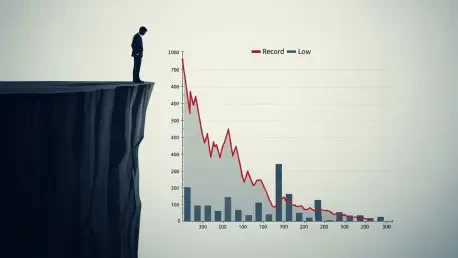

The regional economic landscape of Southern Nevada is currently facing an unprecedented wave of apprehension as local business leaders recalibrate their expectations amidst growing global and domestic instability. According to the latest quarterly report released in May 2026 by the Center for Business and Economic Research at the University of Nevada, Las Vegas, the Southern Nevada Business Confidence Index has experienced a dramatic collapse. This proprietary metric, which serves as a barometer for executive sentiment across several key indicators, plummeted by nearly 32 points, falling from a neutral 94.4 in the first quarter to a deeply pessimistic 62.7. Such a sharp descent signifies a definitive pivot away from the stability seen earlier in the decade toward a contractionary outlook that reflects deep-seated fears regarding the near-term economic trajectory. This shift is not merely a statistical anomaly but a broad-based consensus among the region’s decision-makers that the cooling of the local economy is now an unavoidable reality.
The most striking revelation within the data is the record-breaking pessimism regarding the national economy, with that specific sub-index crashing to an all-time low of 24.2. Approximately 84.8% of respondents expressed a belief that U.S. economic conditions will deteriorate further, a sentiment largely fueled by the ongoing U.S.-Israel conflict and persistent macroeconomic volatility. This synchronized downturn across all five index components—including general economic conditions and industry sales—marks the first time in recent memory that every metric has simultaneously fallen below the neutral threshold, suggesting a rare and total alignment of negative expectations among the business elite. As the national landscape becomes increasingly unpredictable, Southern Nevada’s reliance on discretionary spending and tourism makes it particularly sensitive to these shifts, prompting a rapid withdrawal from the optimistic projections that characterized the previous fiscal year.
Internal Firm Struggles and Operational Challenges
Labor Stagnation: The Crisis of Recruitment
The labor market in Southern Nevada is currently defined by a persistent and deep-seated hiring weakness that shows no immediate signs of recovery as firms adopt a defensive stance. For the eighth consecutive quarter, sentiment regarding recruitment has remained in negative territory, with the latest reading dropping to 69.7 as executives prioritize cost containment over expansion. While approximately 63% of business leaders intend to keep their current staffing levels unchanged for the time being, a significant 33.3% are preparing for active workforce reductions in the coming months. Only a nominal 3% of respondents anticipate any growth in their employee headcount, a statistic that highlights the extreme caution currently dominating the corporate landscape. This stagnation suggests that the era of rapid post-pandemic hiring has fully concluded, replaced by a strategic focus on lean operations and the preservation of existing resources rather than the pursuit of new talent or market share.
This trend in human capital management is not occurring in a vacuum but is a direct response to the mounting pressures of maintaining operations in a high-cost environment. The reluctance to hire is compounded by the fact that many firms are seeing their labor costs rise even as their revenue projections begin to falter. Consequently, the regional job market is entering a phase of significant cooling where the competition for existing positions will likely intensify as the total number of available roles shrinks. Business owners are increasingly looking toward automation or process optimization as alternatives to traditional hiring, aiming to maintain productivity without the long-term liabilities associated with an expanding payroll. This shift marks a fundamental change in the local economic engine, where the service-oriented nature of the regional economy is forced to grapple with a shrinking workforce and a more conservative approach to organizational growth and development.
Financial Defensive Posturing: Prioritizing Liquidity
Beyond the challenges of the labor market, Southern Nevada businesses are increasingly engaging in rigorous financial defensive posturing to insulate themselves from projected losses in sales and profits. Expectations for sales volume have dropped by more than 31% compared to previous quarters, while profit projections have plummeted nearly 44%, forcing many organizations to reconsider their long-term growth strategies. This environment of fiscal retrenchment is further evidenced by a 22% decline in anticipated capital expenditures, as companies choose to slash investment in infrastructure and technology in favor of maintaining higher levels of liquidity. This shift toward austerity is driven by a profound sense of economic uncertainty, which nearly 58% of respondents cited as their primary obstacle—outweighing concerns about rising operating costs or competition. By prioritizing cash reserves over physical expansion, firms are signaling that they expect a prolonged period of volatility where survival hinges on financial flexibility rather than aggressive market positioning.
The strategic pivot toward liquidity is a direct reflection of broader national stressors, such as the implementation of new trade tariffs and shifting federal policies that have created a climate of unpredictability for Chief Financial Officers. In Southern Nevada, this caution is particularly evident in the slowdown of facility upgrades and the postponement of major equipment purchases that were originally slated for the current fiscal cycle. Rather than investing in the future, businesses are focusing on the immediate necessity of weathering an anticipated economic storm, leading to a stagnant environment for vendors and service providers who rely on corporate spending. This defensive positioning is likely to have a ripple effect throughout the regional supply chain, as reduced capital spending naturally leads to fewer contracts and less economic activity across supporting industries. The prevailing narrative is now one of caution, as the focus shifts from capturing new opportunities to defending the existing bottom line.
Sector-Specific Outlooks and the Sentiment Gap
Industry Projections: Real Estate and Construction
The construction and real estate sectors, traditionally the engines of Southern Nevada’s growth, are providing a more nuanced but ultimately bearish perspective on the regional future. Although the home-price component of the UNLV report showed a slight improvement—indicating that residential property values might be declining at a slower rate than previously anticipated—the outlook for the construction industry remains notably grim. More than 45% of surveyed executives expect a measurable decrease in construction activity through the second quarter, reflecting a slowdown in both commercial developments and new residential starts. This cooling effect is a direct consequence of high interest rates and the broader reduction in capital spending seen across other industries. While the stabilization of home prices offers a small measure of relief for current property owners, the lack of new project starts suggests that the construction pipeline is beginning to dry up, potentially leading to a quieter period for the trades and architectural services in the region.
Furthermore, the commercial real estate segment is grappling with the same uncertainty that has paralyzed other parts of the economy, leading to a significant pause in major infrastructure commitments. The disconnect between the slow stabilization of prices and the rapid decline in activity levels suggests that the market is currently in a state of suspended animation, where buyers and developers are waiting for a clearer signal before committing to new ventures. This bearish sentiment is reinforced by the fact that many existing projects are facing delays due to financing difficulties or shifting market demand, further dampening the enthusiasm for future growth. As construction activity wanes, the secondary impacts on the local economy—from hardware suppliers to landscaping services—will become more pronounced, highlighting the interconnected nature of the regional business ecosystem. The resilience of the real estate market is being tested by a combination of high costs and low confidence, creating a challenging environment for any new expansion.
The Sentiment Gap: Contrasting Data with Perception
A fascinating “sentiment gap” has emerged between the dire predictions of local business leaders and the relatively resilient economic data currently being reported in Clark County. As of early 2026, the tangible indicators of the local economy remain surprisingly strong, with unemployment hovering at a low 5.5% and taxable sales and gaming revenues continuing to show year-over-year increases. This disconnect suggests that while the operational reality on the ground is currently stable, the psychological and strategic foundation of the business community has already shifted toward extreme caution. Leaders appear to be bracing for a downturn that has yet to fully manifest in the hard data, perhaps anticipating that national instability will eventually override local successes. This fragmented view is also visible in recession expectations; while 20% of leaders believe the nation is already in a recession, nearly 47% do not expect a total collapse within the next two years. The current situation is thus a race between present-day momentum and the growing weight of negative expectations.
This disparity between current performance and future outlook highlights the importance of psychological factors in economic forecasting and decision-making within the Las Vegas Valley. Even though the casinos are full and the shops are busy, the executives running these establishments are looking at the geopolitical horizon and making decisions based on fear of what is to come rather than what is happening now. This proactive retreat could potentially become a self-fulfilling prophecy if the reduction in hiring and spending leads to a genuine cooling of the local consumer market. The current stability provides a buffer, but the UNLV study serves as a critical warning that the strategic reserves of confidence have been exhausted. Whether the actual economic data will eventually align with these pessimistic views or if the regional economy can maintain its course despite the psychological downturn remains the most critical question for the remainder of the year. The tension between robust current revenues and record-low confidence creates a volatile environment for future planning.
The findings from the latest UNLV report necessitated a proactive response from both public and private sector leaders to bridge the widening gap between sentiment and reality. Rather than succumbing to the paralysis of record-low confidence, successful organizations implemented rigorous contingency plans that focused on operational efficiency and the diversification of revenue streams. Policymakers leaned into these insights by exploring targeted incentives for sectors showing resilience, such as gaming and tourism, while also addressing the underlying anxieties regarding trade and national policy. To navigate the period following these record-low readings, businesses were encouraged to foster transparent communication with stakeholders to mitigate the psychological impact of volatility. By treating this era of pessimism as a catalyst for structural reform rather than an inevitable decline, the regional economy sought to maintain its competitive edge. Ultimately, the focus shifted toward building a more robust financial infrastructure that could withstand the fluctuations of national sentiment and geopolitical shocks.