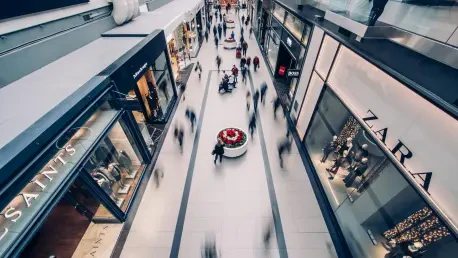

The cavernous silence left by the departure of an iconic department store no longer signals the end of a shopping mall’s relevance; instead, it marks the beginning of its transformation into a highly curated lifestyle destination. The American retail landscape is undergoing this seismic shift as a new, exclusive tenant takes the place of traditional anchors: the private membership club. This analysis explores the ascent of these clubs as the new epicenters of high-end commercial real estate, examining the economic drivers, strategic benefits, and future implications of a trend that is fundamentally reshaping retail spaces from transactional venues into centers of community and exclusivity.
The Evolution of the Retail Anchor
The traditional retail anchor, once the primary driver of foot traffic and the foundational tenant of any major shopping development, has seen its influence wane. In its place, a new model has emerged that prioritizes experience and community over mass-market commerce. Private clubs are stepping into this role, not as mere tenants, but as strategic partners capable of redefining a property’s identity and attracting a highly desirable consumer base.
The Data Behind the Demand
The rise of private clubs is intrinsically linked to the “K-shaped” economic recovery, a phenomenon where high-income households have accumulated significant discretionary spending power while other demographics face economic constraints. This affluent segment is precisely the target for membership clubs, which often feature a high barrier to entry that ensures an exclusive environment. The financial commitment required underscores the target demographic’s capacity for luxury spending and their desire for curated experiences.
The costs associated with membership are substantial, creating an immediate filter for clientele. For instance, Park House, located in Dallas’s prestigious Highland Park Village, requires a $7,000 initiation fee on top of $292 in monthly dues. In Miami’s Design District, The Moore House commands a $5,000 initiation fee with monthly dues exceeding $400. Even in emerging markets for this trend, the price of entry remains high, with The Social House in Cincinnati setting its initiation fee at $4,000. These figures illustrate a business model built not on volume but on value, catering to consumers who prioritize status and community.
Real World Applications and Geographic Expansion
Once confined to major coastal hubs like New York and Los Angeles, the private club model is now expanding into mid-sized American cities, signaling a broader cultural and economic shift. This geographic diffusion demonstrates that the demand for exclusive, metropolitan-style amenities is no longer limited to the country’s largest urban centers. Developers in these emerging markets are recognizing the potential of these clubs to anchor new projects and revitalize existing properties.
A prime example of this expansion is The Commerce Club in Grand Rapids, Michigan. Set to occupy a building that has been vacant for over a decade, the club aims to create a sophisticated hub for local entrepreneurs and professionals, complete with a cafe, coworking spaces, and a speakeasy. This project is not merely filling an empty space; it is injecting a new form of social and economic energy into the city’s core. Simultaneously, the trend is diversifying to serve niche interests, as seen with The Executive Branch in Georgetown. This club demonstrates how membership can align with specific cultural and even ideological identities, offering a community built around shared values.
Perspectives from Industry Leaders
The strategic shift toward private clubs as retail anchors is championed by developers, landlords, and market analysts who see a multifaceted solution to the challenges facing modern commercial real estate. From generating consistent foot traffic to enhancing a property’s overall brand, the benefits are compelling for property owners. At the same time, understanding the consumer psychology behind the demand is crucial to appreciating the trend’s momentum.
The Landlord and Developer Viewpoint
For property owners, private clubs offer an elegant solution to the problem of large, vacant anchor footprints. According to Jia Li of Wake Forest University, these establishments can absorb significant square footage without diluting a property’s upscale brand, unlike a discount retailer. Furthermore, the traffic they generate is both consistent and high-value. Sam Vise of Optimum Retailing notes that a club member may visit a property several times a week, providing a steady stream of activity that surpasses the infrequent visits of a typical shopper.
This high-frequency visitation from an affluent demographic creates a powerful “halo effect.” As Daniel Spiegel from Coldwell Banker Commercial explains, these members possess significant discretionary income, which directly benefits surrounding tenants, from luxury boutiques to fine-dining establishments. The ultimate goal for developers is to increase “dwell time,” a key metric for driving sales. Charlie Koniver of Odyssey Retail Advisors emphasizes this point, stating that the longer an individual remains on a property, the more money they are likely to spend. Private clubs are designed explicitly to be destinations where members linger, work, and socialize, thereby maximizing this crucial metric.
Understanding Consumer Motivation
The pull of private clubs extends beyond simple luxury; it taps into deep-seated consumer desires for community, status, and security. R.J. Hottovy of Placer.ai identifies the pursuit of exclusivity as a primary driver, as membership offers a tangible status symbol in an increasingly commoditized world. Moreover, these clubs provide a physical antidote to digital isolation, fostering genuine social connection and community among like-minded individuals. In a post-pandemic context, they also offer a “safe space”—a controlled, familiar environment for socializing.
This model is not a foreign concept to its target audience. According to Greg Zakowicz of Omnisend, high-end consumers are already well-acquainted with membership structures through experiences like country clubs, airline lounges, and subscription services. The private club in a retail setting is a natural extension of this lifestyle, seamlessly blending social life with commerce. It meets a pre-existing expectation for curated, premium experiences, making it an intuitive and attractive proposition for the affluent consumer.
Future Outlook Opportunities and Challenges
While the integration of private clubs into retail real estate presents a compelling vision for the future of luxury commerce, it is not without its complexities. The model offers significant potential for revitalizing underperforming properties and redefining the community role of shopping centers. However, its success is contingent on specific market conditions, and the inherent volatility of the hospitality industry poses notable risks.
Potential for Growth and Revitalization
The trend holds immense potential for developers seeking to transform struggling commercial properties into vibrant, exclusive lifestyle destinations. By installing a private club as a new anchor, a landlord can immediately elevate a property’s prestige and attract a clientele with substantial spending power. This strategy effectively acts as a “retail revitalizer,” injecting new life and purpose into spaces that might otherwise remain vacant or be filled by less synergistic tenants.
In many ways, this movement brings the modern shopping mall “full circle.” It harkens back to the original post-war concept of the mall as a community and civic center—a place for social gathering, not just commercial transactions. By integrating spaces for work, dining, and socializing, developers are moving beyond a purely transactional model and toward a more holistic, curated experience that meets the evolving demands of today’s consumers for integrated lifestyle environments.
Inherent Risks and Limitations
Despite its clear advantages, the private club model is not a universal solution for every empty retail box. Its success is heavily dependent on locating in upscale environments with the right demographic profile to support high initiation fees and monthly dues. This approach is not viable for a mid-tier mall struggling to retain tenants; it thrives only where there is a critical mass of affluent consumers seeking such an experience.
Furthermore, the private club industry itself is subject to economic cycles and shifting consumer tastes. The mixed financial results of a well-known brand like Soho House serve as a cautionary tale about the challenges of scaling this model and maintaining long-term profitability. Finally, the anticipated spillover benefits for surrounding retailers are not guaranteed. For the “halo effect” to materialize, adjacent tenants must intentionally align their product offerings, service levels, and marketing efforts to appeal to the club’s sophisticated clientele, creating a cohesive and compelling luxury ecosystem.
Conclusion The New Face of Luxury Retail
The emergence of private clubs as the new anchors of retail real estate was a strategic and timely response to fundamental economic and social shifts. It directly addressed the decline of the traditional department store while capitalizing on the consolidated spending power of affluent consumers who increasingly prioritize experiences over mere transactions. For property developers, these clubs became more than just rent-paying tenants; they acted as strategic partners that generated consistent, high-value foot traffic and fundamentally redefined a property’s brand identity.
This trend reaffirms the idea that the most successful commercial spaces are those that foster community and offer a sense of belonging. By blending commerce, exclusivity, and social connection, these clubs transformed passive shopping centers into dynamic lifestyle destinations. They proved that the path to revitalization lay not in simply filling vacant storefronts, but in curating a cohesive environment that catered to the holistic needs of a discerning clientele.
As this model has matured, it has permanently altered the definition of a modern luxury experience. The integration of social clubs into retail environments has challenged developers and retailers alike to think beyond the transaction and toward comprehensive lifestyle curation. This evolution has set a new standard, pushing the industry to innovate and create spaces that are not just places to shop, but places to live, work, and connect.