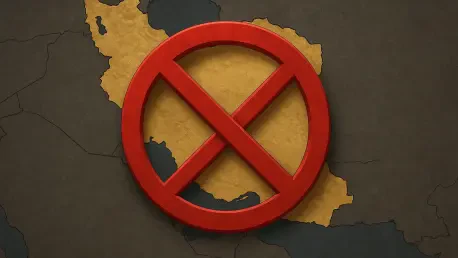

The Trump administration’s early 2026 strategy marks a pivot from targeted sanctions to a comprehensive economic blockade aimed at the total isolation of the Islamic Republic of Iran. This strategic offensive represents an unprecedented escalation of the previous “Maximum Pressure” campaign, shifting from specific industry restrictions to a complete financial quarantine. By targeting every commercial sector simultaneously, Washington intends to cripple Tehran’s domestic stability and force a choice between absolute policy capitulation or total internal collapse. This aggressive posture departs from traditional diplomatic efforts, positioning economic warfare as the primary lever of American power in the Middle East. The strategy is designed to dry up the regime’s liquidity and ignite widespread domestic chaos by cutting off all remaining financial lifelines. Treasury officials have signaled that the ultimate goal is total severance, ensuring that the Iranian government can no longer sustain operations or its hold on the nation.
Global Isolation: The Impact of Secondary Sanctions
A cornerstone of this plan involves the expanded use of secondary sanctions to force a global boycott of the Iranian economy. The United States is signaling to third-party nations and private corporations in countries like China, Russia, Turkey, and Pakistan that they must choose between the Iranian market and access to the American financial system. Because most global private sectors are deeply integrated into Western trade networks, the administration bets that even historically friendly nations will be forced to sever ties with Tehran to protect their own interests. This shift places enormous pressure on Beijing and Moscow, which have previously relied on creative accounting to bypass trade restrictions. The modern era of surveillance and digital tracking makes such maneuvers increasingly risky for international banks. By leveraging the dominance of the dollar, Washington is effectively turning the global financial ecosystem into a mechanism for enforcement that leaves no room for neutrality.
To ensure the blockade is as airtight as possible, the framework provides only the narrowest exemptions for humanitarian essentials such as food and medicine. By closing nearly all other avenues for legitimate trade, the U.S. is effectively turning the Iranian economy into a closed circuit that lacks the necessary pressure release valves for survival. This net is intended to catch not just energy and banking, but every conceivable commercial interaction that could provide the regime with hard currency or dual-use technologies. The administration is working closely with maritime insurance companies and logistics providers to ensure that any vessel or entity related to Iranian commerce is flagged and blacklisted. This exhaustive approach creates an environment where the risks of doing business with Iran far outweigh any potential rewards. The goal is to move beyond simple containment and achieve a state of total economic hibernation where the Iranian state can no longer function as a coherent participant in the global market.
Military Enforcement: Implementing Operation Epic Fury
The economic pressure is being reinforced by a significant military presence through Operation Epic Fury. The U.S. Navy is reportedly executing a strategy to establish total control over the Strait of Hormuz, which remains the world’s most critical maritime chokepoint. This naval dominance is intended to transform paper sanctions into a physical reality, creating an impenetrable barrier that monitors and halts the flow of Iranian oil and commercial goods. By physicalizing the blockade, the U.S. aims to suffocate Iran’s maritime trade routes entirely, preventing any attempt to bypass the restrictions through clandestine shipments. This operation involves the deployment of advanced sensor networks and autonomous drones to patrol the Persian Gulf and the Gulf of Oman around the clock. Any vessel suspected of carrying illicit cargo is subject to boarding and inspection under this framework. This assertive stance ensures that the blockade is not merely a legal hurdle but a physical obstacle that prohibits the regime from generating revenue.
By asserting control over these sea lanes, the U.S. prevents the regime from using its navy or shadow fleets to bypass financial restrictions that are already strangling the domestic economy. The presence of American warships serves as a constant reminder to the international community that any attempt to breach the blockade will be met with immediate and decisive intervention. This military layer of the strategy is designed to deter foreign entities from testing the resolve of the administration. Furthermore, the blockade extends to the monitoring of ship-to-ship transfers that have historically been used to mask the origin of Iranian crude. Advanced satellite imagery and signals intelligence are being utilized to track every vessel leaving Iranian ports, making it nearly impossible for the shadow fleet to operate undetected. This technological edge provides the U.S. with a tactical advantage that traditional sanctions lacked, ensuring that the economic isolation of the Islamic Republic is backed by the full might of American naval power.
Financial Warfare: Dismantling the Digital Empire
Recognizing that the Islamic Revolutionary Guard Corps (IRGC) has increasingly relied on cryptocurrencies to bypass traditional banking, the U.S. Treasury has mobilized a specialized task force to track and seize digital assets. This financial hunt specifically targets Khatam al-Anbiya, the IRGC’s massive engineering and construction conglomerate that functions as a parallel state. Since this entity controls nearly half of Iran’s economy, its destruction is viewed by Washington as a decisive blow against the regime’s long-term survival. The task force is utilizing sophisticated blockchain analysis tools to identify the digital wallets and exchange platforms used by the IRGC to move funds across borders. This effort is supported by international cooperation with several key financial hubs that have agreed to freeze assets linked to the organization. By cutting off the IRGC’s ability to use digital currencies, the administration is stripping away one of the last remaining avenues for the regime to purchase weapons.
The administration’s focus on digital asset seizures marks a new frontier in economic warfare that reflects the changing nature of global finance. By identifying and freezing digital wallets associated with the IRGC, the U.S. is effectively stripping the regime’s elite military wing of the wealth it uses to fund international operations and maintain internal security. This multi-pronged attack on both physical and digital assets leaves the Iranian leadership with fewer options to sustain their influence at home or abroad. The disruption of these digital networks also creates a ripple effect throughout the Iranian economy, as the IRGC is involved in everything from telecommunications to infrastructure development. Without access to these funds, the organization will likely struggle to pay its personnel or maintain its vast network of surveillance and control. This strategy aims to hollow out the regime from the inside, targeting the very institutions that have kept it in power for decades to ensure the blockade is comprehensive in every realm.
Domestic Crises: Strategic Outlook and Solutions
Inside Iran, the impact of these policies is already manifesting as a severe domestic crisis characterized by hyperinflation and a total loss of confidence in the national currency. Real wages have decoupled from the cost of living to such an extent that the average urban worker can no longer afford basic rent, let alone food and utilities. This economic desperation has led the Iranian public to abandon the toman in favor of gold and other tangible assets, further destabilizing the national financial system. The central bank has tried to intervene, but its efforts have been largely ineffective against the tide of market panic and the sheer lack of hard currency reserves. As the value of the toman continues to plummet daily, the social contract between the government and the people is beginning to unravel. The Iranian middle class, once the backbone of the nation’s progress, is being systematically wiped out by the rising costs of essential goods. This collapse is creating a volatile environment where mass civil unrest is no longer a question of if.
The collapse of international trade partnerships became the defining metric of the blockade’s success. China, which once accounted for nearly all of Iran’s oil exports, saw its non-oil trade with Tehran plummet by 75% as the risk of U.S. sanctions became too high for major state-owned enterprises to ignore. Similarly, the United Arab Emirates officially ceased all trade relations, and India’s trade volume bottomed out as the closure of maritime routes prevented the delivery of raw materials. To maintain the integrity of this economic wall, it was recommended that the Treasury Department continue its expansion of real-time blockchain monitoring to stay ahead of evolving evasion techniques. Strategic planners also suggested that the focus on Iranian infrastructure should transition toward a long-term reconstruction plan to be deployed only after a total policy shift occurred. These steps ensured that the blockade was not just a tool of destruction but a foundational element of a new regional security architecture. The international community was encouraged to monitor these developments.